Table of Contents
Let Our Experts Optimize Your Deliveries Today
Let's talkFree shipping drives decisions. It strongly influences 77% of online shoppers and matters to nearly everyone. Those expectations put pressure on margins just as delivery windows get tighter. Customers also expect accurate ETAs, real-time tracking and easy rescheduling that doesn’t cause frustration.
Manual planning and spreadsheets can’t keep up with traffic changes, driver availability or mixed fleet policies. That’s where route optimization using AI becomes a real advantage.
With FarEye, intelligent routing turns into everyday execution. Clean integrations keep systems aligned, control tower visibility protects OTIF and user-friendly driver apps keep the plan on track. The outcome is a delivery experience that feels simple for customers and calmer for operations, with fewer escalations and a lower cost to serve.
Where Traditional Routing Breaks Down
Most routing tools were designed for a world with predictable demand and longer delivery windows. Today, networks change by the minute. That makes manual planning and fixed scheduling a risky foundation for high-velocity operations.
Here’s where friction builds fast:
- Fixed plans can’t adjust when traffic or access rules change suddenly
- Crew skills, compliance limits and EV range are often missed in manual assignments
- Inaccurate or incomplete addresses lead to repeat attempts and frustrated customers
- Late-stage orders derail established shifts and workloads
- Without real-time visibility, early SLA risks stay hidden until it’s too late
- Planners spend hours reworking routes during the day instead of improving outcomes
This is where AI-based route optimization becomes essential. It reinforces the plan with intelligence that adapts to real conditions, keeping delivery commitments steady even when the network becomes unpredictable.
What is AI-based Routing Optimization?
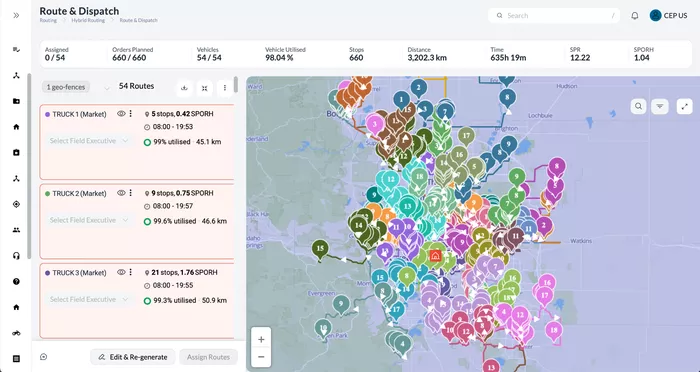
AI-based route optimization applies machine learning and advanced heuristics to create efficient, feasible routes under real operational constraints. The engine evaluates traffic patterns, delivery windows, vehicle attributes, service durations, driver shifts and location constraints at once.
It learns from historical data, incorporates telematics and GPS signals and monitors ground conditions to deliver credible ETAs. The same capabilities support real-time re-optimization when disruptions occur, allowing planners to protect OTIF while keeping drivers and customers informed.
Why Businesses are Adopting AI in Route Optimization
Businesses are embracing AI in route optimization to boost efficiency, cut costs and enhance delivery performance.
Meeting SLAs and Reducing Delays
Delays ripple through the network and raise the risk of penalties. Route optimization using AI anticipates congestion, sequences stops to protect tight windows and reassigns workloads when exceptions emerge. The result is consistent time-window adherence without overburdening crews or compromising safety rules.
Improved Resource Utilization
Mixed fleets demand smart allocation. AI evaluates payload, distance, geography and service type to match jobs to vehicles, including EVs and bikes for dense zones. This orchestration helps eliminate idle time, balance depot throughput and stabilize driver workloads over a shift.
Enhanced Customer Experience
Customers receive reliable ETAs and proactive alerts. A unified view of the order timeline makes "Where is my order?" simple to answer. The system supports unattended delivery rules, access codes and photo or barcode proof to reduce reattempts and manual calls.
Lower Operational Costs
Executives seek to reduce operational costs without eroding service quality. Optimized routes shorten distance, minimize overtime and cut failed attempts. Cleaner plans lower back-office effort by reducing reschedules and exceptions that require manual intervention.
Scalability and Flexibility
Networks grow, product assortments expand and new service tiers appear. AI-based route optimization scales from regional pilots to national fleets and adapts to complex offerings like white glove delivery or store-to-door transfers. Planners can run scenario tests to validate policy changes before rollout.
How AI-based Route Optimization Works
Here’s a closer look at how AI in route optimization transforms raw data into intelligent, adaptive delivery plans that keep operations efficient and customers satisfied.
Data Collection
The system ingests orders, locations, delivery windows, driver rosters, vehicle capacity, depot cutoffs and map data. API integration connects TMS order capture, mapping and telematics.
Analysis and Prediction
Models learn travel times, dwell times and neighborhood patterns from historical data. The system predicts service duration by stop type and accounts for city rules, curb access and building constraints.
Route Planning
The optimizer generates feasible sequences that honor priorities, capacity, service levels and labor policies. It supports handling complex constraints such as refrigeration, hazmat exclusions and two-person crews.
Real-time Reoptimization
When conditions change, real-time re-optimization adjusts routes, ETAs and driver assignments. Updates flow to the driver app and to customer notifications automatically.
Feedback Loop
Planned versus actual outcomes feed continuous improvement. The engine refines travel-time matrices, service durations and exception handling to keep plans credible over time.
Integrating Route Optimization with Core Systems
Modern logistics runs on connected data. At FarEye, API integration anchors the platform to enterprise systems:
- WMS for inventory availability, pick readiness and dock schedules
- TMS and ERP for order flow, allocations and billing references
- Telematics for vehicle health, driver duty cycles and live positions
- Customer applications for booking, notifications and proof of delivery
This integration powers control tower visibility across planning and execution. Operations teams see early risks to OTIF and trigger targeted actions. Customer service views a single source of truth, so status updates stay consistent across channels.
Turn Every Mile into a Competitive Advantage with FarEye
Delivery expectations will keep rising, while networks get more complex. The companies that win will plan with data, adapt in the moment and measure what matters. In route optimization, AI converts constraints into feasible routes, updates ETAs as conditions shift and aligns planners, drivers and customers around a single truth.
At FarEye, we operationalize that model with clean integrations, control tower visibility and policy-driven execution so teams protect OTIF without inflating cost to serve. If your goal is fewer escalations and steadier schedules, now is the time to act. Implement intelligent routing as a standard operating procedure.
Source:
https://www.alixpartners.com/media/4kwla5tl/home-delivery-report-2025-pt04sig2025.pdf