Table of Contents
- Why Delivery Errors Hurt Food Businesses More Than They Realize
- Where Traditional Processes Break Down on Order Accuracy
- How Modern Food Delivery Software Builds Accuracy into Every Step
- Deep Dive: Food Delivery Route Optimization as an Accuracy Engine
- How FarEye Optimizes Food Delivery Route Optimization
- Designing an Accuracy-first Operating Model with Food Delivery Software
- Implementation Playbook: From Pilot to Network-Wide Accuracy Gains
- Delivery Accuracy as a Competitive Moat in Food Delivery
Let Our Experts Optimize Your Deliveries Today
Let's talkWith the United States online food delivery market estimated to reach USD 74.03 billion by 2033, scale is inevitable. However, delivery errors represent a significant financial leak draining profitability. These mistakes hurt marketplace rankings and customer retention rates far more than brands admit.
The problem extends beyond late orders to include wrong items, missed modifiers, incorrect addresses and failed first attempts. Modern food delivery software orchestrates accuracy into every step to ensure precision from the kitchen to the customer's door.
Through dispatch orchestration and food delivery route optimization, businesses can engineer accuracy into every workflow step. Let's learn how to reduce delivery errors, enhance order accuracy and how FarEye can help.
Why Delivery Errors Hurt Food Businesses More Than They Realize
Brands often overlook the cumulative financial impact of delivery errors, viewing them as minor operational nuisances rather than profit drains.
- What Counts as a Delivery Error in Food and Grocery Operations
Common delivery errors include incorrect items, missing modifiers, mixed bags, spoiled temperature-sensitive Stock Keeping Units (SKUs) or deliveries made to the wrong customer entirely.
These errors plague various real-world food use cases, ranging from Quick Service Restaurants (QSR) and hyperlocal grocery stores to high-volume cloud kitchens. Operators must understand that an error is any deviation from the perfect order that results in customer dissatisfaction or refund requests.
- How Small Error Rates Explode at Hyperlocal Volumes
A seemingly negligible error rate of three percent becomes operationally significant when a business processes thousands of daily orders across regions. This volume leads to substantial refund costs, expensive remakes and support tickets that quickly erode the already slim delivery profit margins.
Even minor discrepancies in inventory or packing can compound into major financial losses when scaled across a large network of stores.
- Reputation, Ratings and Marketplace Penalties
A few negative customer experiences translate directly into lower application ratings, fewer organic impressions and higher customer acquisition costs on aggregators. Operational accuracy must be viewed as a critical brand growth issue rather than just a simple back-of-house operational performance metric.
Platforms frequently penalize restaurants with low accuracy scores by reducing their visibility, directly impacting top-line revenue and future growth potential.
Where Traditional Processes Break Down on Order Accuracy
Legacy operational models struggle to maintain high accuracy under hyperlocal pressure, creating a critical need for the adoption of specialized food delivery software systems.
- Tablet Chaos and Fragmented Order Streams
Kitchen staff often struggle to juggle multiple aggregator tablets while manually re-entering orders into the Point-of-Sale (POS) system during peaks. This manual process increases the risk of data-entry errors and critical modifier errors, ultimately frustrating the waiting customer. The lack of integration creates a chaotic environment where staff focus more on managing devices than on ensuring food quality.
- Static Routing in a Dynamic Hyperlocal Network
Planning routes on static maps or spreadsheets fails when orders pour in on demand from various locations within a city. This outdated approach leads to cross-bagging, late arrivals and wrong-drop scenarios that frequently occur in dense, complex urban delivery environments.
Dispatchers cannot effectively manage the variables of traffic and driver availability without the assistance of real-time algorithmic decision-making tools.
- Blind Spots Between Kitchen, Dispatch and Driver
The critical processes of packing, handover and final delivery are often managed in silos, with no shared digital visibility. The lack of end-to-end visibility creates internal blame games and allows repeated errors to persist without any systemic resolution or improvement. Without a unified view, stakeholders cannot identify where the error occurred or how to prevent it from happening again.
How Modern Food Delivery Software Builds Accuracy into Every Step
Modern food delivery software introduces critical functional capabilities that systematically engineer precision and reliability directly into the core delivery workflow and fleet operations.
- Unified Order Capture that Eliminates Manual Re-Entry
Advanced food delivery software consolidates orders from brand apps, websites and aggregators into a single stream that flows to the kitchen. This integration results in significantly fewer transcription mistakes and ensures better modifier handling for complex orders placed by discerning customers.
By automating the flow of information, restaurants can focus their human resources on the quality of preparation rather than on administrative data entry tasks. - Real-time Menu and Inventory Syncing for Honest Promises
Menu availability and stock levels must sync across all sales channels so customers cannot order items that are currently out of stock. This synchronization directly leads to fewer order cancellations and eliminates the need for manual substitutions that often disappoint the end consumer. Accurate inventory data ensures that the digital promise made to the customer matches the physical reality available in the kitchen. - Accuracy-first Packing: Digital Checklists, Labels and E-POD
Operators use digital checklists, bag labeling and electronic Proof-of-delivery (ePOD) to create a verifiable chain from kitchen to doorstep. This digital process ensures that every item is accounted for and that the correct package reaches the correct customer every time. Technology in food delivery software enforces a rigorous validation step that prevents staff from handing over incomplete orders to the waiting delivery drivers. - Driver Apps that Remove Ambiguity at the Doorstep
Food delivery software provides clear in-app order details and address validation to help drivers avoid common delivery errors at the customer's location. These intelligent features contribute to higher first-attempt success rates while significantly reducing the number of returns caused by ambiguous delivery instructions.
Drivers equipped with accurate information can successfully navigate complex final-mile challenges without needing to contact the customer for any additional clarification.
Deep Dive: Food Delivery Route Optimization as an Accuracy Engine
By utilizing food delivery route optimization, operators transform chaotic delivery schedules into structured workflows that prioritize accuracy and customer satisfaction equally.
- Turning Promised Time Windows into Realistic ETAs
Food delivery route optimization uses live traffic data, historical service times and micro-zones to generate highly realistic estimated arrival times. This technology serves as the foundation for setting accurate customer expectations and ensuring that promises made during checkout are kept. Accurate timing prevents rushing, which can lead to dangerous driving and increase the likelihood of errors during the drop-off. - Smart Batching that Avoids Cross-bagging and Mix-ups
Future-fit food delivery software engines cluster compatible orders by temperature band, cuisine type and neighborhood location rather than relying solely on simple distance.
Smarter batching protocols significantly reduce the probability of drivers swapping bags between stops when managing multiple deliveries in a single trip. This intelligent grouping ensures that hot food stays hot and cold items remain frozen while traveling to the customer. - Address Intelligence and Micro-zoning for Dense Urban Areas
Geocoding, address verification and hyperlocal microgrids reduce the frequency of deliveries made to nearby but incorrect locations in dense areas. This precision is essential for successful deliveries in multi-tower residential societies or complex commercial parks where GPS often fails. Accurate location data ensures that drivers spend less time searching for addresses and more time completing accurate handovers. - Real-time Exceptions: Rerouting Around Failures Before They Become Errors
Dynamic rerouting capabilities handle closed restaurants, traffic disruptions or unavailable customers to prevent service failures before they become critical errors. This agile routing approach effectively avoids misdeliveries and ensures that the delivery network adapts instantly to unforeseen on-ground operational challenges.
Dispatchers can proactively manage exceptions to maintain service levels even when the original plan encounters unexpected real-world obstacles.
How FarEye Optimizes Food Delivery Route Optimization
FarEye transforms the delivery experience by integrating deep logistical intelligence directly into the daily workflow of high-volume food and grocery networks. For instance, a leading food service provider struggled with manual same-day route planning.
They also missed delivery windows and needed a solution to operationalize stores as mini-fulfillment centers. FarEye implemented capacity planning alongside order management for the provider.
This enabled them to scale their omnichannel strategy and increase speed without sacrificing fulfillment accuracy. These windows were previously missed due to manual inefficiencies. Also, FarEye implemented capacity planning alongside order management for the provider.
By adding digital last-mile capability, the company grew its sales by 8.6%. Significantly, last-mile delivery from their stores accounted for 36% of that growth. This enabled them to scale their omnichannel strategy and increase speed without sacrificing fulfillment accuracy.
- Orchestrating Orders from Kitchen to Driver in Hyperlocal Food Networks
FarEye helps coordinate order capture, picking, packing and driver dispatch for meal kits, QSR chains and hyperlocal grocery operations with precision. The platform uses machine learning embedded in routing decisions to ensure every order moves efficiently through the complex delivery network. This orchestration ensures that kitchen prep times align perfectly with driver arrival times to maintain optimal food quality. - Reducing Late and Wrong Orders with Dynamic Routing and Address Verification
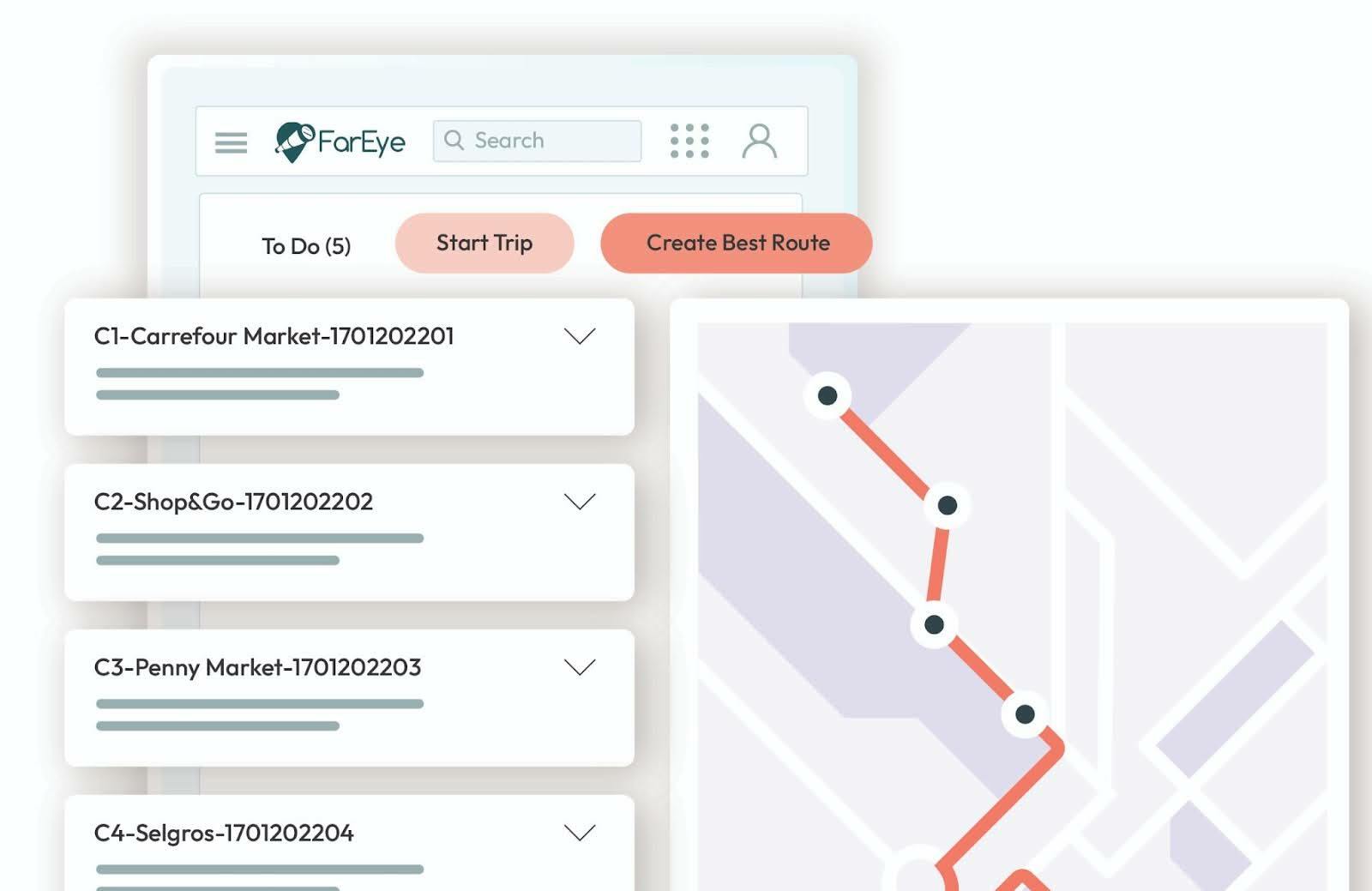
The platform uses real-time dynamic routing and proactive address verification to prevent costly misroutes. It also prevents late drop-off scenarios. Drivers are routed efficiently through a dedicated app using optimized paths to hit target delivery windows.
Additionally, the system continuously recalculates paths as conditions change. This process ensures that the delivery promise remains achievable and accurate. - Scaling Accuracy During Peaks: Festivals, Big Game Nights and Weekend Spikes
FarEye blends core fleets with gig drivers and uses hyperlocal routing to maintain order accuracy even when volumes spike significantly. This scalability ensures that operational standards remain high during festivals, big game nights and weekend spikes that typically strain capacity.
The platform allows businesses to absorb demand surges without compromising the stringent accuracy protocols established during normal operations. - Closing the Loop with ePOD, Analytics and Continuous Improvement
The software connects analytics, ePOD and control-tower views to drive ongoing reductions in error rates and improve performance. Meanwhile, customers receive automated updates via track-and-trace features, which closes the visibility gap that hinders the service experience.
This continuous improvement loop boosts On-time In-full (OTIF) performance and Net Promoter Scores (NPS) by identifying and rectifying the root causes of errors. Managers can utilize granular data to make informed decisions that permanently eliminate recurring operational inefficiencies from the delivery network.
Designing an Accuracy-first Operating Model with Food Delivery Software
The goal is to build a comprehensive operating philosophy that prioritizes accuracy across the entire food delivery organization through the lens of food delivery software.
- The Metrics That Matter: Order Accuracy, First-attempt Success, OTIF
Operations leaders must define Key Performance Indicators (KPIs) for food delivery accuracy, including order accuracy, First-attempt Delivery Rate (FADR) success and OTIF metrics. Food delivery software makes these critical metrics measurable and actionable, allowing managers to track performance and identify areas for improvement. Consistent monitoring of these KPIs creates a culture of accountability where every team member prioritizes the accuracy of the order.
- Standardizing Kitchen and Handover Rituals Around the Platform
Packing flows, bag identification and driver handover steps should align directly to the food delivery software workflow rather than running in parallel. This standardization ensures that physical operational rituals match digital processes, reducing the likelihood of human error during the critical handover phase.
When digital tools and physical actions are synchronized, the operation achieves greater reliability and consistency.
- Coaching Drivers and Store Teams with Data, Not Anecdotes
Error heatmaps, time-of-day trends and route-level performance data allow managers to provide targeted training rather than relying on anecdotal evidence. This data-driven coaching approach helps store teams and drivers understand their specific performance gaps and implement the necessary changes to improve.
Using objective data for feedback sessions builds a culture centered on continuous learning and professional development.
Implementation Playbook: From Pilot to Network-Wide Accuracy Gains
Operators must follow a structured approach when implementing food delivery route optimization to ensure that technology investments yield measurable improvements in order accuracy.
- Start with an Error Audit, Not a Feature List
Operators should begin by mapping current error hotspots by channel, store format and city before choosing specific software configurations or features. This audit provides a clear baseline for improvement and ensures that the technology implementation addresses the most critical operational pain points. Understanding the root causes of existing errors is the first step toward building a successful and lasting solution. - Pilot in One Hyperlocal Zone and Measure Hard Outcomes
Operators should test food delivery route optimization in a single hyperlocal zone with targets for error reduction and fewer refunds. This focused approach allows businesses to measure hard outcomes.
They can then refine strategies before rolling out the solution across the network. A successful pilot builds confidence among stakeholders. Additionally, it provides the necessary data to justify a broader investment in technology. - Rolling Out by Format: QSR, Grocery, Cloud Kitchens
Different formats, such as QSR, grocery and cloud kitchens, can use the same food delivery software backbone with tailored routing logic. This flexibility ensures that the specific needs of each format are met while maintaining a unified technological infrastructure for operations. Centralizing the technology stack simplifies management and enables the sharing of best practices across business units. - Building a Continuous Feedback Loop Between Ops, Product and Support
Cross-functional teams must use error data and customer feedback to continuously refine food delivery route optimization rules over time. This collaboration ensures that the operating model evolves alongside changing market dynamics and customer expectations to maintain high levels of accuracy.
Regular reviews of performance data allow the organization to stay ahead of upcoming trends and potential operational risks.
Delivery Accuracy as a Competitive Moat in Food Delivery
Delivery accuracy is no longer just a metric in on-demand logistics. It is the definitive competitive moat. While speed captures customer attention, reliability retains loyalty. FarEye's food delivery software transforms the pressure of high-volume kitchens and dynamic traffic into a synchronized, predictable operation.
By integrating dispatch orchestration, real-time inventory syncing and food delivery route optimization, brands can finally close the gap between the digital promise and the physical handover. This move toward proactive precision protects thin margins from refund erosion and safeguards brand reputation against negative reviews.
Investing in an accuracy-first infrastructure is not merely an operational upgrade. It acts as a critical requirement for long-term business expansion. Ready to perfect your delivery operations? Book a demo with FarEye today to see how our platform drives precision.
Sources:
https://www.researchandmarkets.com/reports/5743011/united-states-online-food-delivery-market-size
https://fareye.com/resources/case-studies/gordon-food-service
Frequently Asked Questions
How does food delivery software improve order accuracy?
Food delivery software improves accuracy by unifying orders, syncing inventory, validating addresses, guiding packing, supporting ePOD, and reducing manual data-entry errors.
What counts as a delivery error in food delivery?
Delivery errors include wrong items, missing modifiers, mixed bags, incorrect addresses, spoiled temperature-sensitive products, failed attempts, and deliveries made to wrong customers.
How does food delivery route optimization reduce delivery errors?
It improves ETA accuracy, batches compatible orders, verifies addresses, and dynamically reroutes around disruptions before delays, cross-bagging, or wrong-drop scenarios occur.
What KPIs measure food delivery accuracy?
Key KPIs include order accuracy, First-attempt Delivery Rate, On-time In-full performance, error rates, refunds, and route-level delivery performance trends.
How has FarEye helped food businesses improve delivery accuracy?
FarEye helped Gordon Food Service (GFS) optimize same-day routes, improve delivery-window consistency, and provide real-time tracking across food deliveries. GFS also reported 8.6% sales growth, with last-mile delivery from stores contributing 36% of that growth.