Table of Contents
- The 3PL Imperative - Routing is Now a Strategic Lever
- What a Multi Stop Route Planner Actually Does
- The Operational Reality - Where 3PLs Lose Margin Without Intelligent Routing
- Beyond Efficiency - Routing as a Customer Experience Multiplier
- Why FarEye Stands Out as an Integrated Fleet Management Software Platform
- Practical Evaluation Checklist: What Fleet Managers Should Look For
- The Risk of Inaction
- The New Baseline for 3PL Competitiveness
Let Our Experts Optimize Your Deliveries Today
Let's talkKey Takeaways
- In a competitive 3PL landscape, manual routing and basic navigation tools fall short of meeting complex delivery requirements and shrinking delivery windows.
- A multi stop route planner drives operational efficiency by optimizing fleet utilization and reducing unnecessary mileage.
- Intelligent routing lowers operating costs while improving on-time delivery performance and service reliability.
- Smart route planning helps 3PLs scale capacity without proportionate increases in vehicles or labor.
- FarEye’s AI-driven orchestration platform unifies routing, dispatching, automation, fleet visibility, and predictive intelligence into one enterprise-grade solution.
- Fleet managers who adopt intelligent routing gain a strategic advantage, turning delivery execution into a dependable driver of efficiency, customer satisfaction, and profitable growth.
The economics of third-party logistics have changed. Margins are tighter, customer expectations are higher, and volumes fluctuate unpredictably. At the same time, shippers demand faster turnarounds, narrower delivery windows, and full visibility across the order lifecycle. In this environment, fleet managers cannot afford routing inefficiencies.
A modern multi stop route planner is no longer an operational add-on. It is the control system that determines whether a 3PL operates profitably, scales sustainably, and consistently meets SLAs. For competitive providers managing high-density, multi-drop deliveries, intelligent routing has become the difference between operational strain and strategic advantage.
Let’s break down why.
The 3PL Imperative - Routing is Now a Strategic Lever
3PL operations sit at the intersection of cost control, delivery reliability, and customer satisfaction. Every day, fleet managers must orchestrate dozens or thousands of stops across varying geographies, service levels, and contractual obligations.
Historically, routing was treated as a tactical dispatch function. Today, it directly impacts:
- Cost per delivery
- On-time, in-full (OTIF) performance
- Driver productivity
- Asset utilization
- Customer retention
Manual route planning, static maps, or basic GPS navigation tools cannot keep pace with multi-node delivery networks. High-volume 3PL environments require dynamic sequencing, constraint management, and real-time recalculation. Without a multi stop route planner, inefficiencies compound quickly, leading to late deliveries, overtime costs, empty miles, and underutilized fleet capacity. Routing is no longer a back-office task. It is a margin-protection engine.
What a Multi Stop Route Planner Actually Does
At its core, a multi stop route planner determines the most efficient sequence of stops for each vehicle while respecting operational constraints. However, in competitive 3PL operations, this goes far beyond “shortest path” optimization.
A robust planner evaluates:
- Delivery time windows
- Vehicle capacity (weight, volume, equipment)
- Driver shifts, skills, and compliance rules
- Traffic conditions and road restrictions
- Service time predictions
- Customer SLAs
- Rate structures across owned and outsourced fleets
It generates optimized routes across multiple vehicles simultaneously, ensuring balanced workloads and maximized throughput. A multiple route planner operates at a network level. Instead of optimizing one vehicle in isolation, it orchestrates the entire fleet’s delivery campaign. It assigns orders intelligently across drivers, redistributes workload dynamically, and recalculates routes when disruptions occur. This distinction matters. In high-density 3PL operations, optimization must happen across the system, not vehicle by vehicle.
The Operational Reality - Where 3PLs Lose Margin Without Intelligent Routing
To understand why routing cannot be ignored, consider the daily friction points inside a typical 3PL network:
- Drivers finish late due to unrealistic route sequencing
- Vehicles leave hubs partially loaded
- Overtime increases due to route deviations
- Customer service teams handle ETA complaints
- Dispatchers spend hours manually adjusting routes
- Outsourced carriers are used reactively, not strategically
- Each of these inefficiencies links back to routing quality.
A high-performance multi stop route planner directly addresses these friction points:
- Maximized Fleet Utilization
By reducing deadhead mileage and intelligently clustering stops, each vehicle completes more deliveries per shift. Idle time decreases and stops per hour increase. Vehicles are filled closer to optimal capacity. Higher utilization means the same fleet handles more volume without expanding the asset base. Lower Cost Per Delivery
Routing directly impacts fuel consumption, maintenance wear, driver hours, and outsourced carrier usage. Even a small percentage improvement in route efficiency can translate into significant annual savings for a mid-size 3PL operation.Optimization reduces:
- Empty miles
- Driver overtime
- Unnecessary outsourcing
- Failed delivery attempts
Cost control becomes systematic rather than reactive.
- Improved On-time Performance
Time windows are tightening. Retail, healthcare, food, and big-and-bulky deliveries demand precise adherence. A dynamic multiple route planner factors traffic conditions, service times, and stop priority sequencing to generate realistic ETAs. When disruptions occur, such as accidents, weather delays, or last-minute order changes, routes are recalculated in real time. On-time delivery stops being a best-effort metric. It becomes engineered performance. Scalable Growth Without Linear Cost Expansion
As 3PLs win new contracts or expand into new territories, complexity multiplies. Without intelligent routing, growth leads to:
- More drivers
- More vehicles
- More manual planning overhead
With a scalable multi stop route planner, capacity increases through optimization first. Expansion becomes data-driven rather than asset-driven.
Beyond Efficiency - Routing as a Customer Experience Multiplier
In competitive 3PL markets, service quality is a differentiator. Shippers evaluate providers not only on price but on reliability, transparency, and delivery experience. Routing quality directly influences all three.
A high-performing planner enables:
- Accurate, real-time ETAs
- Proactive delay notifications
- Reduced reattempts
- Better adherence to delivery windows
- Predictable performance metrics
When deliveries consistently arrive within promised windows, trust increases. Fewer escalations reach customer service teams. Contract renewals become easier. The multi stop route planner is not just a fleet tool. It is a customer retention mechanism.
Why FarEye Stands Out as an Integrated Fleet Management Software Platform
In modern logistics, tools that only optimize routes are no longer enough. Leading enterprises need unified systems that plan, dispatch, monitor, and improve delivery operations end-to-end. FarEye stands out because it is not just a routing engine; it is an AI-powered fleet management software platform built to optimize planning, dispatching, fleet visibility, and delivery performance at enterprise scale.
Here’s what makes it distinct:
- AI-based Routing and Constraint Optimization
FarEye’s platform models time windows, vehicle capacity, service times, driver shifts, and real-time conditions to generate feasible multi stop plans. This reduces fuel cost, improves ETA accuracy, and increases route compliance. - Unified Visibility Across Owned, Outsourced, and EV Fleets
It aggregates telematics, GPS, and partner carrier APIs into a single control tower. Dispatchers can instantly assign the right vehicle for the right job, whether it’s in-house, outsourced, or electric-powered. - Workflow Automation and Exception Handling
FarEye orchestrates the entire delivery lifecycle: orders flow into dispatch, routes auto-assign, and exceptions trigger predefined actions. This automation eliminates manual patchwork and reduces SLA breaches. - Predictive Intelligence with Machine Learning
By learning from historical delays, zone patterns, and driver behavior, the platform continuously improves routing accuracy and delivery performance. Real-time data from traffic, weather, and order changes feed into this predictive engine. - Complete Integration Stack
With an API-first design, FarEye integrates seamlessly with ERP, OMS, WMS, CRM, telematics, TMS, and IoT sensors. This allows enterprises to adopt advanced logistics capabilities without replacing legacy systems. - Financial and Carrier Optimization
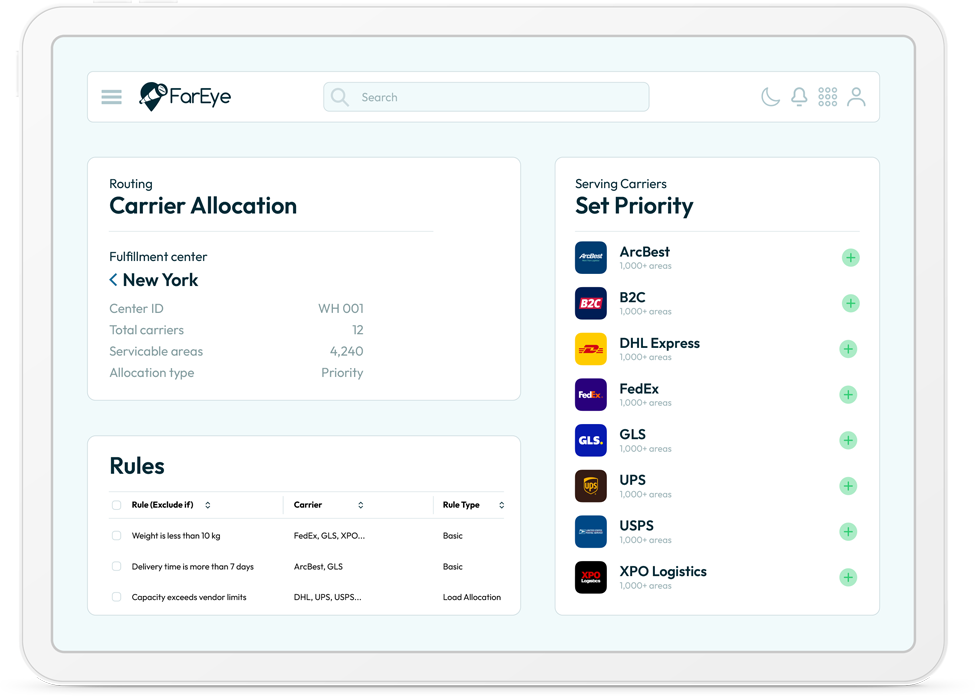
FarEye tracks cost per mile, rate cards, billing exceptions, and carrier performance, revealing hidden savings and reducing carrier leakage. This financial visibility helps fleet managers make smarter allocation decisions.
By embedding routing orchestration, visibility, and analytics into one unified platform, FarEye elevates fleet operations from tactical execution to strategic execution. Enterprises can not only plan better routes but also continuously measure performance, adapt in real time, and optimize across fleets.
Practical Evaluation Checklist: What Fleet Managers Should Look For
If routing is this critical, choosing the right solution becomes strategic. A competitive multi stop route planner should provide:
- Real-time dynamic recalculation
- Advanced multi-constraint optimization
- Territory planning capabilities
- Hybrid fleet orchestration
- Predictive service time modelling
- Seamless TMS, WMS, and ERP integrations
- Driver mobile applications with proof-of-delivery
- Comprehensive analytics dashboards
- SLA-aware sequencing
- Scalable architecture for high-volume networks
Routing software should integrate into the broader last-mile ecosystem, not operate as a siloed optimization engine.
The Risk of Inaction
Ignoring multi stop route planning does not simply slow operations. It leads to:
- Rising fuel costs
- Driver dissatisfaction and turnover
- Missed SLAs
- Revenue penalties
- Reduced shipper confidence
- Inability to scale profitably
In highly competitive 3PL markets, operational inefficiency compounds quickly. Competitors leveraging intelligent routing will deliver faster, cheaper, and more predictably. Routing maturity becomes a competitive barrier.
The New Baseline for 3PL Competitiveness
Fleet managers today operate in an environment defined by complexity. Multi-node deliveries, fluctuating volumes, hybrid fleets, and strict service commitments demand precision. A robust multi stop route planner is no longer optional. It is the operational backbone that determines cost efficiency, SLA performance, and customer experience outcomes.
As AI reshapes logistics decision-making, FarEye’s multiple route planner ensures both human operators and intelligent systems can collaborate seamlessly. We transform routing from a daily dispatch activity into a strategic control layer across the 3PL network.
In competitive operations, the question is no longer whether to adopt intelligent routing. It is whether your fleet can afford not to. So, make sure to schedule a meeting with FarEye today and discover how enterprise-scale routing and dispatch intelligence can transform your 3PL performance.