Table of Contents
- The Dispatch/Allocator’s Daily Struggle: Why LTL Freight isn’t Simple
- LTL vs FTL Routing: A Critical Comparison
- Key Concepts in LTL Freight Software
- Dispatchers’ Pain Points and How Smart Routing Solves Them
- Why Enterprises Invest: Strategic Payoffs
- Why FarEye Stands Out: AI + Deep Domain in LTL Routing
- Best Practices for Deploying LTL Route Optimization
- Start Optimizing Your LTL Network Today
Let Our Experts Optimize Your Deliveries Today
Let's talkFreight networks move millions of small shipments that could never fill a truck outright. Yet many carriers still dispatch them almost as if they were full loads, ending up with half-empty trucks, wasted miles and lost margins.
U.S. logistics providers are under mounting pressure, as labor scarcity, rising fuel costs, and tighter delivery windows all squeeze profitability. According to a recent report, route optimization software has become the most widely adopted logistics tool in 2025, used by 51% of logistics operations.
For dispatchers and allocators, the central question is: can you turn those fragmented, small loads into a cohesive, efficient route that delivers big savings? The answer lies in smart LTL route optimization powered by AI and machine learning.
Let’s explore how LTL route optimization transforms multiple small loads into high-yield consolidation, what dispatchers must consider and how an AI-driven platform makes it a reality.
The Dispatch/Allocator’s Daily Struggle: Why LTL Freight isn’t Simple
When you manage LTL freight, you constantly juggle:
- Dozens of pickup and delivery points generate small orders
- Varying size, weight, handling requirements (hazmat, temperature, fragile)
- Strict time windows or delivery deadlines
- Vehicle constraints (height, length, compartments)
- Road and regulatory constraints (low bridges, restricted roads)
- Driver hours, rest requirements and labor compliance
Each alone is manageable; in combination, they explode the complexity. Naively sending out trucks with loose groupings or fixed routes leads to suboptimal fill, excessive deadhead and constant manual patching.
LTL vs FTL Routing: A Critical Comparison
Before diving deeper, it helps to see the contrast:
- FTL (Full Truckload) routing is simpler: one customer’s load occupies a vehicle, so routing is mainly about path, not consolidation.
- LTL routing demands grouping multiple customers’ shipments into one vehicle run, with branching pickups and deliveries. That introduces combinatorial decision-making: which loads to group, sequence them and handle returns or transfers.
Thus, while FTL routing optimization is about efficient path planning, LTL routing is about load allocation + path planning + operational constraints, a much richer problem space.
Key Concepts in LTL Freight Software
Here are the building blocks dispatchers and allocators need to internalize:
Load Consolidation and Clustering
You must cluster shipments that are compatible in location and time. Good clustering looks beyond simple geographic proximity; it factors in deadlines, slack and compatibility (e.g., whether two shipments can cohabit the same truck given weight, special constraints). Over-consolidation (stretching too far) risks SLA breaches; under-consolidation wastes capacity.
Multi-stop Route Sequencing
Once a cluster is chosen, the optimal order of stops matters. You want minimal backtracking, the shortest travel distance and adherence to customer time windows. In LTL, you often mix pickups and deliveries: e.g., a truck might pick up from point A, deliver somewhere, then pick up again, all in one trip.
Constraint Handling
You must encode all operational constraints:
- Time windows/delivery windows
- Vehicle capacity (weight, volume, equipment constraints)
- Compatibility (hazmat, temperature, stacking rules)
- Road restrictions (bridge height, tunnel, restricted roads)
- Driver hours/rest breaks / regulatory compliance
A routing engine that ignores any of these yields routes that are infeasible or unsafe.
Hub/Relay/Transfer Moves
Sometimes, direct consolidation across all stops isn’t optimal. A route may drop off cargo at an intermediate hub or transfer point, then reassign it to another vehicle for further delivery. This is akin to relay routing.
With multiple carriers collaborating, you can optimize across a hyperconnected hub network for cost sharing. Research is emerging on these multi-carrier relay networks.
Dynamic/Real-time Reoptimization
The plan you set at midnight often unravels by morning: traffic changes, customer changes, truck breakdowns. Good LTL freight software must support mid-route reoptimization, patching or dynamically rerouting routes to maintain efficiency and SLA compliance.
Learning and Feedback
Every route run produces data, including deviations, delays, idle times and driver behavior. A system that learns from this, adjusting cluster parameters, travel time estimates and slack buffers, improves over time. FarEye’s platform, for example, applies machine learning to adjust routing decisions as it sees more runs.
Dispatchers’ Pain Points and How Smart Routing Solves Them
Let’s put ourselves in the boots of a dispatcher:
I don’t know which small orders to group together.
Smart LTL routing software analyzes the full order set and proposes optimal clusters, relieving you of manual guesswork.
My trucks end up half-empty on returns (empty backhaul).
Advanced routing tools detect possible returns or pickups along the route to minimize empty runs. FarEye’s AI engine matches load opportunities in near-real time.
Schedules and time windows clash and I have to manually patch.
The routing engine considers all constraints and can re-optimize dynamically when conflicts arise.
Unexpected disruptions ruin our plan.
With real-time visibility and rerouting logic, dispatchers can respond to road closures or delays and correct routes proactively.
We lack insight into which routes under- or over-perform.
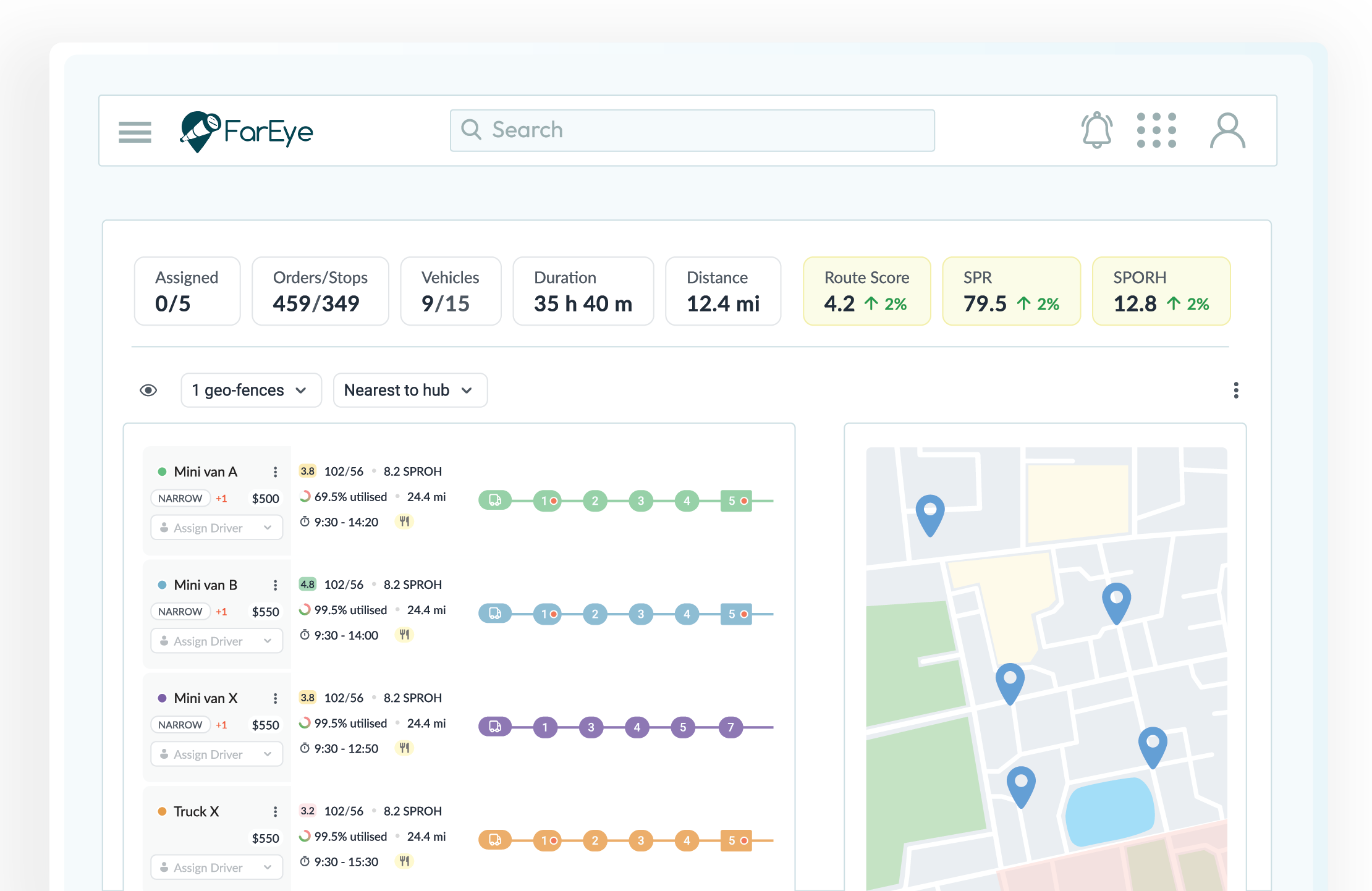
A modern system gives analytics, key metrics and performance dashboards so you can see where bottlenecks or inefficiencies lie and iterate.
When the dispatcher no longer battles logistics chaos but instead uses an intelligent co-pilot, productivity and morale both improve.
Why Enterprises Invest: Strategic Payoffs
Beyond daily routing gains, enterprises get:
- Lower cost per shipment as fixed costs (fuel, driver hours, incremental maintenance) are spread over more freight.
- A leaner fleet needs, in many cases, the same capacity to handle more load without fleet expansion.
- Network design insights aggregated routing data reveals where hubs, drop zones or cross-docks could reduce transit cost.
- Scalable operations when volumes grow (peaks, seasonality, expansion), the routing engine scales; planners don’t drown.
- Improved SLAs and customer experience, tighter delivery adherence and accurate ETAs generate trust and competitive differentiation.
- Sustainability gains fewer miles, less waste and lower emissions, which support ESG goals.
- Data-driven continuous improvement over time, your routing decisions improve, reducing margin erosion.
In short, the ROI is not just incremental operations cost reduction; it becomes a structural lever for competitiveness.
Why FarEye Stands Out: AI + Deep Domain in LTL Routing
When you need more than a mapping tool, when you demand an intelligent engine, FarEye becomes compelling. Here’s how:
- AI/ML-powered Engine: Uses past trip data, traffic patterns and driver behavior to refine routing and clustering on the fly.
- Constraint-rich Modeling: Bottleneck aware (roads, vehicle constraints, delivery windows, driver hours) so suggested routes are feasible, not theoretical.
- Real-time Dynamic Routing: Routing updates mid-day as conditions change, with dispatchers getting proactive alerts.
- Co-mingling/Load Pooling Logic: Intelligently combine shipments across customers in optimized clusters.
- Reduced planning time: Internal reports show dispatch planning time shrinks from hours to 30 minutes.
- Reduction in Driving Hours: 10% reduction through better routing.
- Seamless integration with TMS, telematics and order systems, so real-time order and vehicle data flow into routing decisions.
In a landscape where routing decisions determine margins, FarEye offers dispatchers and logistics leaders the kind of decision intelligence that older systems can’t match.
Best Practices for Deploying LTL Route Optimization
To capture the full benefit, here are practices dispatch teams should follow:
- Start small, with a high-density lanes pilot in areas where shipments cluster heavily.
- Clean your data, accurate addresses, weights, constraints; bad data kills optimization.
- Allow human override/visibility dispatchers should see, adjust and understand suggested routes.
- Set performance targets and KPIs to track miles saved, fill rate, planning time and on-time deliveries.
- Feedback loop feed route execution data back into clustering and routing logic for continuous learning.
- Train staff and build trust, show them why a route is chosen and expose tradeoffs.
- Iterate and expand once one region shows ROI, expand across geographies and operations.
Start Optimizing Your LTL Network Today
For dispatchers managing LTL freight, the difference between guesswork and optimization is the difference between margin erosion and profitability. By consolidating small loads intelligently, sequencing stops optimally and adapting in real time, you turn fragmentation into scale.
FarEye’s AI-driven platform elevates the role of the dispatcher from firefighter to strategist, giving you visibility, control and optimization in one package. If your trucks aren’t running full or your planners are drowning in spreadsheets, LTL route optimization can help. It offers not just cost savings but also a new way to deliver smarter, faster and leaner.
Source: