Table of Contents
- What is EV Routing?
- Why EV Truck Routing Demands a New Approach
- Addressing Range Anxiety in Fleets
- Charging Infrastructure and its Impact on Routing
- Integration of Real Time Data and Predictive Models
- Scheduling Deliveries with Charging Needs in Mind
- Benefits of EV Truck Routing for Logistics Operations
- Common Challenges in EV Truck Routing
- FarEye’s Role in EV Truck Routing
- Future of EV Truck Routing
- Key Metrics for Success
- EV Routing as a Competitive Edge
Let Our Experts Optimize Your Deliveries Today
Let's talkA delivery van stalled halfway through a route because its battery drained faster than predicted, delaying multiple customer orders. This scenario reflects a pressing challenge for fleet managers today: how to balance tight delivery schedules with charging demands. Electric trucks are no longer niche investments.
The United States electric commercial vehicle market is projected to reach USD 64,561.4 million. Rising adoption is fueled by sustainability goals, e commerce growth and regulatory support. Yet, scaling fleets without precise planning creates risks of missed SLAs, driver frustration and hidden costs. This is where intelligent EV truck routing becomes mission critical.
What is EV Routing?
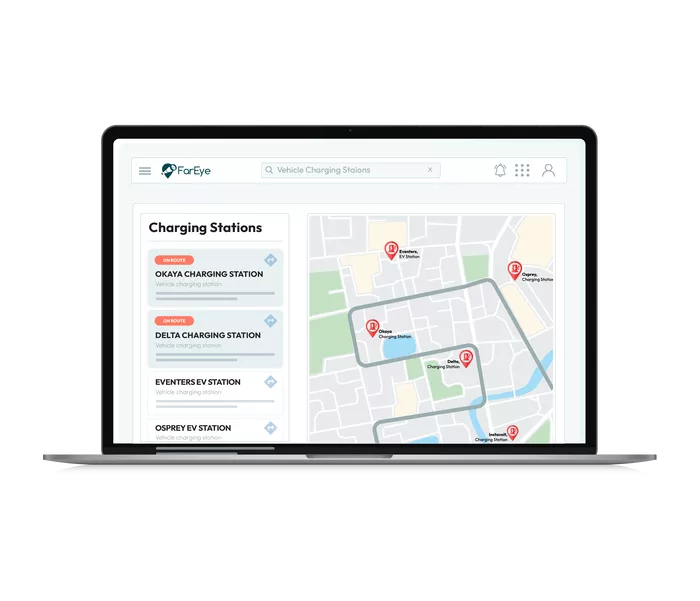
EV routing is the process of designing and managing delivery paths that account for battery capacity, charging needs and operational constraints. Unlike conventional routing, it goes beyond mapping shortest paths.
It integrates real time charging infrastructure availability, terrain, traffic and load weight to predict energy consumption. A robust EV truck route planner considers both delivery windows and charging events, making routing not just a question of time and distance, but also of energy and availability.
Why EV Truck Routing Demands a New Approach
Traditional vehicle routing focused on minimizing distance or time. Electric fleets introduce new complexity. Battery performance fluctuates based on temperature, load and terrain. Chargers vary in type, cost and speed. Waiting times at stations can disrupt planned delivery slots.
A missed calculation here does not just waste fuel, it risks stranded vehicles and dissatisfied customers. Businesses need routing solutions that anticipate and adapt to these variables in real time.
Addressing Range Anxiety in Fleets
Range anxiety is no longer just a consumer concern; it directly impacts dispatchers and drivers managing multiple stops. Without accurate routing, drivers may overcompensate by charging too often, wasting valuable time.
An advanced EV truck routing system calculates precise state of charge predictions and optimizes charging intervals. It balances risk by scheduling partial fast charges instead of long full charges when delivery windows are tight. The outcome is fewer delays and better resource utilization.
Charging Infrastructure and its Impact on Routing
Even with rapid charger installations, infrastructure gaps remain. Rural areas or secondary delivery zones may lack reliable fast chargers. An EV truck route planner helps fleets navigate these gaps by intelligently sequencing stops near verified charging points.
It also accounts for queue risks by monitoring charger occupancy in real time. For fleets operating on strict service commitments, this intelligence reduces uncertainty and builds confidence in meeting promised windows.
Integration of Real Time Data and Predictive Models
Modern EV routing thrives on live data. Traffic patterns, weather conditions and charger availability all influence route performance. Predictive analytics powered by AI and machine learning combine historical consumption data with real time feeds.
For instance, algorithms can detect that heavy rain or hilly terrain will increase battery drain by 10% and adjust plans instantly. This integration enables dispatchers to maintain delivery promises without adding unnecessary slack into schedules.
Scheduling Deliveries with Charging Needs in Mind
A delivery plan is only as good as its scheduling engine. In EV fleets, this requires balancing vehicle range, order priorities and customer commitments. An EV truck route planner ensures deliveries are grouped logically to minimize detours and align charging breaks with driver rest periods.
Constraint based scheduling adapts dynamically to disruptions, such as traffic accidents or unexpected high energy use. This keeps routes both efficient and resilient.
Benefits of EV Truck Routing for Logistics Operations
When executed well, EV routing offers measurable advantages:
- Improved On Time Delivery Rates: Routes align charging with delivery deadlines, protecting customer satisfaction.
- Reduced Operating Costs: Optimized energy use and fewer detours cut electricity expenses and vehicle wear.
- Higher Fleet Utilization: Smart planning enables more trips per vehicle without increasing risk.
- Sustainability Impact: Efficient routes lower carbon emissions while maximizing EV range.
- Lower Driver Stress: Clear guidance reduces uncertainty about where and when to charge.
These outcomes reinforce why routing cannot remain a back office task. It is central to building resilient, customer focused logistics operations.
Common Challenges in EV Truck Routing
While benefits are clear, several hurdles persist:
- Variable Charging Speeds: Different stations deliver different outputs, making uniform planning difficult.
- Energy Consumption Variability: Cargo weight, road gradient and speed drastically change energy use.
- Charger Compatibility: Not all chargers suit every EV model, creating additional complexity.
- Limited Rural Coverage: Sparse infrastructure in non urban areas increases planning pressure.
- Battery Degradation Over Time: Aging fleets require recalibrated consumption models.
An effective EV truck routing solution must confront these challenges head on through accurate models and adaptive planning.
FarEye’s Role in EV Truck Routing
FarEye brings a powerful combination of AI based routing and machine learning to the EV transition. Its platform does more than calculate routes; it continuously re optimizes them as conditions change. By ingesting telematics, traffic data and charging availability, FarEye generates dynamic ETAs that remain accurate even during disruptions.
Machine learning models learn from every trip, refining predictions of energy consumption and queue times at stations. For dispatchers and allocators, this translates into higher predictability, fewer failed deliveries and optimized cost structures.
FarEye also helps enterprises plan strategically by analyzing long term charging trends and highlighting where infrastructure investments will yield maximum value.
Future of EV Truck Routing
Looking ahead, EV routing will become even more integrated with broader logistics ecosystems. Vehicle to grid (V2G) technology could allow fleets to discharge energy back to the grid during idle periods. Autonomous delivery trucks will depend entirely on intelligent route planners that factor charging stops into their programmed decisions.
As regulations tighten and consumers demand greener services, companies that master EV routing will lead in both operational efficiency and brand credibility.
Key Metrics for Success
Dispatchers should not just implement EV routing; they must measure it. Metrics include:
- Percentage of deliveries completed on time without extra charging.
- Average energy cost per mile compared to baselines.
- Utilization rates of vehicles across peak and non peak hours.
- Average waiting time at charging stations per route.
- Battery health trends correlated with charging behavior.
Tracking these KPIs creates visibility and ensures continuous improvement in both cost and sustainability outcomes.
EV Routing as a Competitive Edge
The shift to electric fleets is not optional; it is an operational and reputational imperative. Intelligent EV truck routing transforms potential disruptions into opportunities for cost savings and customer loyalty.
Enterprises that embrace FarEye’s advanced routing gain more than efficiency. They gain the ability to promise reliable, sustainable deliveries in a market where both regulators and consumers are watching closely.
For dispatchers and allocators, mastering EV routing is not just about avoiding empty batteries. It is about powering growth, safeguarding commitments and building a logistics ecosystem ready for the future.
Source:
North America Electric Commercial Vehicle Market Size & Outlook, 2030