Table of Contents
- The Operational Complexity of Electric Vehicle Route Planning in Urban Cores
- Dynamic Replanning and Fleet Orchestration: Solving for Real-world Volatility
- How FarEye's Intelligent Electric Vehicle Route Planner Simplifies Complex Urban Operations
- Implementation of Electric Vehicle Route Planning: A Practical Roadmap
- Why FarEye Leads the EV Route Planning Revolution
Let Our Experts Optimize Your Deliveries Today
Let's talkKey Takeaways
- Real-world conditions, traffic, weather, and weight can drain batteries faster than expected, while charging gaps and tight delivery windows leave no room for error.
- FarEye's AI-driven electric vehicle route planner anticipates energy depletion 3-5 stops ahead, automates charging during natural delivery gaps, and integrates smart parking to protect on-time performance.
- Successful rollout requires staged execution, energy audits, team alignment, platform evaluation against live data requirements, and continuous refinement, transforming energy constraints from operational anxiety into competitive advantage.
Urban last-mile EV fleets are approaching an operational tipping point. Electrification mandates are accelerating the shift to zero-emission transport, yet charging networks continue to lag behind route density. The result is a daily operational trade-off between battery health and delivery commitments.
If you place a 40-minute charging stop at the wrong point in the route, multiple delivery windows unravel. Delay charging too long, and productivity collapses before the afternoon peak. Energy planning is no longer a back-office calculation. It is a live operational variable.
FarEye removes this uncertainty with an AI-powered electric vehicle route planner that treats battery range as a dynamic constraint, alongside traffic conditions, time windows and service expectations.
Let’s see how leading fleets are replacing range anxiety with structured, profitable execution.
The Operational Complexity of Electric Vehicle Route Planning in Urban Cores
The physics of urban delivery creates a constraint environment where traditional routing logic fails. It demands a specialized electric vehicle route planner that accounts for charging energy as a dynamic, depleting resource rather than a fixed-radius range.
- The Range Reality Gap
EV range on paper rarely reflects the realities of urban delivery. Manufacturer estimates assume stable speeds, moderate payloads and limited stop-start movement. However, dense urban routes operate differently. Vehicles idle in congestion, accelerate repeatedly between short stops, and carry variable loads that directly affect energy draw.
Add HVAC usage in extreme weather and battery degradation over time, and the theoretical range begins to shrink. This gap between stated range and usable range creates planning volatility.
An effective electric vehicle route planner must therefore model real-world consumption patterns. - The Charging Infrastructure Gap
Urban electrification is expanding faster than public charging capacity. Even where charging stations exist, availability is uncertain. Queues, incompatible connectors, variable charging speeds and unpredictable downtime introduce operational friction.
For fleets, this creates a structural imbalance. Routes are dense, but charging access is sparse or unevenly distributed. A single unavailable charger can force detours that destabilize delivery sequences and time commitments.
A specialized electric vehicle route planner must therefore treat charging nodes as constrained assets. It should evaluate charger reliability, proximity to clustered deliveries and expected wait times before assigning stops. - Time-window Compression
Urban deliveries operate within tight, customer-defined windows. Retail replenishment, gated communities and commercial drop-offs often impose narrow acceptance periods.
A 30 to 45-minute charging session does not exist in isolation. It reshapes arrival sequences across downstream stops. Miss one committed slot and customer experience degrades, WISMO queries rise and SLA penalties follow.
Electric vehicle route planning in dense networks must therefore synchronise energy events with time windows. Charging should align with low-sensitivity stops or naturally longer dwell periods, ensuring service commitments remain intact while battery security is preserved. - The Topology Problem
Urban cores are not neutral grids. They are asymmetric systems shaped by one-way streets, restricted zones, congestion corridors and micro-distribution clusters. Short physical distances do not always translate into short travel times.
This topology amplifies EV constraints. A vehicle cannot simply detour to the nearest charger if road restrictions or traffic patterns add disproportionate travel time and energy burn.
An advanced electric vehicle route planner must understand network topology in depth. It should optimize for directional flow, traffic density patterns and charging accessibility within the broader delivery cluster.
Dynamic Replanning and Fleet Orchestration: Solving for Real-world Volatility
Leading operations teams need a route planning software to deploy layered solutions addressing energy prediction, charger access and asset coordination simultaneously. These are:
- Predictive Energy Intelligence
Electric vehicle route planners deploy models anticipating state-of-charge shortfalls three to five stops ahead of critical thresholds, triggering proactive rerouting before range anxiety manifests. These systems integrate traffic congestion corridors, charger availability feeds and vehicle telemetry, including actual consumption rates versus planned profiles.
Machine learning layers trained on historical data improve prediction accuracy over manual dispatch heuristics, shifting operations from reactive rescue to proactive prevention.
- Charger Congestion Management
Popular charging locations fill up fast. A driver arriving without a reservation often faces idle time, which pushes back subsequent deliveries. Here is when an AI powered electric vehicle route planner predicts these bottlenecks, weighing the gamble of a fast hub against the certainty of a slower but available option.
This keeps First Attempt Delivery Rate (FADR) intact by preventing charging delays from cascading into missed customer windows.
- Depot Charging Optimization
As electrified vehicles return with varying state-of-charge levels and departure schedules, load balancing across available charging ports becomes a scheduling problem in its own right. Platforms coordinating depot charging sequences with next-day route assignments reduce overnight demand charges and ensure morning readiness without manual intervention.
This integration of depot energy management with route planning closes the loop between returning fleet status and departing route feasibility.
How FarEye's Intelligent Electric Vehicle Route Planner Simplifies Complex Urban Operations
FarEye's electric vehicle route planner addresses the unique constraints of urban EV logistics through purpose-built capabilities that optimize performance while ensuring operational reliability.
- Intelligent Charging Infrastructure Orchestration
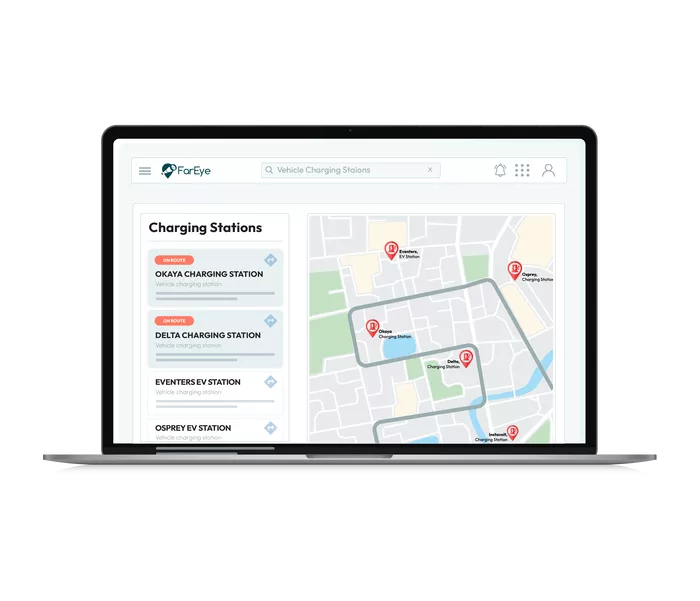
The platform integrates real-time charging station data, including location, availability and compatibility, directly into route sequences. Rather than treating charging as an emergency interruption, FarEye schedules stops during natural vehicle idle periods.
Advanced battery management algorithms account for charging curves, preconditioning requirements and regenerative braking potential to maximize range efficiency and minimize dwell time. - Predictive Energy Analytics with Control Tower Visibility
Machine learning models forecast battery depletion based on vehicle-specific consumption patterns, payload weight, ambient temperature and route topography. This predictive capability enables proactive charging stop placement and eliminates the range anxiety that disrupts driver performance and customer commitments.
Unified control tower visibility aggregates these insights across the entire fleet, showing state-of-charge, charging status and route progress in a single operational view. The efficiency gains translate to real impact. FarEye's platform has helped customers save 600 million miles annually through optimized routing. - Precision Geocoding for EV-specific Requirements
Accurate destination resolution accounts for geographical nuances that impact electric vehicle performance, such as road grades, surface types and parking accessibility. This precision ensures route feasibility and charging stop accessibility in dense urban environments.
In practice, this means drivers arrive at destinations where they can actually park and complete deliveries without circling blocks or hunting for charging points. The system identifies loading zones, building access points and nearby charging infrastructure before the vehicle departs, eliminating the surprise delays that cascade through afternoon schedules. - AI Driven Smart Parking Integration
Dense urban deliveries fail when drivers circle blocks in search of legal parking. FarEye's vehicle route planner integrates smart parking intelligence, identifying the closest available spots to delivery addresses before the vehicle arrives.
This cuts dwell time, reduces congestion penalties and protects on-time delivery windows that would otherwise collapse during extended searches. This proactive management has driven 18% year-over-year increases in first-time delivery rates, keeping drivers on schedule and customers satisfied without the frustration of redelivery attempts.
Implementation of Electric Vehicle Route Planning: A Practical Roadmap
Transitioning to electric vehicle route planning at enterprise scale requires staged execution.
- Start with Energy Audits
Pull telematics data from current routes to see actual kWh-per-mile. Pick pilot routes, busy, short loops under 100 miles that can rely on depot charging. Establish performance baselines before expanding to riskier, longer corridors. - Align Your Teams
Electrification disrupts multiple functions simultaneously. Dispatchers need retraining on energy-constrained routing logic. Drivers may require coaching on regenerative braking and charging protocols. - Choose the Right Planner
Evaluate electric vehicle route planners against live data requirements, including real-time charger availability APIs, temperature- and payload-adjustable consumption models and telematics integration. - Validate and Refine
Track metrics beyond cost-per-mile: FADR maintenance, WISMO ticket volume, driver satisfaction and overnight charging costs. Compare against diesel baselines to build the business case. Document pilot failures, emergency charging events and delayed customers to refine algorithms before broader rollout.
Why FarEye Leads the EV Route Planning Revolution
Urban logistics is at an inflection point. Successful fleets have already stopped treating charging stops as operational surprises and started managing them as scheduled waypoints. FarEye enables this shift, turning energy constraints from a source of anxiety into a competitive advantage through predictive intelligence and automated orchestration.
Electrification is no longer a strategic debate for fleets. The real question is whether your routing infrastructure is built to manage the operational complexity that comes with it. Operators still relying on fixed maps and manual dispatch adjustments are already falling behind competitors who automated these decisions months ago.
Book a demo with FarEye to see implementation frameworks, ROI models and migration timelines used by fleets already scaling profitable zero-emission operations.