Table of Contents
- What is a Delivery Route Optimizer and How Does it Help Protect SLAs?
- How a Delivery Route Optimizer Solves Critical Last Mile Goals
- Strategic Features of a Modern Delivery Route Optimizer
- Why FarEye Stands Out as a Leading Delivery Route Optimizer
- Best Practices for Implementing a Delivery Route Optimizer
- Start Optimizing Your Last Mile Delivery Network Now
Let Our Experts Optimize Your Deliveries Today
Let's talkKey Takeaways
- Beyond Simple Navigation: Move beyond basic maps with a delivery route optimizer that balances real-world constraints to ensure your SLAs are met.
- Unified Platform: See how FarEye's AI-powered platform unifies planning and execution to streamline operations.
- Measurable Growth: Discover how intelligent orchestration drives measurable growth and secures customer loyalty.
What happens when your perfect delivery plan meets rush hour reality? Fixed routes crumble the moment drivers depart. As traffic shifts and service times drift, relying on legacy tools forces constant manual recovery, guaranteeing missed SLAs and spiraling overtime costs.
The cost of failure is rising fast as the global last mile delivery market projects a surge from USD 203.36 billion in 2026 to USD 487.20 billion by 2035. You cannot compete if your dispatchers are stuck reacting to yesterday's data.
To protect your margins, you need a delivery route optimizer that solves for real-world chaos in real time. Let’s examine how this technology fixes broken logistics operations and how FarEye helps you deliver on your promises.
What is a Delivery Route Optimizer and How Does it Help Protect SLAs?
Think of a delivery route optimizer as the central brain of your fleet. Unlike simple navigation apps, it balances complex variables like capacity, shifts and traffic to create feasible multi-stop plans. While basic route planning software offers fixed lists, a true optimizer recalculates instantly when conditions change.
This dynamic adaptability is the backbone of last mile delivery optimization, ensuring a single delay doesn't cascade into a day of missed targets. When SLAs are the primary benchmark, missing a window does more than annoy a customer. It triggers penalties, increases support costs and damages brand reputation.
- Optimize Delivery Routes for Time Window Compliance
Fixed plans fail by relying on averages rather than real-world hurdles like dwell time and congestion. It helps optimize delivery routes using realistic constraints to promise narrow delivery windows and actually respect them. - Reducing "Where is My Order?" (WISMO) Calls
WISMO inquiries drain support teams when loose routing causes ETA drift. A delivery route optimizer generates precise, real time ETAs that trigger automated updates. This transparency boosts Customer Satisfaction (CSAT) and keeps phone lines open for emergencies. - Mitigating Contractual Penalties and Churn
Service failures often lead to chargebacks or credits that erode margins directly. By using dynamic tools to optimize delivery routes, businesses ensure operational feasibility before dispatch. This proactive precision minimizes late arrivals, protecting revenue and strengthening shipper relationships during contract renewals. - Adapting to Same Day and On Demand Pressures
Modern SLAs are shrinking from days to hours, making fixed planning incomplete. An intelligent system continuously re-sequences stops to accommodate last minute orders. This agility allows fleets to accept premium, same day requests without sacrificing the service levels promised to existing customers.
How a Delivery Route Optimizer Solves Critical Last Mile Goals
Adopting this technology hits the bottom line by eliminating common operational waste.
- Cost-to-Serve Reduction
Fuel and wages drive last mile costs. Using route optimization software to increase stop density and cut deadhead (empty miles) lets fleets handle more volume without adding vehicles. - Driver Productivity
Smart route planning software maximizes legal driving hours while ensuring strict Hours-of-Service (HoS) compliance. Instead of backtracking, drivers follow a logical path that boosts Stops Per Route (SPR). - First Attempt Delivery Rate (FADR)
Failed deliveries are costly. They double the mileage for one package and frustrate the receiver. Intelligent routing ensures the driver arrives when the customer is actually there, improving FADR. - Customer Satisfaction
Net Promoter Score (NPS) often hinges on reliability. Consistently on-time deliveries backed by last mile delivery tracking correlate directly with higher NPS and repeat business.
Strategic Features of a Modern Delivery Route Optimizer
To deliver these results, the software needs to do more than plot points on a map.
- Dynamic Re-optimization
Morning plans rarely survive rush hour. A strong system offers dynamic re-optimization, letting dispatchers adjust routes mid-shift. If a truck breaks down or a rush order drops, the delivery route optimizer reshuffles the remaining stops among available drivers to keep SLAs intact.
- Constraint Based Modeling to Optimize Delivery Routes
Logistics runs on constraints. Some stops need a lift-gate; others sit in restricted zones. To effectively optimize delivery routes, the engine must model these details, including Electric Vehicle (EV) range and charging points, so dispatchers never assign an impossible job.
- Real Time Visibility Integration
Planning cannot happen in a vacuum. The delivery route optimizer must sync with the driver's app to pull actual execution data. This loop updates ETAs based on real progress, automating status reports and lifting the manual workload off dispatch teams.
Why FarEye Stands Out as a Leading Delivery Route Optimizer
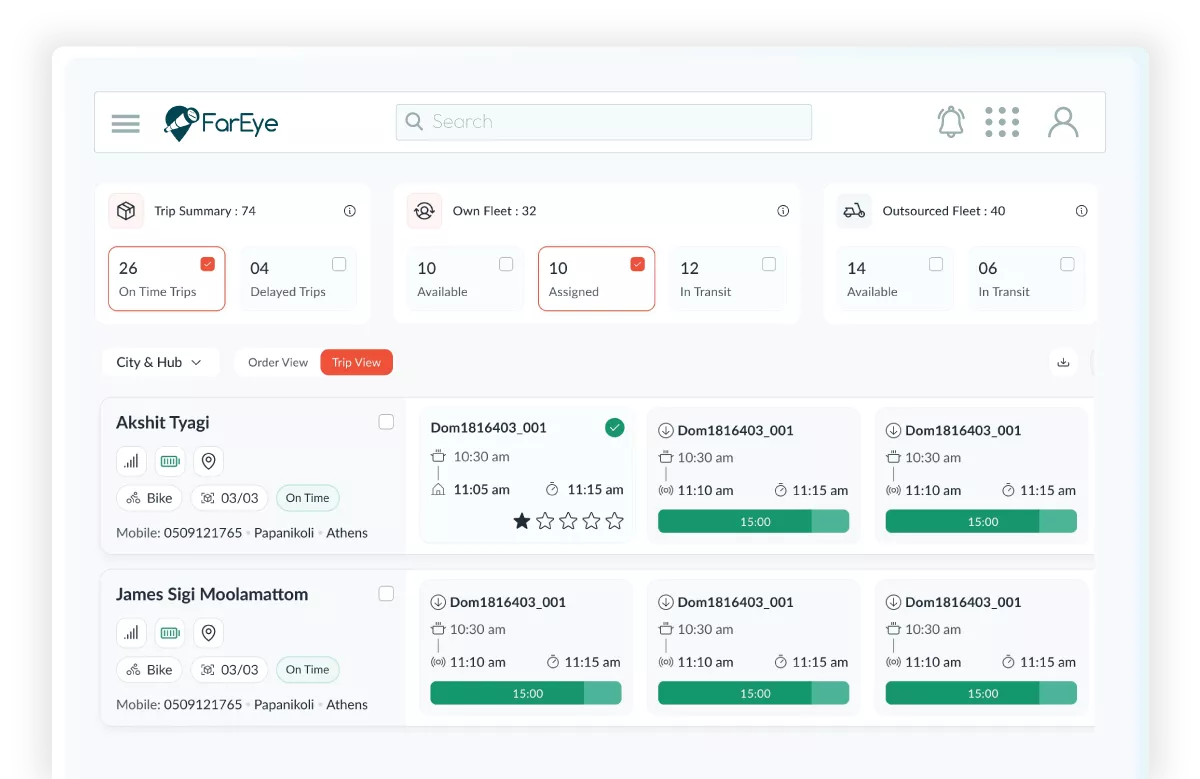
FarEye is more than a standard delivery route optimizer, it is an AI-powered platform uniting planning, dispatch and execution. It integrates directly with your OMS, WMS, ERP and TMS to build a single source of truth.
- AI Based Routing and Constraint Optimization
FarEye models time windows, capacity, service times and traffic to build plans that work in the real world. This precision drives a 16% YoY increase in SPR and a 12% increase in capacity utilization. Our clients have saved over 75M+ kilometers via route optimization, helping drive an 18% reduction in avg. cost per delivery. - Unified Visibility Across Owned, Outsourced and EV Fleets
The platform brings telematics, GPS and partner carrier APIs into one control tower to manage mixed fleets. Built for enterprise scale, the platform supports 550Mn annual deliveries while streamlining operations, resulting in an 80% reduction in manual status update efforts. - Workflow Automation and Exception Handling
Orders flow to dispatch, routes auto-assign and exceptions trigger automated fixes. Automation leads to a 22% Decrease in Dispatch Time. It drives a 6% Increase in On Time In-Full (OTIF) compliant deliveries, with high performers seeing up to a 95% Increase in OTIF Delivery Rate. - Predictive Intelligence and Customer Experience
The system learns from past delays to give customers ETAs they can trust. Reliable timing supports an 18% YoY Increase in first time delivery. Real-time updates mean a 50% reduction in WISMO inquiries/contact per order and a +15-point increase in customer NPS. Better delivery options also contribute to 5% reduced cart abandonment rates. - Sustainability and Green Logistics
FarEye aligns routing with sustainability targets without killing density. Optimization has resulted in 600Mn Miles Saved Annually and 550K+ Metric Tonnes of GHG Emissions Reduced. - Complete Integration Stack With an API First approach
FarEye connects with your ERP and core systems, so data moves freely across your ecosystem. This seamless synchronization removes data silos, allowing dispatchers and support teams to act on a single source of truth without ever switching screens.
Best Practices for Implementing a Delivery Route Optimizer
Success comes from strategic alignment, not just installing software.
- Cleanse Master Data
Accurate geocodes and service times are vital. Scrub data pre-launch so the delivery route optimizer builds plans drivers trust immediately. - Phased Rollout Strategy
Avoid a simultaneous network wide launch. Deploy by depot to refine settings and standardize workflows before scaling further. - Prioritize Change Management
Train teams hands-on. High driver adoption is critical for capturing accurate tracking and Proof-of-Delivery (PoD). - Set KPI Baselines
Record pre-switch metrics. Clear baselines for cost and service are essential to quantify ROI and guide future tuning. - Run Parallel Tests
Operate the software in "shadow mode" alongside manual planning for a week. This exposes configuration gaps without risking live service failures. - Create a Feedback Loop
Drivers know the reality of the road. Enable them to report bad geocodes or tight windows to continuously refine the algorithm's accuracy.
Start Optimizing Your Last Mile Delivery Network Now
Meeting strict SLAs and controlling costs isn't about adding drivers. It is about execution. A robust delivery route optimizer turns chaotic days into predictable operations by balancing real constraints with business goals. By adopting dynamic, AI-driven optimization, logistics leaders can cut cost-to-serve, boost driver productivity and give customers the transparency they expect.
FarEye helps enterprises achieve this scale with a platform that connects planning, dispatch and execution. Don't let inefficient routing hurt your bottom line. Take the next step toward measurable growth. Contact FarEye today to see how our intelligent routing platform can transform your delivery network.
Sources:
https://www.precedenceresearch.com/last-mile-delivery-transportation-market