Table of Contents
- Why Sustainable Delivery Matters in Modern Logistics
- What AI Route Planning Really Means
- The Sustainability Imperative: Why Routing Efficiency Reduces Emissions
- How AI Route Planners Drive Sustainability in Delivery
- Why FarEye AI Route Planner Stands Out in Decision Making
- Practical Steps for Logistics Leaders
- Unlock Sustainable Growth with Smarter Routing Decisions
Let Our Experts Optimize Your Deliveries Today
Let's talkToday’s logistics systems face two relentless pressures: rising delivery costs and the imperative to cut carbon emissions. Fuel prices, customer expectations and tightening sustainability requirements push fleets to rethink how they operate.
Forward thinking logistics leaders do not see sustainability as a checkbox. They see it as a strategic advantage where efficiency and environmental responsibility reinforce each other.
An AI route planner sits at the core of this strategy. It integrates real time data with advanced optimization to craft delivery routes that are efficient, reliable and greener.
Why Sustainable Delivery Matters in Modern Logistics
Transport accounts for a significant share of global emissions. Road freight alone contributes a large portion of those figures, driving the need for smarter delivery practices.
Customers increasingly expect brands to reduce their environmental impact. They prefer partners who can deliver on speed and sustainability without compromise. At the same time, regulators are tightening carbon reporting requirements and sustainability audits.
Beyond environmental duty, inefficiencies in delivery, such as delays, empty miles and poor resource utilization lead to real financial waste and erode margins. Sustainable practices directly address both cost and climate.
What AI Route Planning Really Means
At its core, AI route planning is the intelligent orchestration of delivery routes using advanced machine learning and predictive optimization engines. These systems consider multiple real time and historical inputs, including traffic, weather, vehicle capacity, delivery windows and driver shifts to recommend optimal routing decisions.
Unlike fixed, rule based systems, AI planners continually adapt to changing conditions. They ingest live telematics and sensor data to refine routes, reduce idle time and improve fleet performance.
In simple terms, AI route planning means smart decisions at every step of the delivery journey, not just a one time route calculation.
The Sustainability Imperative: Why Routing Efficiency Reduces Emissions
Empty miles are the distance a vehicle drives without loading waste fuel and increasing emissions. Traffic congestion, detours and poor load planning amplify these inefficiencies.
AI planners reduce these waste factors in measurable ways:
- Smart load consolidation cuts unnecessary trips
- Real time routing avoids congestion and idle time
- Predictive traffic forecasting prevents delays that increase fuel use
Studies show that AI driven route optimization alone can cut fuel consumption and emissions by 15–30%, depending on fleet scale and data infrastructure.
How AI Route Planners Drive Sustainability in Delivery
To reduce emissions and improve delivery performance, smart routing must go beyond distance and time. AI driven systems enhance sustainability by optimizing load, anticipating disruptions and adapting routes in real time.
- Intelligent Load Consolidation and Optimization
AI evaluates delivery volume, vehicle capacity and service windows to allocate jobs efficiently. Optimal load packing reduces empty space and cuts down on extra trips. This means fewer vehicles on the road and lower aggregate emissions. - Predictive Traffic and Travel Time Forecasting
Real time traffic data and historical patterns help AI predict congestion and plan ahead. Avoiding delays means engines spend less time idling and more time moving efficiently, reducing fuel use and emissions. - Dynamic Rerouting for Real World Disruptions
Disruptions such as weather events or traffic incidents happen every day. Traditional routing fails in such conditions. With AI, routes adjust live, minimizing unnecessary detours, reducing fuel waste and keeping deliveries on track. - EV and Green Fleet Enablement
Sustainable fleets increasingly include electric vehicles (EVs). AI route planners now account for EV range limits and charging station availability, helping planners integrate green fleets without operational compromise. This strategic capability ensures green technology is used effectively, not just symbolically.
Why FarEye AI Route Planner Stands Out in Decision Making
FarEye is not simply a routing engine. It is an AI first logistics decision platform that ties advanced routing intelligence to enterprise scale planning, fleet visibility, delivery performance and sustainability outcomes.
Our route planning software generates actionable, executable decisions that drive measurable results across fleets of all types, owned, hybrid, outsourced and green fleets alike.
- AI Routing and Constraint Optimization
FarEye’s AI route planner uses proprietary algorithms to balance time windows, vehicle capacity, driver schedules, traffic patterns and sustainability constraints in real time. This enables intelligent multi stop planning that reduces fuel costs, improves ETA accuracy and increases route compliance across complex delivery networks.
Impact: FarEye’s dynamic routing has helped clients save 75M+ kilometers, cut average delivery costs by 18% and reduce vehicle greenhouse gas emissions by 550,000+ metric tons. - Unified Fleet Visibility Across All Assets
FarEye aggregates telematics, GPS feeds and partner carrier APIs into a single control tower. Dispatchers gain a real time view of all vehicles, whether electric, outsourced or owned, enabling them to assign the right vehicle for the right job instantly. This unified visibility reduces empty miles and supports smarter fleet decisions that balance cost and sustainability. - Workflow Automation and Smart Exception Handling
Orders flow seamlessly into the planning engine, where routes auto assign and exceptions trigger predefined actions. This automation eliminates manual route patches and reduces late deliveries, SLA breaches and fuel waste caused by inefficient dispatching. - Predictive Intelligence and Continuous Improvement
FarEye’s AI learns from historical delays, zone patterns and driver behavior to continuously refine routing accuracy. This predictive capability anticipates potential disruptions, better matches drivers to stops and improves delivery performance over time. - API First Integration Stack
Built with an API first design, FarEye integrates with ERP, OMS, WMS, CRM, telematics systems and IoT sensors. This ensures seamless adoption without ripping out legacy systems. It also means route optimization decisions are embedded directly into existing business workflows, enhancing operational efficiency across systems. - Analytics, Cost Signals and Sustainability Metrics
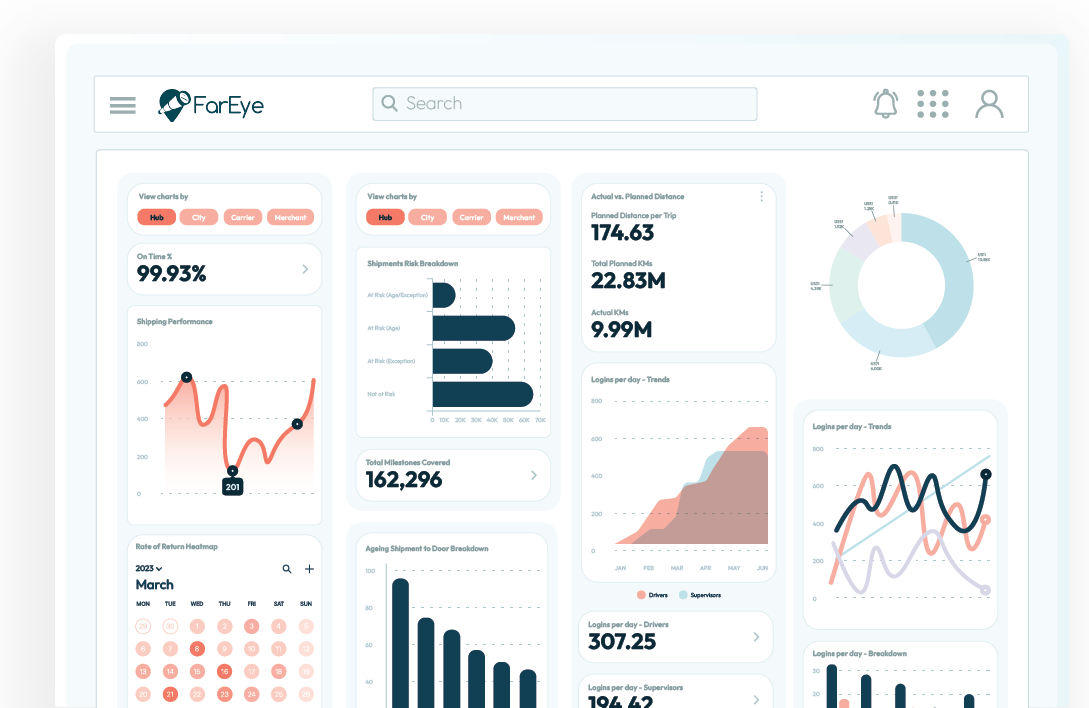
FarEye’s analytics layer tracks operational metrics such as cost per mile, delivery times, carrier performance and constraint adherence. By exposing hidden inefficiencies and cost drivers, it reveals savings opportunities and helps logistics leaders make data driven decisions that support both financial goals and sustainability targets.
Practical Steps for Logistics Leaders
To adopt the AI route planning effectively:
- Evaluate AI Capabilities
Assess how well a system ingests telematics, real time data and business rules. - Integrate with Core Systems
Ensure connectivity with fleet management, order management and customer portals. - Define KPIs
Focus on emissions per delivery, empty miles, fuel consumption and on time rates. - Prepare the Organization
Train staff and support change management for smooth adoption.
These steps help transition from intention to operational reality.
Unlock Sustainable Growth with Smarter Routing Decisions
Sustainable delivery is more than a goal; it’s a strategic advantage that drives growth, profitability and long term resilience. An AI route planner empowers logistics operations to cut fuel consumption, reduce carbon emissions and improve delivery reliability without compromising efficiency.
FarEye’s route optimization software combines real time data, AI enhanced analytics and integrated workflows to help businesses make smarter decisions that align with both environmental objectives and operational goals.
Take the next step. Explore FarEye’s advanced route planning platform to elevate delivery performance and meet your sustainability targets with confidence.