Table of Contents
- What is Route Mapping Software and How Has AI Changed it
- How AI-powered Route Mapping Software Learns From Data
- The Business Impact of Self-improving Route Mapping Systems
- How FarEye Delivers AI-driven Route Mapping Software at Enterprise Scale
- Implementation Best Practices for Learning Route Mapping Software Systems
- Deploy FarEye's Route Mapping Software That Grows Smarter With Every Delivery
Let Our Experts Optimize Your Deliveries Today
Let's talkKey Takeaways
- The Learning Revolution in Route Mapping Traditional route planning wastes operational intelligence. Modern route mapping software transforms past performance into predictive optimization through machine learning, turning every delivery into training data.
- From Fixed Rules to Adaptive Intelligence Legacy systems apply fixed parameters. AI-native platforms continuously refine recommendations based on feedback. This shift from GPS sequencing to predictive optimization compounds advantages over time.
- Four Learning Layers Historical performance becomes training data. Real-time traffic enables dynamic re-routing. Driver patterns inform intelligent pairing. Customer preferences improve accuracy. Systems grow more efficient with every delivery.
- FarEye’s Enterprise Grade Route Mapping Software Self-learning algorithms save 20% on miles and create routes 90% faster. Carrier management cuts costs 15%. 12-month forecasting with 90% less planning time. Real-time scheduling delivers 2X the number of stops per hour. Execution adds 15% driver stops, cuts firefighting 60%. WISMO calls drop 67%, missed deliveries 25%. 61+ metrics drive a 60% reduction in SLA breaches.
- Implementation Essentials Feed clean historical data. Define aligned success metrics. Enable real-time feeds. Review outcomes quarterly. Route planning software tuning maintains strategic alignment.
Traditional route planning treats every day as a blank slate, ignoring the operational intelligence hidden in completed deliveries. Modern route mapping software changes this paradigm entirely.
By applying machine learning and AI to historical route data, traffic patterns, and delivery outcomes, these systems transform past performance into future optimization. For logistics teams managing complex networks, the shift from traditional to adaptive routing represents a fundamental competitive advantage.
Every stop, every delay, and every successful delivery becomes training data for smarter decisions tomorrow. The teams capturing this advantage aren't working harder. They're deploying systems that learn.
Let's explore how AI-driven route mapping turns operational history into predictive intelligence and how FarEye enables logistics leaders to gain command of their network performance.
What is Route Mapping Software and How Has AI Changed it
Route mapping software comprises digital platforms that sequence delivery stops, calculate optimal routes, and guide drivers from origin to destination. Legacy systems operated as fixed-rule engines, applying fixed parameters regardless of changing conditions. AI-native platforms function as adaptive learning systems, continuously refining recommendations based on operational feedback.
This evolution from basic GPS sequencing to predictive optimization marks a generational shift in logistics technology. Operations leaders evaluating technology investments must distinguish between systems that maintain historical patterns and those that improve upon them. The operational and financial implications of this distinction compound significantly over time.
How AI-powered Route Mapping Software Learns From Data
The learning loop in modern route mapping software operates across three interconnected stages: data capture, pattern recognition, and predictive application.
- Historical Route Performance Becomes Training Data
Completed routes feed algorithms with actual versus planned time, distance, and success rates. Outliers, including delays, failed attempts, and customer unavailability, receive weighted emphasis for pattern detection. Seasonal, weekly, and daily patterns emerge from aggregated historical data, enabling predictive models to anticipate recurring conditions. - Real-time Traffic and Environmental Integration
Live traffic, weather, construction, and event data feed dynamic re-routing decisions. Machine learning models predict congestion before it forms based on historical correlation. Route mapping software adjusts dispatch recommendations minute-by-minute, maintaining optimization as conditions evolve. - Driver Behavior and Skill Pattern Recognition
Individual driver performance profiles encompassing speed, accuracy, and customer interaction quality inform future assignments. Skill-based mapping matches driver competencies to delivery type requirements. The route mapping system learns which drivers excel at specific route characteristics or customer segments, improving outcomes through intelligent pairing. - Customer Preference and Delivery Outcome Learning
Time-window preferences, access instructions, and successful delivery conditions are incorporated into predictive models. Failed-attempt root causes are analyzed and predicted to enable future avoidance. Predictive ETA accuracy improves with customer-specific historical data, reducing uncertainty and service failures.
These learning layers compound. The result is route mapping software that grows more accurate and efficient with every delivery completed, not more outdated.
The Business Impact of Self-improving Route Mapping Systems
Learning systems deliver measurable operational advantages that legacy routing cannot match. Smart teams quantify these gains across four dimensions.
- Continuous Efficiency Gains Without Manual Reconfiguration
Traditional systems require analyst intervention to update rules or parameters. AI-driven route mapping software self-tunes based on performance feedback. Efficiency improvements compound quarter-over-quarter without additional labor input or system downtime. - Predictive Accuracy That Reduces Exception Management
Anticipated delays trigger proactive customer communication before complaints form. Predicted ETAs align with actual arrival times, reducing WISMO volume and contact center load. Exception workflows are triggered by data signals rather than customer calls, shifting operations from reactive to proactive. - Scalable Optimization Across Network Complexity
Learning systems handle increasing numbers of stops, carrier types, and constraint layers without performance degradation. Route optimization software scales intelligence alongside operational growth, maintaining optimization quality as complexity expands. This capability ensures that operational expansion does not dilute performance standards. - Knowledge Retention Despite Workforce Turnover
Institutional route knowledge is captured in route mapping algorithms rather than in individual dispatchers. New team members leverage accumulated intelligence from day one. Continuous improvement persists regardless of personnel changes, protecting organizational learning from attrition.
The competitive moat widens over time. Teams with learning systems compound advantages while competitors struggle to maintain static performance levels.
How FarEye Delivers AI-driven Route Mapping Software at Enterprise Scale
FarEye connects adaptive intelligence, operational control, and enterprise scalability in a unified platform that improves with every delivery.
- Self-learning Route Mapping and Optimization
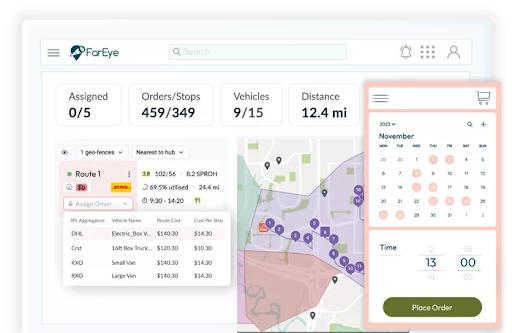
FarEye's route mapping algorithms automatically learn and optimize complex, recurring delivery decisions. Pattern recognition across millions of stops continuously refines recommendations.
Dynamic sequencing minimizes total miles, maximizes vehicle utilization, and reduces fuel spend. Enterprises save up to 20% on miles driven, create optimized routes 90% faster with 1M+ stops processed in under 15 minutes, and achieve up to 20% improvement in capacity utilization. - Intelligent Carrier Management
Real-time rate comparison across carrier contracts ensures optimal allocation. Automated rate shopping and carrier leaderboards eliminate manual selection bias. Dispatchers spend 80% less time responding to carrier Request for Proposals (RFPs). Enterprises achieve up to 15% reduction in delivery costs through intelligent multi-carrier orchestration. - 12-month Capacity Forecasting
FarEye PLAN enables forecasting up to 12 months in advance while reducing time spent on fleet sizing, cost modeling, and territory planning by 90%. What-if simulations at scale support strategic decision-making. This Final Mile Digital Twin capability ties capacity planning directly to operational execution. - Effortless Real-time Scheduling
AI-managed slot availability based on demand and fleet capacity enables dynamic scheduling. Urgent HOT orders fit into schedules with minimal disruption. Fleet Managers achieve 2X improvement in stops per hour while reducing delivery cost. - Seamless AI-powered Route Mapping Execution
Pre-sort and pre-load orders by SLA, vehicle, and zone before dispatch. Load-out time cuts by 25% or more. An AI-powered control tower generates real-time insights into delays, detours, and prolonged halts.
Drivers complete 15% more stops per day with 50% fewer navigation errors. Control tower agents spend 60% less time firefighting by proactively resolving issues before SLAs break. - Exceptional Consumer Experience
Proactive communication cuts WISMO calls by up to 67%. Consumers self-serve up to 70% of routine inquiries, freeing support teams to focus on complex cases. Perfectly timed, personalized notifications reduce missed deliveries by up to 25%. Customer Service teams see 50% fewer tickets, faster resolution, and higher CSAT scores. - Business Intelligence and Continuous Improvement
FarEye tracks 61+ business metrics with drill-down capabilities to isolate areas for improvement. Month-on-month and year-on-year monitoring supports carrier governance and strategic planning. CXOs achieve 60% reduction in SLA breaches with real-time reassignments and less time spent firefighting.
Implementation Best Practices for Learning Route Mapping Software Systems
Deploying AI-driven route mapping software requires thoughtful integration to capture learning benefits from day one.
- Feed Clean Historical Data to Accelerate Initial Learning
Audit past route data for accuracy before platform migration. Garbage in, garbage out: learning speed depends on data quality. Complete historical records enable faster algorithmic training and earlier optimization returns. - Define Success Metrics That Align With Learning Objectives
Cost per stop, first-attempt rate, on-time performance, and customer satisfaction establish clear targets. Defined metrics enable algorithm optimization toward business priorities rather than generic efficiency. - Enable Real-time Data Feeds for Dynamic Adaptation
Traffic, weather, vehicle location, and customer communication systems require integration. Learning requires current inputs, not merely historical analysis. Real-time connectivity maximizes adaptive potential. - Review and Refine Learning Outcomes Quarterly
Algorithm recommendations versus actual outcomes require systematic analysis. Human oversight ensures learning aligns with strategic objectives. Route planning software tuning informed by operational feedback maintains alignment between system optimization and business goals. Regular refinement ensures that learning systems continue to deliver superior performance as operational conditions evolve.
Deploy FarEye's Route Mapping Software That Grows Smarter With Every Delivery
The logistics operations winning tomorrow are not those with the most experienced dispatchers or the largest fleets. They are the teams deploying systems that compound intelligence with every completed route.
Legacy planning cannot compete with learning. Manual optimization cannot scale with complexity. The gap between teams using adaptive route mapping software and those relying on legacy systems widens daily.
Cost advantages compound. Service levels improve. Operational resilience deepens. For leaders ready to transform route performance from repetitive effort into self-improving capability, FarEye provides the clear choice.
Evaluate route mapping software that learns, adapts, and delivers superior outcomes automatically. FarEye enables exactly that transformation. Book a Route Optimization Assessment today and discover how AI-driven mapping elevates your network performance from the first delivery forward.