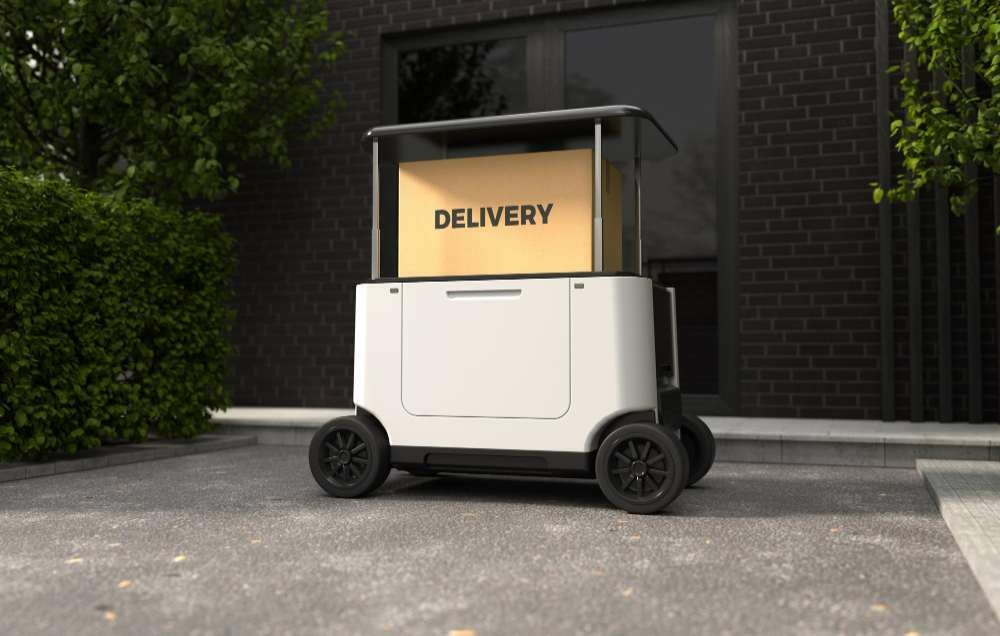
- EVs cut energy and maintenance costs per stop versus diesel on dense urban routes
- Zero-emission access to low-emission zones and delivery curfews adds route options
- Regenerative braking recovers energy at frequent stops, extending effective range
- Battery range, payload, charging time, and temperature become hard routing constraints
- Distance-based planning tools fail because EVs need energy modeled, not just miles
- Charging must sit inside the route plan as scheduled dwell time
- Mixed electric-combustion fleets need one allocation model, not two separate plans
- Agentic AI reassigns orders and books charging slots before shifts strand
- FarEye reports 75M+ km saved, 18% lower cost per delivery, 6% higher OTIF
- Market growth (18.6% CAGR to 2034) doesn't guarantee ROI without planning discipline
Electric vehicles for last mile delivery now anchor most enterprise sustainability roadmaps, with investment accelerating across global markets. According to Fortune Business Insights, the electric last-mile delivery vehicles market is projected to grow to USD 118.43 billion by 2034, at an 18.6% CAGR.
Yet many deployments still underdeliver against these promised returns, since vehicles are rarely the only challenge. Efficiency depends on planning systems that treat range, charging, payload, and vehicle capacity as routing constraints, not afterthoughts.
These vehicles cut energy costs and tailpipe emissions, but introduce limits conventional planning tools were never built to model. Let's explore where the efficiency gains come from, where electric fleets break down, and which planning capabilities protect returns as deployment scales.
What are Electric Vehicles for Last Mile Delivery?
Electric vehicles for last mile delivery are battery-powered vans, trucks, and two-wheelers that move shipments from a hub to the end customer. They replace combustion fleets across urban and suburban routes, where frequent stops, short legs, and low average speeds favor electric drivetrains. Range, charging access, and payload become routing constraints rather than afterthoughts.
- Built for dense, short-leg duty cycles. Urban routes with many stops suit battery range profiles better than long-haul linehaul work.
- Operated across mixed fleets. Most enterprises run electric and combustion vehicles together during a multi-year transition period.
- Deployed across verticals. E-commerce, grocery, retail, and pharmaceutical networks electrify urban routes first.
- Lower energy and maintenance cost per stop. Electricity costs less per mile than diesel, and electric drivetrains carry fewer serviceable parts.
- Access to restricted urban zones. Low-emission zones and delivery curfews increasingly favor or require zero-emission vehicles.
- Measurable emissions reduction. Route-level energy data feeds directly into sustainability reporting and customer-facing commitments.
Section Takeaway: An electric van is not a drop-in replacement. It is a vehicle with a different constraint set your planning system must understand. The vehicle delivers the savings, but the routing system decides whether you actually capture them.
How do Electric Vehicles for Last Mile Delivery Improve Efficiency?
Efficiency gains from EVs in last mile delivery appear across cost, service, and compliance rather than fuel alone.
| Efficiency Area | What Changes With an Electric Fleet |
|---|---|
| Energy Cost Per Stop | Electricity per mile runs well below diesel across dense urban routes |
| Maintenance Downtime | Fewer moving parts reduce servicing frequency and unplanned vehicle outages |
| Urban Route Access | Zero-emission vehicles enter restricted zones that conventional fleets cannot |
| Stop Density | Compact electric vans and two-wheelers handle narrow streets and tight parking |
| Driver Experience | Quieter cabins and simpler controls reduce fatigue across long shifts |
| Regenerative Braking | Frequent stops recover energy instead of wasting it as heat, improving effective range |
| Sustainability Reporting | Per-route energy data supports verifiable emissions claims to customers |
| Brand Positioning | Green delivery windows let customers choose lower-impact slots at checkout |
| Maintenance Load | Fewer moving parts reduce servicing downtime and keep more vehicles available daily |
| Idling Waste | Electric drivetrains consume almost nothing while stationary at stops or in traffic |
| Urban Access | Low-emission zones and delivery curfews stay open to compliant electric fleets |
| Emissions Reporting | Cleaner routes support corporate sustainability targets with auditable delivery data |
| Driver Experience | Quieter, smoother vehicles reduce fatigue across long multi-stop shifts |
Operational Insight: The duty cycle doing the most damage to a diesel van is the same cycle where an electric van performs best.
Key Insight: Green delivery windows convert a sustainability investment into a consolidation tool that also lifts vehicle utilization.
What Constraints do Electric Fleets Introduce Into Last Mile Delivery Planning?
EVs in last mile delivery fail when planners treat battery vehicles exactly like combustion vehicles.
- Range ceilings cap route length. A route that works for a diesel van may exceed battery range by mid-afternoon.
- Payload reduces effective range. Heavier loads drain batteries faster, so capacity and range interact on every stop.
- Charging time becomes route time. Idling at a charger must sit inside the plan, not outside it.
- Charger availability varies. Depot, public, and partner charging points differ in speed, access, and reliability.
- Terrain and temperature shift consumption. Gradients, heat, and cold change range in ways distance alone never predicts.
- Traffic affects batteries differently. Congestion drains combustion fuel faster but can preserve electric range through regeneration.
- Mixed fleets complicate allocation. Assigning the right order to an electric or combustion vehicle requires both profiles in one model.
Planning Reality: Range anxiety is a planning failure, not a driver failure. Model energy as a constraint and it disappears.
A leading logistics company in Thailand cut the vehicles needed for the same workload from 300 to 130 using FarEye Route. A smaller fleet makes any electrification program materially cheaper to fund. Check out the Full Case Study.
Why Does EV Routing Differ From Conventional Route Planning?
A last mile electric vehicle operates under constraints that distance-based planning never considered.
- Range is finite and variable. Battery capacity caps route length, and actual range shifts with conditions throughout the shift.
- Payload drains the battery. Heavier loads consume more energy, so early-route stops affect late-route feasibility.
- Terrain and traffic change consumption. Gradients, stop-start congestion, and climate control all reduce effective range.
- Charging is a planned stop. Charger location, connector type, and dwell time belong inside the route, not after it.
- Temperature affects performance. Cold weather measurably reduces battery output across winter delivery cycles.
- Mixed fleets need one plan. Electric and conventional vehicles must be sequenced together, not planned separately.
Operational Insight: EV routing is an energy problem disguised as a distance problem. Plan kilowatt-hours, not just kilometers.
How Does Route Planning Software Solve EV Range and Charging Constraints?
Purpose-built route planning software converts each electric constraint into a modeled input before dispatch.
| Constraint | How the Platform Resolves it |
|---|---|
| Battery Range Limits | Precise range prediction factors payload, terrain, traffic, and delivery area into every route |
| Charging Dependency | Routes map available charging stations and schedule idling time to protect fleet utilization |
| ETA Reliability | Traffic-aware and terrain-aware models produce near-perfect ETAs across electric routes |
| Mid-shift Disruption | Dynamic routing recalculates affected stops when traffic, orders, or charge levels change |
| Mixed-fleet Allocation | One model assigns orders across electric, combustion, outsourced, and gig vehicles |
| Territory Imbalance | Territory planning sizes service areas so electric routes stay within range |
| Emissions Evidence | Last mile delivery analytics compares planned and actual distance for sustainability reporting |
Strong route optimization software then tests alternative sequences against cost, service commitments, and remaining charge together.
Technology Lens: Mapping chargers is table stakes. Predicting the charge each route will actually consume is the differentiator.
How Does Agentic AI Strengthen EV Fleet Dispatch?
Agentic AI moves beyond recommendation and executes approved dispatch actions across your electric operation.
- Monitors charge and route risk together. Agents flag routes trending toward insufficient charge before drivers strand mid-shift.
- Reassigns orders between fleets. Work shifts from electric to combustion vehicles automatically when range becomes the binding constraint.
- Schedules charging windows. Agents book depot or partner charging slots around committed delivery windows.
- Handles exception recovery. Failed attempts, cancellations, and urgent orders trigger resequencing without manual dispatcher intervention.
- Escalates judgment calls. Higher-risk decisions stay under authorized human review through governed approval workflows.
Agentic AI Analysis: Conventional AI tells a dispatcher a route will run short on charge. Agentic dispatch fixes the route and reports what changed.
What Should Enterprises Look for in Electric Last Mile Delivery Solutions for Businesses?
Evaluate electric last mile delivery solutions for businesses against your transition plan, not a feature list.
| Criterion | What to Verify in a Demo | Why it Matters at Enterprise Scale |
|---|---|---|
| Range Modeling Depth | Payload, terrain, temperature, and traffic effects on consumption | Distance-only range estimates fail on loaded urban routes |
| Charging Intelligence | Station mapping, idling time planning, depot and public charger support | Unplanned charging stops destroy utilization and ETA accuracy |
| Mixed-Fleet Support | Electric, combustion, outsourced, gig, and hybrid models in one plan | Full electrification takes years, so both fleets must coexist |
| Dynamic Re-Optimization | Resequencing and reassignment after dispatch, including charge-aware logic | Static plans lose validity hours after vehicles leave the depot |
| Compliance Handling | Low-emission zones, delivery curfews, and vehicle access restrictions | Urban rules decide which routes are legal before they are efficient |
| Visibility | Last mile delivery tracking software with predictive ETAs and exception alerts | Teams cannot protect promises they cannot see slipping |
| Integrations | TMS, OMS, WMS, CRM, telematics, and carrier management connectivity | Fragmented data weakens every energy and routing calculation |
| Sustainability Reporting | Distance saved, empty miles, and emissions per delivery | Sustainability targets need auditable operational evidence |
Buyer's Lens: Ask any vendor to route your densest real territory on a loaded electric van. Demo routes hide range failures.
Interested in what customer-selected slots do for efficiency? A leading furniture retailer recorded a 97% increase in ETA accuracy and 24% more on-time deliveries with FarEye. Green delivery windows build on exactly this capability. Take a Look at the Story.
How Does FarEye Support Electric Vehicles for Last Mile Delivery?
FarEye ranks #1 in Last Mile Delivery in the G2 2026 Best Software Awards, rated 4.7/5 across 344 verified enterprise reviews. FarEye also appears in the Gartner Market Guide for Multicarrier Parcel Management Solutions and holds a 4.6 rating on Capterra.
FarEye EV routing plans routes around charging station availability, vehicle range, and delivery area together. Precise range prediction and traffic-aware ETAs reduce missed deliveries across last mile electric vehicle fleets. Planned idling time at chargers protects utilization instead of leaving charge stops unmanaged.
The wider platform supports last mile delivery via EVs end-to-end:
- PLAN forecasts demand, territory size, and fleet capacity up to twelve months ahead. Planners spend 90% less time forecasting fleet size and cost.
- Route builds constraint-aware routes across parcel, hyperlocal, and scheduled big and bulky operations, generating routes 90% faster with 1 million-plus stops in under 15 minutes.
- Track consolidates multimodal visibility and last mile carrier tracking across road, rail, air, and sea.
- Experience delivers live tracking, proactive notifications, and controlled rescheduling that lift NPS and CSAT.
- Analyze compares planned and actual outcomes across 61-plus business metrics.
- PILOT runs eleven specialized agents handling more than 200 daily decisions. It compresses roughly ten dispatcher hours into sixty minutes of supervised oversight.
Verified platform outcomes include more than 75 million kilometers saved, an 18% reduction in average cost per delivery, a 6% increase in OTIF-compliant deliveries, and more than 550,000 metric tonnes of greenhouse gas emissions reduced. Customers also report up to 20% fewer miles driven, 2X stops per hour, and up to 67% fewer WISMO contacts.
A plug-and-play routing API lets your OMS or TMS request optimized routes directly. Ongoing platform enhancements extend these capabilities each release cycle.
Platform Note: Emissions reduction becomes credible only when distance saved is measured against the plan, not estimated afterward.
Want evidence at grocery scale? Super Indo executed more than 100,000 routes and saved 10,000 planning hours with FarEye auto-routing, alongside a 12% truck fill rate increase. Better fill rates mean fewer vehicles and fewer miles. Give it a Read.
What are the Implementation Best Practices for Using EVs in Last Mile Delivery?
Electrification succeeds operationally when routing, data, and charging infrastructure are sequenced deliberately.
- Baseline before you electrify. Capture current cost per delivery, miles per route, and utilization for honest comparison later.
- Match routes to range, not the reverse. Identify which existing territories already fit electric range before buying vehicles.
- Plan charging infrastructure alongside vehicles. Depot charger capacity determines how many electric vehicles you can actually dispatch daily.
- Integrate telematics from day one. Live state-of-charge data turns estimated consumption into measured consumption quickly.
- Pilot one depot through a full season. Summer range rarely predicts winter performance in northern networks.
- Train dispatchers on energy constraints. Teams accustomed to diesel planning will under-load electric routes without guidance.
- Review planned versus actual weekly. Feed deviations back into range models, territory rules, and charging schedules.
Rollout Insight: Treat the first quarter as calibration. Early range overrides reveal which vehicle assumptions were set too optimistically.
Build Your Electrification Program on Routing That Understands Energy
Electric fleets reward operations that plan around energy, charge, and access rather than distance alone. The efficiency is real, but it is unlocked by routing intelligence rather than by the vehicle purchase itself. Accurate range prediction, charger-aware sequencing, mixed-fleet allocation, and agentic dispatch turn electrification into measurable savings.
FarEye supports high-volume enterprises across planning, EV routing, execution, visibility, analytics, and automated dispatch. Book a meeting with FarEye to cut cost per delivery, reduce emissions, and protect every delivery promise your electric fleet makes.
Book a Meeting With FarEye →Frequently Asked Questions
What is EV last mile delivery?
EV last mile delivery uses battery-electric vans, trucks, or two-wheelers to move goods from local hubs to customers during the final delivery stage.
What are the benefits of using electric vehicles for last mile delivery?
Electric last mile vehicles can lower energy and maintenance costs, perform efficiently in stop-and-go service, reduce tailpipe emissions, and support quieter urban deliveries.
What are the main advantages of electric vans over diesel vans?
Electric vans offer lower maintenance needs, efficient stop-and-go operation, regenerative braking, reduced tailpipe emissions, and more predictable energy costs than diesel vans.
Which companies are leading in EV last mile delivery?
Amazon and FedEx are notable large-scale adopters: Amazon reports 40,000+ electric vans, while FedEx reported nearly 9,500 on- and off-road EVs.
Is electric last mile delivery cheaper than diesel?
Often operationally, yes: DOE reports light-duty EV operation and maintenance averaging 6.1 cents per mile, but total cost depends on purchase and charging.
How do electric last mile delivery companies ensure timely deliveries?
Operators combine range-aware routing, charging schedules, state-of-charge monitoring, depot planning, and reserve capacity to keep electric delivery vehicles aligned with service windows.
What is the range of electric delivery vans?
Range varies by model; DOE lists the Rivian Delivery 500 at 161 miles and the Ram ProMaster EV at 180 miles per charge.
What are the biggest challenges of adopting EVs for last mile delivery?
Major challenges include higher upfront costs, charging infrastructure, range limitations, charging downtime, payload effects, grid capacity, and matching vehicles to suitable routes.
Are there tax incentives for electric last mile delivery vehicles?
In the U.S., federal 45W credits ended for vehicles acquired after September 30, 2025, though state, local, and utility incentives still vary.
How does route optimization software help electric last mile fleets?
Route optimization software matches routes to battery range, charging needs, payload, traffic, and delivery windows, helping EV fleets reduce energy use and downtime.
Reference: Fortune Business Insights. "Electric Last-Mile Delivery Vehicles Market Size, Share & Industry Analysis, 2026–2034." Last updated September 14, 2026. Figures are subject to change — verify current numbers before publishing updates.