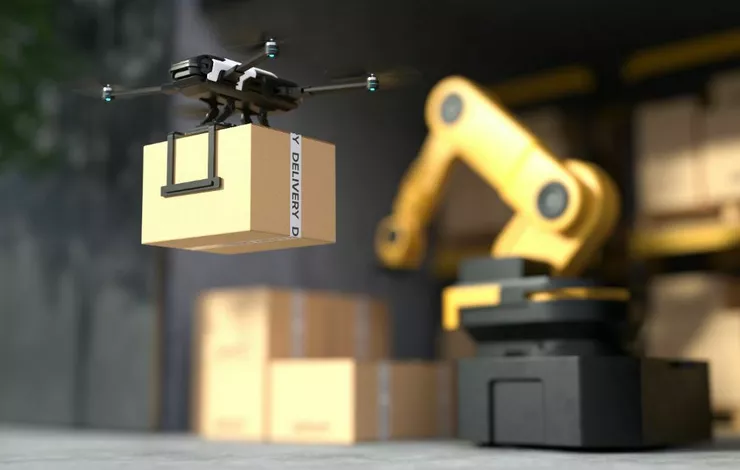
- AI learns from operational data to predict outcomes, adjust plans during execution, and automate dispatcher decisions.
- Deloitte's 2026 outlook shows 30% of retailers use AI for supply chain visibility, with 41% planning adoption soon.
- Self-learning algorithms refine service times, travel predictions, and risk scoring using completed-route data every cycle.
- Value concentrates in high-frequency decisions: capacity planning, route generation, dispatch, EV routing, and tracking.
- Agentic AI executes approved actions autonomously, escalating higher-risk decisions to human review under governance.
- Enterprise buyers should verify model transparency, learning mechanisms, constraint depth, and integration depth before purchase.
- FarEye ranks #1 in G2's 2026 Last Mile Delivery category, delivering measurable cost and OTIF gains.
- Successful rollout requires clean data, phased piloting, and weekly review of planned-versus-actual performance.
Your customers now judge your brand on what happens after checkout. Meanwhile, order volumes rise, delivery windows narrow, and driver availability stays unpredictable. Traditional rules-based systems cannot absorb that variability across high-volume, multi-hub delivery networks.
AI is increasingly becoming part of the response. Deloitte's 2026 retail outlook found that 30% of surveyed retailers currently use AI for supply chain visibility, while 41% expect to adopt it within the next year.
The role of AI in last mile delivery is to learn from operational data, predict outcomes, adjust plans during execution, and automate decisions that dispatchers once handled manually. Let's learn how the technology works, where it creates measurable value, and how to evaluate it.
What is AI in Last Mile Delivery?
AI in last mile delivery refers to machine learning systems that predict, plan, and adjust final-mile delivery decisions automatically. These systems learn service times, travel patterns, and failure risk from historical delivery data. They then apply that learning to routing, ETA prediction, exception handling, and customer communication.
- Predictive models forecast travel time, stop duration, and delivery risk before vehicles leave your hub.
- Optimization engines evaluate millions of route combinations against capacity, windows, and cost constraints.
- Self-learning algorithms compare planned versus actual outcomes, then correct their own assumptions each cycle.
- Agentic systems execute approved operational actions without waiting for a dispatcher to intervene.
Section Takeaway: AI does not replace your planning logic. It replaces the fixed assumptions that make planning logic wrong by midday.
Why is AI in Last Mile Delivery Becoming Essential?
Last mile economics have shifted faster than most planning systems were designed to handle.
| Operating Pressure | Why Rules-based Systems Struggle |
|---|---|
| Same-day and Slot-based Expectations | Fixed schedules cannot resequence stops once a window is threatened |
| Mixed and Electric Fleets | Fixed rules ignore battery range, payload effect, and charging time |
| Driver Shortages and Turnover | Manual balancing creates unrealistic workloads that accelerate attrition |
| Urban Congestion and Access Rules | Historical averages misprice travel time across changing city conditions |
| Rising Cost Per Delivery | Distance-only logic overlooks capacity, carrier rates, and failed attempts |
| Sustainability Reporting | Teams cannot evidence emissions reduction without planned-versus-actual data |
Market Reality: Variability is the real cost driver. Systems that cannot learn from variability will keep repeating the same expensive mistakes.
How do Self-Learning Algorithms Improve Delivery Performance?
Self-learning algorithms close the gap between what planners assume and what drivers actually encounter.
- They learn true service times. Parking difficulty, building access, assembly, and customer handoff vary widely by location and order type.
- They refine travel-time prediction. Models absorb traffic patterns, terrain, and seasonal behavior rather than relying on fixed averages.
- They score delivery risk early. Address quality, customer history, and route position signal which stops are likely to fail.
- They improve capacity assumptions. Completed routes reveal where territories were oversized, undersized, or unevenly loaded.
- They sharpen ETA accuracy. Better inputs produce predictive ETAs that hold through execution, protecting NPS and CSAT.
The compounding effect matters most. Each delivery cycle makes the next plan more executable, which is what separates AI in last mile delivery from basic automation.
Learning Loop Insight: A model that never sees actual outcomes cannot learn. Feed completed-route data back, or the intelligence stalls.
Amway connected multiple third-party logistics providers through FarEye and reached 100% ETA accuracy for customer order tracking, alongside improved NPS and CSAT scores. Check out the Full Case Study.
Where Does AI Deliver the Most Value Across the Last Mile?
Value concentrates in decisions that repeat thousands of times daily and change constantly.
| Delivery Stage | What AI Contributes |
|---|---|
| Capacity Planning | Demand forecasting, territory sizing, and fleet requirements modeled months ahead |
| Route Generation | Constraint-aware sequencing through route planning software across stops, vehicles, and depots |
| Dispatch | Dynamic routing that recalculates affected stops after disruption, protecting nearby commitments |
| Electric Fleet Routing | EV routing with range prediction, charging-station mapping, and traffic-aware ETAs |
| Execution Visibility | Last mile delivery tracking software that flags ETA drift, long halts, and missed stops |
| Customer Experience | Proactive notifications, green delivery windows, and controlled rescheduling |
| Carrier Management | Last mile carrier tracking and performance scoring across multi-carrier networks |
| Performance Improvement | Last mile delivery analytics comparing planned versus actual cost, time, and utilization |
Operational Insight: Target the decisions that repeat most often. One percent gained on a daily decision beats ten percent on a quarterly one.
Asia Pacific's leading healthcare provider increased vehicle capacity utilization by 30% with FarEye, alongside a 15% gain in on-time performance. Take a Look at the Story.
What is Agentic AI in Last Mile Delivery and How Does it Change Dispatch?
Agentic AI marks the shift from systems that advise to systems that act under governance.
- Conventional AI recommends. It surfaces the next best action and waits for a dispatcher to approve and execute it.
- Agentic AI executes. Approved agents validate orders, correct addresses, schedule appointments, and contact drivers autonomously.
- Exceptions escalate upward. Higher-risk decisions route to authorized human review instead of running unattended.
- Workflows stay connected. Agents coordinate across planning, execution, recovery, proof auditing, and carrier invoice reconciliation.
- Oversight remains auditable. Permissions, approval workflows, and audit trails record every automated decision.
Automation Analysis: Autonomy without governance is a liability. Demand human-in-the-loop controls before you expand agent authority.
What Should Enterprises Look for in AI-powered Last Mile Technology?
Evaluate vendors on evidence rather than demonstrations built around ideal conditions.
| Criterion | What to Verify | Why it Matters |
|---|---|---|
| Model Transparency | Can the system explain why a route or ETA was produced? | Unexplainable decisions stall dispatcher adoption and audit requirements |
| Learning Mechanism | Does completed-route data measurably improve plans? | Fixed models marketed as AI degrade as your network changes |
| Constraint Depth | Capacity, windows, driver hours, skills, EV range, access rules | Shallow constraints generate routes drivers cannot physically execute |
| Dynamic Re-optimization | Order insertion and driver reassignment after dispatch | Morning plans lose accuracy within hours of leaving the depot |
| Fleet Flexibility | Owned, outsourced, gig, parcel, truck, and hybrid models | Peak demand rarely fits internal capacity alone |
| Integrations | TMS, OMS, WMS, CRM, telematics, carrier, and billing systems | Disconnected data silently degrades every model's accuracy |
| Scale Testing | Peak-season volumes across multiple hubs and territories | A small pilot route proves nothing about November performance |
| Governance | Permissions, approvals, audit trails, human review of agent actions | Automated decisions require accountability at enterprise scale |
Buyer's Lens: Ask for planned-versus-actual data from a comparable deployment. Vendors with real learning loops can produce it quickly.
How Does FarEye Apply AI in Last Mile Delivery?
FarEye ranks #1 in Last Mile Delivery in the G2 2026 Best Software Awards, rated 4.7/5 across 344 verified enterprise reviews. FarEye also appears in the Gartner Market Guide for Multicarrier Parcel Management Solutions and holds a 4.6 rating on Capterra.
- PLAN forecasts demand, territory size, and fleet capacity up to twelve months ahead. Planners spend 90% less time forecasting fleet size and cost.
- Route generates optimized routes 90% faster, handling more than 1 million stops in under 15 minutes.
- Smart Service Time learns stop durations from historical deliveries, supporting a 12.5% increase in stops per hour and 44% lower route deviation.
- Track consolidates multimodal visibility with predictive ETAs and control-tower exception monitoring.
- Experience reduces WISMO contacts by up to 67% and lifts NPS by 15 points through proactive communication.
- Analyze compares planned and actual outcomes across 61-plus business metrics.
- PILOT runs agentic dispatch through eleven specialized agents, handling 200-plus daily decisions. It compresses roughly ten dispatcher hours into sixty minutes of supervised oversight.
Aggregate platform results include more than 75 million kilometers saved, an 18% reduction in average cost per delivery, a 6% increase in OTIF-compliant deliveries, and more than 550,000 metric tonnes of GHG emissions reduced.
Enterprises also report a 22% year-over-year decrease in dispatch time and an 18% increase in first-time delivery. Ongoing platform enhancements extend these capabilities each release cycle, and route optimization software connects natively with your TMS, OMS, and WMS.
Platform Note: These figures reflect specific deployments. Your results depend on network design, delivery density, data quality, and implementation scope.
Blue Dart used FarEye Route, Track, and Experience to improve delivery operations, achieving a 22% increase in first-attempt deliveries and full visibility of ground activities. Give it a Read.
How to Use AI in Last Mile Delivery Effectively?
Rollout discipline determines whether your models learn useful patterns or amplify existing errors.
- Baseline your KPIs first. Record cost per delivery, OTIF, stops per route, and ETA accuracy before go-live.
- Clean operational data early. Addresses, order dimensions, and service times influence accuracy more than algorithm selection.
- Separate mandatory constraints from preferences. Models cannot learn well when every rule is treated as unbreakable.
- Integrate core systems before scaling. Connect TMS, OMS, WMS, telematics, and carrier systems during the pilot.
- Pilot one hub, then expand. Prove measurable improvement in a single territory before network-wide deployment.
- Expand agent authority gradually. Start with low-risk automated actions and widen scope as confidence builds.
- Review planned versus actual weekly. Feed deviations back into service times, territory rules, and capacity assumptions.
Rollout Reality: Treat the first ninety days as calibration. Early dispatcher overrides tell you exactly which constraints were modeled wrong.
Turn AI in Last Mile Delivery Intelligence Into a Durable Advantage
The benefits of AI in last mile delivery compound only when learning, execution, and governance connect as one process. Accurate data makes models useful, dynamic re-optimization makes plans survive contact with reality, and agentic dispatch frees your team for exceptions that genuinely need judgment.
As volumes grow and windows tighten, legacy planning stops scaling well before your order book does. FarEye supports high-volume e-commerce, retail, grocery, food, and healthcare operations across planning, routing, execution, visibility, and last mile delivery optimization.
Book a demo with FarEye to see how applied AI lowers cost per delivery and protects every delivery promise.
Book a Demo With FarEye →Frequently Asked Questions
How does AI improve last mile delivery?
AI improves last mile delivery through predictive ETAs, dynamic routing, demand forecasting, automated dispatch, exception management, and data-driven decisions that improve delivery performance at scale.
What are the main benefits of AI in last mile delivery?
AI improves route efficiency, ETA accuracy, fleet utilization, delivery reliability, customer communication, exception handling, and operational visibility while reducing manual dispatcher workload at enterprise scale.
How does AI reduce last mile delivery costs?
AI reduces last mile costs by optimizing routes, lowering unnecessary mileage, improving vehicle utilization, preventing failed deliveries, and automating planning and dispatch tasks at scale.
How does AI optimize delivery routes?
AI optimizes delivery routes by analyzing traffic, capacity, time windows, driver constraints, service times, and order priorities, then recalculating routes when conditions change during execution.
Can AI predict and prevent failed deliveries?
Yes. AI can identify delivery-risk patterns, predict likely failures, improve ETA accuracy, trigger proactive customer communication, and recommend interventions before service commitments fail during execution.
What are the challenges of implementing AI in last mile delivery?
Common challenges include fragmented data, legacy-system integration, weak governance, inaccurate operational inputs, employee adoption, model transparency, and proving measurable ROI before scaling automation across operations.
How does AI reduce the environmental impact of last mile delivery?
AI reduces environmental impact by minimizing empty miles, improving vehicle utilization, optimizing EV routing, reducing fuel consumption, and limiting unnecessary reattempts across delivery networks overall.
How can businesses start using AI in last mile delivery?
Businesses should begin with delivery KPIs, clean operational data, integrated systems, focused AI use cases, pilot deployments, human oversight, and continuous performance measurement over time.
What is the best AI software for last mile delivery?
The best platform depends on operational complexity and scale. FarEye combines AI-powered routing, predictive planning, real-time execution, autonomous workflows, visibility, and enterprise integrations at scale.
Reference: Sheehan, Evan, Brian McCarthy, Natalie Martini, Lupine Skelly, Bryn Walton, and Oliver Vernon-Harcourt. "2026 Retail Industry Global Outlook." Deloitte Insights, January 8, 2026. Figures are subject to change — verify current numbers before publishing updates.