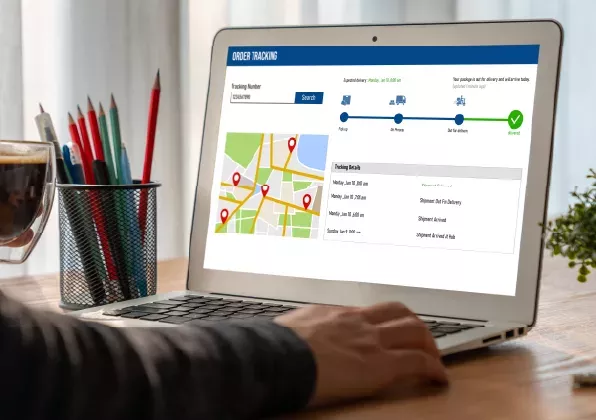
- Market growth: The last mile delivery market is expected to reach USD 378.59 billion by 2033. Same-day delivery is now a baseline expectation. Legacy routing systems cannot support this demand.
- Platform differentiation: A delivery routing platform enables continuous route recalculation and intelligent insertion. AI-driven ETA accuracy supports same-day promises. Real-time scalability handles peak volumes effectively.
- FarEye's delivery routing platform results: Routes optimize 90% faster, handling one million plus stops. Optimization consistently completes in under 15 minutes. Miles driven have been reduced by 20% significantly. Stops per hour improve 2X through automation. On-time performance exceeds 95% across networks. WISMO calls drop 67% through proactive communication.
- Implementation success: Start with the highest velocity routes for pilot testing. Establish ETA accuracy baselines before deployment begins. Train dispatchers on exception workflows thoroughly. Review performance weekly during the first 90 days.
Same-day and on-demand delivery have moved from a premium differentiator to a baseline customer expectation, fundamentally reshaping how logistics networks must operate globally. Enterprises that cannot consistently fulfill compressed delivery windows are rapidly losing customers to agile competitors who can meet these rising expectations immediately.
Globally, the last mile delivery market is valued at USD 207.10 billion in 2026 and is projected to reach USD 378.59 billion by 2033. Amid this growth, the delivery routing platform has become the operational foundation that separates organizations that meet same-day promises from those that absorb broken promise costs.
Leading logistics organizations are investing in purpose-built delivery routing platforms, bringing AI-powered routing intelligence, real-time dispatch, and dynamic slot management into unified operational layers. Let's examine exactly what a modern delivery routing platform actually delivers and how FarEye specifically powers same-day delivery success at enterprise scale.
Why Same-day and On-demand Delivery Breaks Legacy Routing Systems
Traditional planning systems were built for predictable overnight delivery. Same-day and on-demand operations expose every structural weakness they contain, compounding costs and eroding customer trust simultaneously.
1. Fixed Route Plans Cannot Absorb Real-time Demand
Morning manifests are obsolete by midday. On-demand orders arrive continuously and cannot be inserted into fixed sequences without a delivery routing platform recalculating around existing committed windows simultaneously.
2. ETA Accuracy Collapses Under Compressed Windows
Same-day delivery promises require sub-hour ETA precision. Legacy systems produce fixed estimates that drivers cannot meet under live traffic variability, generating customer frustration before the delivery even fails.
3. Dispatcher Capacity Breaks at On-demand Volume
Manual dispatch cannot handle continuous order insertion, driver reassignment, and exception management simultaneously at on-demand delivery speeds. Every new urgent order becomes a dispatcher bottleneck rather than an automated system event.
4. Customer Communication Lags Behind Reality
Without real-time routing intelligence, customer ETAs become guesswork. WISMO calls accumulate and erode the trust that same-day delivery is supposed to build across the customer relationship.
What a Delivery Routing Platform Actually Does Differently
A delivery routing platform is not a GPS tool or a basic scheduling application. It is a continuous intelligence engine that fundamentally transforms how same-day operations function from planning through execution.
1. Continuous Route Recalculation
Route planning software generates a plan once at dispatch. By contrast, a delivery routing platform recalculates sequences continuously as new orders arrive, traffic shifts, and field conditions change throughout the operating window.
2. Intelligent Order Insertion
On-demand orders are inserted into active runs with minimal disruption to committed delivery windows, preserving SLA compliance across the existing route. Delivery routing software with this capability eliminates the manual triage that slows on-demand fulfillment.
3. AI-driven ETA Accuracy
Machine learning models factor in traffic, stop density, driver behavior, and historical patterns. Consequently, they produce ETAs precise enough to support same-day delivery promises and proactive customer communication throughout the journey.
4. Real-time Recalculation Capability
Delivery routing platform recalculates continuously, not just at dispatch. Same-day operations require sub-minute response to order arrivals and changing field conditions throughout the day.
5. On-demand Order Insertion
The platform inserts urgent orders into active runs without breaking existing delivery windows or requiring manual dispatcher intervention. This capability proves non-negotiable for on-demand networks.
6. Scalability Under Peak Volume
Microservices architecture handles same-day surge volumes without performance degradation. Verify the delivery routing software scales individual components independently as order volumes fluctuate across the network.
7. Integration With Existing Systems
API-first design connecting to ERP, OMS, WMS, and TMS without displacing legacy infrastructure. Effective delivery routing software modernizes routing intelligence without requiring costly system replacement.
Core Capabilities of a Same-day Delivery Routing Platform
Not every platform is built for the same-day velocity. These are the capabilities that define genuine operational readiness and separate enterprise-grade solutions from basic dispatch tools.
1. Dynamic Dispatch and Real-time Re-routing
AI engines within an effective delivery routing platform factor live traffic, driver availability, vehicle payload, and SLA priority to generate executable plans in minutes. Route adherence monitoring detects deviations instantly and triggers automatic re-sequencing without direct dispatcher involvement at every step.
2. Real-time Slot Management
AI manages slot availability based on live fleet status and order volume, preventing overcommitment during the scheduling process. Urgent HOT orders fit into existing runs with minimal disruption, and on-time performance consistently exceeds across the network.
3. Multi-stop Optimization at Scale
Effective route optimization software handles multiple stops in under 15 minutes, factoring SLAs, capacity, and driver skills simultaneously. This level of optimization is non-negotiable for on-demand networks that process continuous order volumes throughout the delivery window.
4. Exception Management and Automated Recovery
Delays, breakdowns, and access failures trigger automated reassignment workflows before SLAs break. A delivery routing platform replaces reactive firefighting with structured, proactive recovery that activates before customer impact occurs.
5. Branded Real-time Customer Communication
Proactive notifications, live tracking links, and self-serve rescheduling keep customers informed throughout the same-day window. Delivery routing software that ties real-time route data to customer communication directly reduces WISMO calls and strengthens repeat purchase behavior.
6. Skill-based Dispatch and Driver Assignment
Hazmat certifications, vehicle type requirements, and customer-specific constraints are matched automatically. Drivers receive only appropriate assignments through the delivery routing platform, eliminating compliance risk and improving first-attempt delivery rates.
How FarEye's Delivery Routing Platform Powers On-demand Operations
FarEye provides enterprise-grade delivery routing platform capabilities, purpose-built for the complexity of same-day and on-demand delivery. Here is what the platform delivers across every layer of your operation.
1. Route Better, Dispatch Faster
FarEye's delivery routing platform creates optimized routes 90% faster, handling 1Mn+ stops in under 15 minutes while saving up to 20% on miles driven. Traffic, SLAs, vehicle capacity, and driver skills are automatically factored into every route.
2. Effortless Delivery Scheduling
FarEye manages real-time slot availability based on live demand and fleet status, fitting urgent HOT orders into existing routes with minimal disruption. Fleet managers achieve a 2X improvement in stops per hour while on-time delivery performance consistently exceeds 95%.
3. Seamless Execution Powered by AI
Load-out time drops by 25% or more through pre-sort and pre-load logic sequenced by SLA, vehicle, and zone. An AI-powered control tower generates real-time insights on delays, detours, and long halts, delivering 15% more stops per driver per day and 60% less firefighting for control tower agents through proactive real-time reassignments.
4. Exceptional Consumer Experience
The delivery routing platform cuts WISMO calls by up to 67%, enables 70% of routine inquiries to be self-served, and reduces missed deliveries by up to 25% through perfectly timed personalized notifications. Customer service teams report 50% fewer tickets and a +15-point increase in customer NPS.
5. Forecast Capacity Simply and Precisely
Capacity requirements can be forecast up to 12 months in advance, with network planners spending 90% less time on fleet size, capacity, and cost modeling. What-if simulations at scale give logistics leaders the foresight to plan for same-day demand surges before they arrive.
How to Implement a Delivery Routing Platform for Same-Day Success?
Deploying a delivery routing platform for same-day success requires a phased approach aligned with operational readiness and establishes clear performance governance from day one.
1. Start With Highest-velocity Routes
Pilot on same-day and express lanes first. These most quickly expose the delivery routing platform's real-time capabilities and generate measurable proof points that confidently guide network-wide expansion.
2. Establish ETA Accuracy Baselines
Document current on-time rates and ETA deviation before deployment. Improvement in these metrics is the primary indicator of delivery routing platform performance and the clearest evidence of ROI for leadership.
3. Train Dispatchers on Exception Workflows
Automated exception handling only delivers its full value when dispatchers trust and follow predefined recovery protocols. Hands-on training from day one of go-live is non-negotiable for maximum platform impact.
4. Review and Refine Weekly During Ramp-up
Weekly performance reviews during the first 90 days surface routing parameter adjustments that improve same-day delivery success rates and accelerate self-learning accuracy gains over time.
The four steps build on each other in sequence. Pilot routes generate the baseline you need before rollout, and the baseline is what dispatcher training and weekly reviews get measured against for the first 90 days.
Meet Every Same-day Promise With FarEye's Delivery Routing Platform
Same-day and on-demand delivery expectations are reshaping logistics operations, requiring businesses to deliver speed, accuracy, and reliability at scale. Legacy routing systems cannot absorb this pressure. A purpose-built delivery routing platform converts real-time complexity into operational control, transforming same-day delivery from a costly aspiration into a repeatable, measurable competitive advantage.
FarEye delivers the AI-powered routing, dynamic dispatch, and customer experience capabilities that on-demand operations demand at scale. Recognized in the Gartner® Market Guide, FarEye is trusted by enterprise logistics leaders globally.
Discover how same-day delivery can become your strongest operational differentiator.
Schedule Your Assessment →Frequently Asked Questions
What is a delivery routing platform for same-day and on-demand deliveries?
A delivery routing platform helps businesses plan, optimize, and execute same-day and on-demand deliveries using real-time data, route optimization, and automated dispatch. It considers factors such as traffic, order changes, vehicle capacity, and delivery commitments to improve speed, accuracy, and operational control. FarEye supports same-day delivery execution through dynamic routing and parcel routing capabilities.
How is a delivery routing platform different from traditional route planning software?
Traditional route planning software typically creates routes before dispatch using available information. A delivery routing platform continuously adjusts routes using live data, changing orders, traffic conditions, and delivery priorities. This enables businesses to respond faster and maintain delivery performance in unpredictable environments. FarEye enables real-time dynamic routing for changing delivery conditions.
What are the key features of a same-day delivery routing platform?
A same-day delivery routing platform should include dynamic routing, real-time dispatch, order insertion, predictive ETAs, fleet visibility, delivery tracking, and customer notifications. These capabilities help businesses manage high-volume deliveries while protecting promised time windows. FarEye supports same-day operations with automated parcel routing and real-time route management.
How does FarEye use real-time data to optimize delivery routes?
FarEye uses real-time delivery data, including order information, vehicle status, traffic conditions, and operational constraints, to optimize route decisions. This helps teams adjust routes, improve resource utilization, and manage changing delivery requirements. The parcel routing capabilities support same-day deliveries through dynamic routing and real-time order assignment.
What KPIs should businesses track after implementing a same-day delivery routing platform?
Businesses should track KPIs such as on-time delivery rate, OTIF performance, cost per delivery, stops per hour, vehicle utilization, ETA accuracy, failed delivery rates, and customer satisfaction. These metrics show whether the platform is improving efficiency and service quality. FarEye tracks delivery performance indicators to help teams measure operational improvements.
Reference: Shevgan, Monica. "Last Mile Delivery Market." Coherent Market Insights, March 30, 2026. Figures are subject to change — verify current numbers before publishing updates.