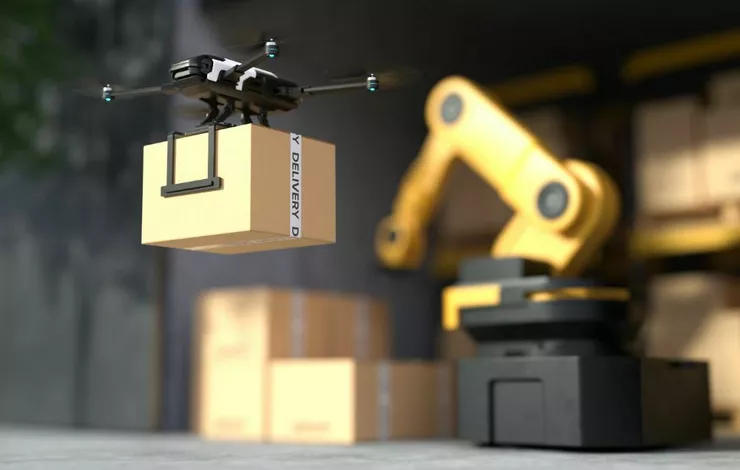
- Omnichannel logistics pools inventory, fulfillment, and delivery into one connected system. Multichannel keeps them in silos. The difference shows up in cost per order and return rates.
- The biggest operational killer is inventory fragmentation. Real-time visibility across all channels can reduce fulfillment costs by 20 to 30% (Aberdeen Group).
- Nine specific challenges stand between most enterprises and true omnichannel execution. Most fixes start with data integration, not new warehouses.
- A five-level maturity model helps you stop guessing. Most companies land at Level 2 and stall because they treat omnichannel as a technology project instead of an operating model.
- The future is AI-powered orchestration: predictive inventory allocation, intelligent order routing, and autonomous exception management.
73% of consumers use multiple channels during a single shopping journey. They browse on their phone, compare on a laptop, and pick up in-store. Those shoppers spend 16% more per order and have 30% higher lifetime value than single-channel buyers (Capital One Shopping Research, 2026).
The problem: most supply chains were built for bulk shipments to stores or for DTC fulfillment from a central warehouse. Not both at the same time, from the same inventory pool. That gap between customer expectations and operational reality is what omnichannel logistics exists to close.
What Is Omnichannel Logistics?
Omnichannel logistics connects inventory, fulfillment, and delivery across every sales channel into a single operation. Online orders, in-store purchases, marketplace sales, and mobile transactions all pull from the same inventory pool, get routed through the same fulfillment logic, and deliver a consistent customer experience.
A practical example: a customer orders from your website. Your DC is 400 miles away, but a retail store 10 minutes from the customer has the item. Instead of shipping from the DC, you fulfill from the store. Inventory updates everywhere in real time. The customer gets it faster, and you save on shipping.
Omnichannel vs Multichannel Logistics
Multichannel means you sell through multiple channels, but each has its own inventory, fulfillment, and team. The channels run in parallel but independently. A customer who buys online cannot return in-store. Inventory in the warehouse is invisible to the retail POS.
Omnichannel pools everything. One inventory view. One order routing engine. One customer experience regardless of where the order originated. Buy online and pick up in-store, buy in-store and have it shipped home, or buy on a marketplace and return through any channel. For more on how omnichannel distribution works at the network level, see FarEye's guide.
Omnichannel Logistics vs Omnichannel Fulfillment
Fulfillment is one piece. It focuses on how orders get picked, packed, and shipped. Logistics is the broader system: inventory planning, carrier management, delivery execution, returns processing, and the customer communication layer. Think of fulfillment as the warehouse operation. Logistics is the full end-to-end orchestration.
How Omnichannel Logistics Works
Five systems that traditionally operate independently must share data in real time: an OMS (order routing across channels), a WMS (inventory at DCs and stores), a TMS (carrier selection and shipment planning), a last-mile delivery platform (driver dispatch, tracking, delivery confirmation), and a customer experience layer (proactive updates, delivery preferences, branded communication). When they connect, you get omnichannel. When they do not, you get multichannel with an omnichannel label.
Key Components of an Omnichannel Logistics Strategy
- Unified inventory visibility: Every channel sees the same stock in real time: DCs, stores, 3PL warehouses, and in-transit. Without it, you oversell on one channel and sit on dead stock in another. Companies with unified commerce see up to 27% lower fulfillment costs (Capital One Shopping Research, 2026).
- Intelligent order routing: Deciding where each order gets fulfilled based on inventory depth, proximity, shipping cost, SLA, and carrier capacity. The more variables the system handles, the more last-mile delivery costs you eliminate.
- Multi-carrier orchestration: Different order types (parcel, bulky, same-day) need different carriers. Carrier integration depth and onboarding speed determine how fast you scale.
- Flexible fulfillment: BOPIS, ship-from-store, curbside, locker delivery, same-day. Each needs different workflows. 77.2% of top U.S. retailers already offered BOPIS in 2024 (Digital Commerce 360). This is table stakes.
- Reverse logistics: Cross-channel returns are a customer expectation. About 20% of online purchases are returned (NRF, 2025 Retail Returns Landscape), and a poor returns experience drives 33% of repeat customers to abandon the brand (McKinsey).
- Post-purchase experience: Real-time tracking, proactive ETA updates, and self-service delivery management directly reduce WISMO inquiries (up to 40% of customer service volume) and drive repeat purchases.
Why Omnichannel Logistics Matters
Omnichannel customers spend 16% more per order. Marketers using three or more channels earn a 287% higher purchase rate than single-channel campaigns. Companies with strong omnichannel engagement retain 89% of customers versus 33% without (Capital One Shopping Research, 2026).
On the cost side: unified inventory reduces safety stock. Intelligent routing cuts shipping costs by fulfilling from the closest node. Automated carrier allocation eliminates manual dispatch. Each shaves 5 to 15% off logistics costs. Together, they compound.
The omnichannel retail solutions market is projected to grow from $29.13 billion in 2023 to $82.9 billion by 2032 at a 12.3% CAGR (Market Research Future). Companies that do not build this capability will become invisible to shoppers who treat cross-channel consistency as a baseline.
9 Omnichannel Logistics Challenges and How to Fix Them
Every company that attempts omnichannel runs into the same set of problems. The difference is whether you treat these as technology problems (they are not) or operating model problems (they are).
1. Inventory Fragmentation
Your e-commerce warehouse, stores, and 3PL each hold stock, but none of the systems talk. You overstock in some places and stock out in others. The fix: a centralized real-time visibility layer that aggregates stock data across all locations. FarEye's visibility control tower provides this across carrier and fulfillment nodes.
2. Disconnected Supply Chain Systems
Your WMS, TMS, and OMS were not built to work together. The integration layer is CSV exports and manual reconciliation. The fix: API-first architecture with pre-built integrations. Plan for 6 to 12 months of integration work. For more on this challenge, see our breakdown of retail visibility challenges.
3. Last-Mile Complexity
Different channels need different delivery modes: same-day for grocery, scheduled windows for big-and-bulky, standard parcel for e-commerce. Managing this manually is where costs spiral. The fix: a delivery execution platform that automates carrier allocation based on order attributes and dynamically routes across its own fleet and 3PL partners. FarEye's orchestration layer handles this across 1,500+ carrier integrations.
4. WISMO Overload
WISMO inquiries can hit 30 to 40% of customer service contacts, costing $5 to $8 per inquiry. The fix: proactive, branded delivery tracking with real-time ETAs and self-service delivery management. FarEye's Experience module automates milestone notifications across carriers, reducing WISMO by 40 to 60% in enterprise deployments.
5. Reverse Logistics Margin Erosion
A customer buys online and returns in-store, but the POS cannot process it. Or the return gets processed but the item never gets restocked. The fix: an integrated returns system that handles initiation, execution, and disposition across channels, updating inventory automatically.
6. Carrier Performance Blind Spots
You use 5 to 15 carriers but measure performance using their own reports. The fix: unified carrier monitoring through an independent tracking layer. FarEye provides this through automated delivery exception detection and carrier scorecards based on actual delivery data, not carrier self-reports.
7. Peak Period Scaling
Normal volume is fine. But peak spikes of 60 to 90% break carrier capacity and warehouse throughput. The fix: pre-built carrier onboarding workflows and dynamic capacity allocation that let you integrate new delivery partners rapidly and shift volume based on real-time data.
8. Inconsistent Cross-Channel Pricing
A product is $49.99 online but $54.99 in-store. 80% of consumers use their phone while shopping in a physical store (Capital One Shopping Research, 2026). The fix: centralized product information management that syncs pricing and promotions in real time, integrated with your logistics stack so delivery promises match capability.
9. Choosing the Right 3PL Partners
A cheap carrier with 70% FADR costs more than a pricier one at 95% when you factor in redelivery, support, and brand damage. The fix: data-driven 3PL selection that evaluates partners on FADR, SLA compliance, and geography coverage, not just price per shipment.
Omnichannel Logistics Maturity Model
Most companies know they need omnichannel. What they do not know is where they actually stand.
| Level | Stage | What It Looks Like |
|---|---|---|
| 1 | Siloed | Each channel has separate inventory, fulfillment, and systems. No data sharing. High safety stock, frequent stockouts. |
| 2 | Connected | Systems integrated at a basic level. Inventory visible across channels, but routing and fulfillment decisions are still manual. |
| 3 | Coordinated | Automated order routing with predefined rules. Semi-automated carrier allocation. Real-time tracking in place. |
| 4 | Optimized | AI-powered routing considers cost, SLA, inventory depth, and capacity in real time. Predictive ETAs. Proactive exception management. |
| 5 | Autonomous | Self-optimizing logistics that learns from every delivery. Predictive inventory allocation. Autonomous exception handling. |
Most enterprises sit at Level 2 or 3. The jump from 2 to 3 is a technology integration problem. From 3 to 4 is an AI and data maturity problem. From 4 to 5 is organizational. Be honest about where you are.
How to Advance Your Omnichannel Logistics Maturity
Level 1 to 2: Get Visibility
Audit every inventory location, system, and data flow. Deploy a visibility layer that aggregates data from your WMS, POS, and 3PL portals into a single view. Standardize SKU naming and status codes before connecting anything. Start with your top 20% of SKUs. FarEye's supply chain visibility layer can aggregate across carrier and fulfillment nodes as the first step.
Level 2 to 3: Automate Decisions
Implement automated order routing based on inventory, proximity, cost, and SLA. Build carrier allocation rules that assign parcels based on serviceability and cost. Deploy real-time tracking that gives customers proactive updates and operations a single-pane view. Enable cross-channel returns through a unified workflow.
Level 3 to 4: Layer AI
Replace static routing rules with ML models that consider traffic, weather, and carrier capacity. Move to predictive ETAs. Implement proactive exception management. Build a carrier performance loop using independent tracking data. FarEye's orchestration platform supports this with AI-powered routing and automated carrier allocation for enterprises managing 10,000+ daily shipments. For more on how delivery automation accelerates this transition, see FarEye's guide.
Level 4 to 5: Autonomous Operations
Very few companies are here today. It requires predictive inventory allocation, self-healing logistics that reroute and reallocate without human intervention, and continuous optimization where every delivery feeds back into the model. This is the frontier.
Real-World Omnichannel Logistics Examples
Gordon Food Service, one of North America's largest food distributors, implemented AI-powered route planning across their multi-depot network for time-sensitive, high-frequency deliveries. The deployment reduced delivery costs while maintaining service-level commitments across a complex distribution operation that serves restaurants, healthcare facilities, and retail locations.
A Sub-Saharan Africa retail chain operating 400+ stores across 12 countries switched from manual carrier allocation to FarEye's rule-based, multi-dimensional carrier scoring. The result: 30% NPS improvement, 40% FADR increase, and 10% delivery cost reduction across 2 million parcels per year.
BlueDart, one of India's leading express logistics companies, achieved a 22% improvement in first-attempt delivery rate after FarEye identified anomalies in load distribution and recommended carrier rebalancing based on actual performance data.
Key Omnichannel Logistics KPIs to Track
Standard metrics like OTIF and fill rate are not enough for omnichannel. These KPIs tell you whether channels are actually integrated. For a deeper framework, see our guide to last-mile analytics.
| KPI | What It Measures | Why It Matters for Omnichannel |
|---|---|---|
| Cross-channel order accuracy | Orders fulfilled correctly regardless of channel | Low accuracy = data sync failures between OMS and WMS |
| WISMO rate | Customer inquiries as % of total orders | High WISMO = broken tracking or missing carrier data |
| Cost per delivery by channel | Fulfillment + delivery cost per channel | Exposes hidden cross-subsidies (marketplace vs DTC) |
| First-attempt delivery rate | Deliveries completed on first try | Each failed attempt costs $8 to $15 in redelivery |
| Order cycle time by channel | Order placement to delivery, per channel | Shows if all channels meet expectations equally |
| Unified inventory turnover | Inventory velocity across all channels | Low turnover = routing not using all inventory nodes |
| Cross-channel return rate | Orders bought on one channel, returned via another | Growing rate = healthy omnichannel adoption |
The Future of Omnichannel Logistics: From Visibility to AI-Powered Orchestration
Visibility is solved (or solvable) for most enterprises. The next frontier is intelligent orchestration: systems that do not just show you what is happening but automatically decide what to do about it.
- Predictive inventory allocation: AI pre-positions inventory across nodes based on predicted demand, seasonal patterns, and promotional calendars.
- AI-powered order routing: ML models consider carrier capacity, congestion, fuel costs, margin impact, and carbon footprint simultaneously. The single biggest efficiency gain for Level 3 to Level 4 transitions.
- Predictive ETAs: Dynamic predictions based on real-time traffic, carrier history, and last-mile constraints. Accurate ETAs reduce failed attempts because customers are home.
- Intelligent exception management: AI predicts exceptions, triggers corrective workflows, and learns from every incident.
- Autonomous logistics: Every delivery and exception feeds back into the model. Carrier allocation and inventory distribution adjust dynamically.
Leading enterprises are increasingly adopting platforms that combine visibility, orchestration, automation, and AI to support omnichannel at scale.
FarEye is building toward this with AI-powered route optimization, predictive delivery intelligence, and autonomous carrier management. The companies that win at omnichannel logistics will be the ones that move from showing data to acting on it automatically.
Stuck between visibility and execution?
Explore FarEye Track or book a demo to see how delivery orchestration, carrier allocation, and real-time tracking connect across your channels.
Frequently Asked Questions
What is the difference between omnichannel and multichannel logistics?
Multichannel has separate inventory and fulfillment per channel. Omnichannel unifies them so any channel can access any inventory. Companies with strong omnichannel retain 89% of customers versus 33% without (Capital One Shopping Research, 2026).
What are the biggest challenges in omnichannel logistics?
Inventory fragmentation, disconnected systems, last-mile complexity, WISMO overload, and reverse logistics margin erosion. The root cause is usually data integration failure.
How does omnichannel logistics reduce costs?
Unified inventory cuts safety stock. Intelligent routing fulfills from the closest node. Automated carrier allocation optimizes cost-service tradeoffs. Proactive tracking reduces WISMO by 40 to 60%. Together, 10 to 20% total cost reduction.
What technology do you need?
OMS for order routing, WMS for inventory, TMS for carrier management, and a delivery platform for last-mile operations. These must share real-time data through API integrations.
How do you measure omnichannel success?
Cross-channel order accuracy, WISMO rate, cost per delivery by channel, FADR, order cycle time, unified inventory turnover, and cross-channel return rates.
What is an omnichannel logistics maturity model?
A five-level framework: Siloed, Connected, Coordinated, Optimized, and Autonomous. Most enterprises are at Level 2 or 3.
How does AI improve omnichannel logistics?
Predictive inventory allocation, intelligent order routing, dynamic ETAs, and autonomous exception management that resolves issues before customers notice.
Sources: Capital One Shopping Research, 2026; Aberdeen Group; Digital Commerce 360; NRF, 2025 Retail Returns Landscape; McKinsey; Market Research Future. Figures are subject to change — verify current numbers before publishing updates.