Table of Contents
- What is a Route Planner App?
- Key Features That Make the Best Route Planner App
- How FarEye Powers These Features with AI and Machine Learning
- Example: How These Features Translate Into Real Gains
- Metrics and KPIs You Should Track
- Challenges and How to Mitigate Them
- Take Action: Upgrade Your Route Planning Today
Let Our Experts Optimize Your Deliveries Today
Let's talkThe United States express-delivery service market is estimated at USD 96.30 billion in 2025, underscoring the urgency for optimized delivery routes. The rising volume places enormous pressure on dispatchers and allocators: how to deliver faster, cost-effectively and reliably, without exploding costs or customer complaints.
In this environment, the right route planner app, one that understands constraints, adapts in real time and scales across mixed fleets, can become the foundation of competitive advantage.
Here’s why this technical tool matters. When last-mile failure rates reach 5%, each failed delivery incurs an average cost of nearly $17.78 in re-attempts, lost time and customer frustration. That’s not just numbers, it’s the difference between a trusted brand and one that customers abandon.
What is a Route Planner App?
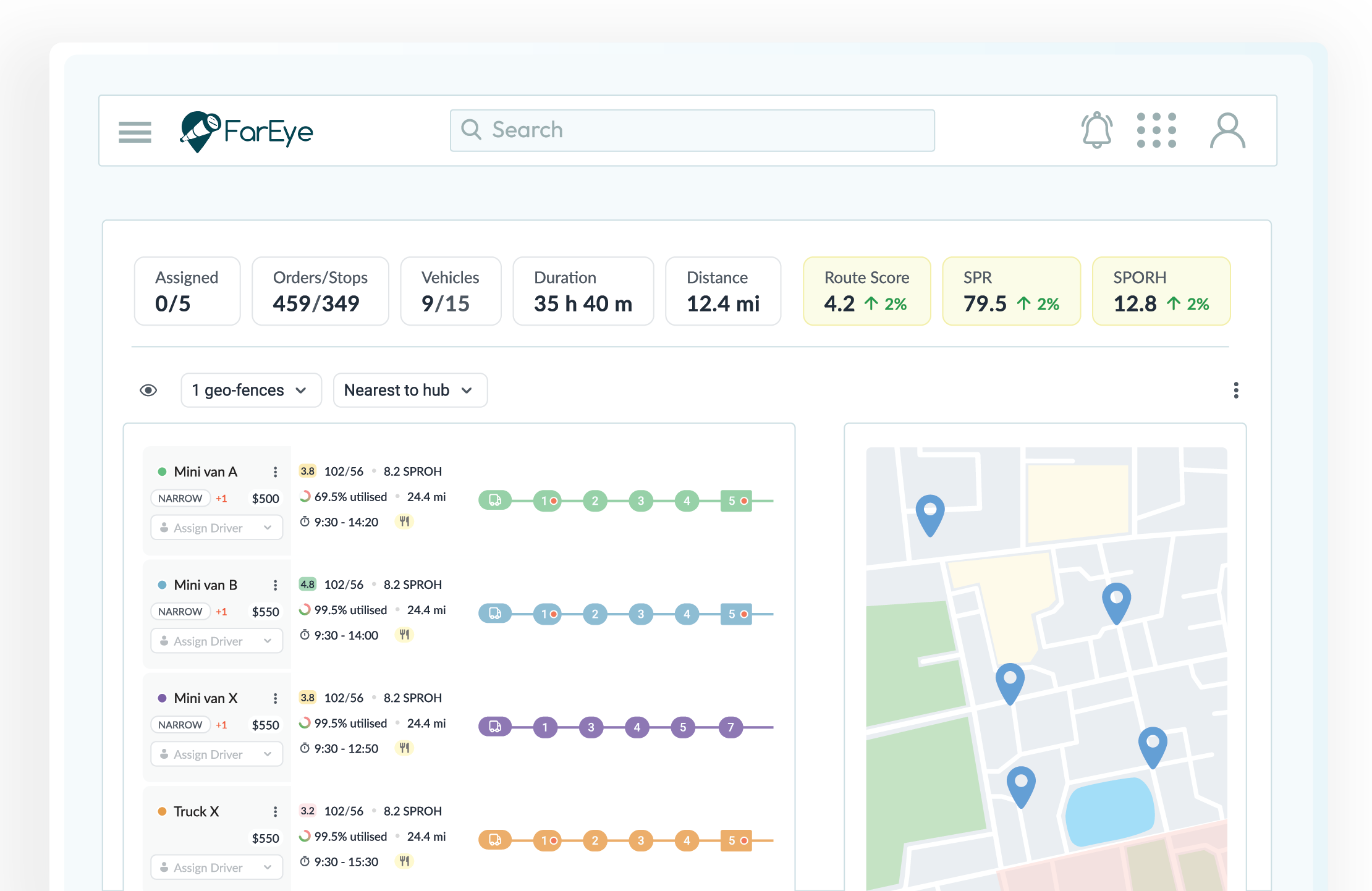
A route planner app is specialized software used by dispatchers and allocators to sequence and manage delivery or field-service stops in the most efficient way, while honoring real-world constraints like driver hours, vehicle capacity and access rules.
Rather than just showing a map, it solves variants of the Vehicle Routing Problem (VRP) and its more dynamic version, Dynamic Vehicle Routing Problem (DVRP), choosing which vehicle serves which stop, in what order, under time windows, skills or other business rules.
Such an app also supports mixed-fleet orchestration (owned vehicles + 3PLs + electric vehicles), incorporates predictive ETAs and offers real-time re-optimization. Critical for enterprises, it integrates with systems like TMS, WMS, OMS and telematics platforms, exposing APIs and maintaining high uptime/SLA.
In effect, a robust route planner app becomes the operational backbone, reducing cost, improving delivery speed and increasing customer trust through visibility and reliability.
Key Features That Make the Best Route Planner App
Below are the essential features dispatchers need, with deep technical insight and customer impact.
Constraint-Aware Optimization (Capacity, Skills, HOS, Building Rules)
The best delivery route planner app respects all realistic constraints.
- Vehicle Capacity and Load Constraints: Weight, volume, shape; prevent overloading.
- Driver Skills and Certifications: Some stops may require specific driver skills (hazardous material handling, lift-gate, forklift).
- Hours-of-Service (HOS) Regulations: US federal/state laws limit driver shift length, break times. The system must plan routes that comply to avoid violations.
- Building Rules and Access Restrictions: Low-clearance, restricted zones, narrow streets and limited loading windows for certain buildings.
Without constraint-aware optimization, routing may look efficient on paper but fails in execution, drivers forced to detour, delays or even safety violations. These failures degrade customer satisfaction when delivery windows are missed or orders are delayed.
Real-Time Reoptimization and Predictive ETAs
Fixed plans break when reality hits. Traffic jams, accidents, unexpected delays/checkpoints and new last-minute orders all happen.
- Real-time re-optimization means the routing engine (often in DVRP) recalculates portions of the route on the fly; it reassigns remaining stops, shifts loads among vehicles, changes stop sequences and accounts for evolving driver locations.
- Predictive ETAs use machine learning and historical data to forecast arrival times more accurately; they consider current traffic, driver behavior, prior stops and time windows.
For customers, this means what you promised, delivery by 2-5 PM, driver arriving in 30 mins is more realistic. For dispatchers, it means fewer where is my driver? calls, fewer SLA violations and lower penalty costs.
Mixed-fleet Orchestration (Owned + 3PL)
Many enterprises operate mixed fleets: some trucks or vans owned, others contracted through 3PLs, subcontractors. A top route planner app handles:
- Assignment Logic: Choose which vehicle (owned or 3PL) is optimal based on cost, availability and location.
- Visibility and tracking across all fleet segments.
- Handling different SLAs or performance guarantees among providers.
This allows you to scale when demand spikes, maintain consistent service without always needing to scale owned assets.
EV/Green-slot Routing
Sustainability is no longer optional. Many brands are under pressure to reduce carbon emissions, meet ESG goals or even comply with city-level green delivery mandates. Routing features must support:
- EV Range and Charging Constraints: The route planner must know battery state, nearest charging stations, charging time and integrate charging stops if needed.
- Prefer lower-emission paths or slower but less congested and less idling routes.
- Green Slots: scheduling deliveries during times when emissions or congestion are lower.
Using a framework to co-optimize route + charging yields substantial savings in charging cost and emissions.
VRP/DVRP Engines Behind the Scenes
To make all the above work, the solver must be strong.
- Vehicle Routing Problem (VRP): classic algorithms that optimize routing with constraints (capacity, time windows, etc.)
- Dynamic VRP (DVRP): handles changes during execution, new orders, cancellations and traffic changes.
Often, machine learning feeds into these: historical data helps shape cost functions, expected delays, driver performance and helps algorithms predict which route changes will yield gains.
Control-tower Visibility + Branded Tracking/Proof-of-Delivery (PoD)
Visibility is key both internally and for customers.
Control-Tower Dashboard: real-time fleet view, stop status, delays, driver compliance, ability to intervene (reassign, reroute).
- Customer-Facing Tracking and Branded Notifications: Customers get branded tracking links, status updates, driver is 10 minutes away, notifications of delays or schedule changes.
- Proof of Delivery Tools: photo, signature, barcode/QR scanning, timestamped; all fed back to the system for audit, for customer service resolution.
These reduce where’s my package? calls, reduce disputes and build trust with end customers.
Enterprise-grade Integrations (TMS, WMS, OMS, Telematics)
No route planner works in isolation. For enterprise deployment, you need:
- Transportation Management System (TMS): To import orders, assign shipments and generate invoices.
- Warehouse Management System (WMS): To handle pick-ups, staging and loading sequences.
- Order Management System (OMS): Channel orders from e-commerce, B2B, bulk and customer portals.
- Telematics and GPS integration: Live location, driver behavior, idle time, fuel consumption.
- APIs and Data Pipelines: For real-time data flows, for feeding routing, for extracting metrics.
Also critical: uptime guarantees/SLA (service-level agreement). Enterprise apps must ensure high availability, data security and disaster recovery.
How FarEye Powers These Features with AI and Machine Learning
FarEye is a solution built to bring all these capabilities together for enterprises.
- FarEye uses AI-based routing. Learning from past delivery data to anticipate delays, better match drivers to stops and dynamically adjust route plans.
- Our constraint engine supports capacity, driver HOS, vehicle skills, restricted access points, EV range and green routing.
- Real-time re-optimization is built in, so if traffic spikes or a vehicle breaks down, FarEye adjusts assignments and ETAs automatically.
- For mixed fleets (owned + 3PL), FarEye provides control-tower visibility across partners; you see performance across the entire delivery network.
- Our route planner app integrates with TMS/WMS/OMS/telematics via APIs to streamline data flows, ensure consistency and provide real-time insight.
Example: How These Features Translate Into Real Gains
Urban same-day deliveries with tight time windows:
A large retailer in Chicago has multiple same-day orders to deliver before 8 pm. Some packages are high-priority, some fragile. Owned vans + 3PL couriers. EV vehicles included.
With a standard route planner (no real-time or constraints), dispatchers often overestimate what can be done, drivers hit HOS limits, EVs lose charge unexpectedly and customers complain about delays.
With a route planner app, FarEye’s routes are created respecting driver HOS, EV range and skill requirements. Real-time traffic integrated, dynamic re-optimization when delays happen. Predictive ETAs sent to customers. Result: A top furniture retailer using FarEye reported a 24% increase in on-time deliveries and a 97% improvement in ETA accuracy.
Metrics and KPIs You Should Track
To judge whether your route planner app is delivering real value, monitor:
| Metric | What a Good Target Looks Like | Why it Matters |
| First-attempt Delivery Rate | Aim for 90%+ depending on geography | Reduces redelivery cost, improves satisfaction |
| On-time Delivery % | 95%+ for enterprise SLA/within promised window | Critical for customer trust |
| Cost per Delivery/Mileage | Lower over time; savings from route optimization | Impacts margins |
| Route Adherence/Driver Compliance | 90%+ of routes followed as planned | Deviations erode the plan's benefit |
| EV Uptime/Charging Downtime | Minimize charging time wasted; keep EVs active | Key in green-fleet scenarios |
| Customer Satisfaction/NPS | Direct feedback on delivery experience | Reflects customer loyalty |
| API/Uptime SLA | 99.9%+ availability for the routing system and integrations | If the routing tool goes down, operations freeze |
Challenges and How to Mitigate Them
Understanding limitations helps dispatchers avoid traps.
Poor Data Quality
Inaccurate addresses, wrong geocoding and missing vehicle specs ruin plans. Mitigate with address verification APIs, regular data audits.
Over-complex Constraints Slow Optimization
Too many constraints or overfitting can make solving VRP/DVRP slow. Use tiered constraints (must vs nice-to-have), ensure the route-planner engine is performant.
Driver Non-compliance
Even the best plan fails if drivers deviate. Use telematics, driver feedback, incentives and clear instructions.
EV Charging Infrastructure Gaps
If charging stations are sparse or unreliable, charging plans may fail. Strategically map charging networks; build a buffer in range calculations.
Integration and Uptime Issues
If API flows or TMS/WMS integrations are slow or unreliable, routing lags and stale data lead to bad decisions. Choose a vendor with an enterprise SLA, robust support.
Take Action: Upgrade Your Route Planning Today
As a dispatcher or allocator working in US enterprise logistics, your job is one of balancing competing pressures: speed, precision, cost, sustainability and customer satisfaction. A route planner app that includes constraint-aware optimization (capacity, HOS, skills), real-time re-optimization and predictive ETAs, support for mixed fleets and EVs, full control-tower visibility + branded tracking/PoD and enterprise integrations is no longer optional. You need it.
With FarEye, you can lift operations: fewer missed time windows, lower delivery costs, happier customers and stronger brand trust. Routing is not just about drawing the shortest path; it’s about building a delivery network that adapts, respects limits and guarantees the promise.
Sources:
https://www.mordorintelligence.com/industry-reports/united-states-express-delivery-market
Last Mile Delivery Statistics: Key Trends & Insights for 2025