Table of Contents
Let Our Experts Optimize Your Deliveries Today
Let's talkEvery delivery promise relies on tight execution, a challenge that intensifies as volumes and customer expectations expand. Data estimates the logistics market will grow from USD 11,234.4 million in 2025 to USD 23,642.0 million by 2032. With North America holding a 36.6% share, success depends on cutting minutes while protecting reliability at every stop.
The industry is pivoting towards intelligence. Research forecasts digital platform adoption will climb to 85% by 2035 and 84% of leaders aim to achieve AI-driven logistics at scale by 2030. This shift makes an AI driven route optimization system the vital nerve center for daily dispatch. Let's learn about the changes AI brings and how FarEye helps teams turn this volatility into a competitive advantage.
How AI is Redefining Route Optimization Systems
AI improves routing by learning inputs that dispatch teams usually estimate. Then it feeds sharper predictions into the solver that builds daily routes. When route optimization software lacks learning loops, teams keep fighting the same ZIP codes because the model never updates dwell and access patterns.
A smart optimization system should blend optimization with predictive models. This keeps plans feasible when traffic, order cutoffs and stop behavior shift hourly. That is how route optimization system software moves from traditional routing into continuous decision support that improves with every executed wave.
- Dynamic Resequencing in Route Optimization Systems
Resequences work instantly when new orders drop or stops fail to keep constraints intact without breaking the plan. - Mid Day Feasibility
Refreshes feasibility mid-day to correct drift early and protect downstream dock appointments, which improves First-attempt Delivery Rates (FADR). - AI Driven Service Times
Refines ETA accuracy and protects On-time In-full (OTIF) outcomes by learning actual service times by stop type and zone. - Proactive Risk Flagging
Identifies high-risk signals like high dwell buildings and peak-hour congestion to prevent reattempts and scan gaps. - Enhanced Customer Satisfaction
Boosts Customer Satisfaction Score (CSAT) and Net Promoter Score (NPS) by ensuring promise accuracy and eliminating late surprises for the end customer.
Where AI Improves Route Adherence and Dispatch Control
Leaders invest in a route optimization system to improve service and cost together, because customers notice delivery consistency more than theoretical efficiency. When the system predicts risk earlier, teams spend less time firefighting and more time executing stable routes that protect Service Level Agreement (SLA) targets.
The system also protects productivity by reducing avoidable detours and reattempts that inflate miles, overtime and driver fatigue.
- ETA Accuracy That Customers Trust
More accurate ETAs reduce "Where is My Order?" (WISMO) contacts, so support teams handle fewer escalations tied to missed arrival promises. A route optimization system supports trust by aligning sequences with realistic service time, parking friction and traffic patterns by micro-zone. - FADR and OTIF Performance
AI lifts FADR by selecting sequences that preserve time windows, reduce missed handoffs and avoid late-day doorstep failures. It also improves OTIF by keeping quantities and timing aligned, especially when split shipments, carrier handoffs and depot cutoffs tighten the day. - Green Delivery Windows and Sustainability Targets
Green delivery windows work when routing consolidates drop density and shifts deliveries to lower-emission slots without breaking promised customer windows. AI helps you reduce idle time, empty miles and detours, improving emissions per stop and supporting Environmental, Social and Governance (ESG) reporting. - Cost Per Stop and Miles Per Route
Better clustering reduces empty miles and a smart optimization system prevents detours caused by late order inserts and poor exception handling. You gain clearer accountability because performance differences show up by territory, stop class and shift structure, then you coach using verified timestamps.
How FarEye Powers AI Driven Route Optimization at Scale
FarEye supports scheduling, routing and execution, so teams can scale without relying on heroics from dispatchers who keep patching broken plans. By unifying planning with day-of execution signals within a single control workflow, FarEye keeps a route optimization system feasible under real operating pressure.
This approach matters because route optimization system software fails when it disconnects planning from real-world loading, traffic variability and exception handling.
- Effortless Delivery Scheduling With Real Time Slots
Real time slotting gives customers choices that still align with fleet capacity and routing feasibility. FarEye updates availability using demand patterns and capacity signals, so urgent orders fit with minimal disruption. As priorities shift mid-day, your route optimization system stays steady and dispatch avoids constant patchwork. - Choose the Right Carrier With Faster Decisions
Carrier selection improves when decisions rely on consistent cost and performance signals across lanes. FarEye supports rate shopping and performance-based selection, reducing manual comparisons and the need for repeated Request for Proposals (RFPs). Better allocation protects service promises because carrier choices shape delays, scans and customer updates. - Route Better and Dispatch Faster at Scale
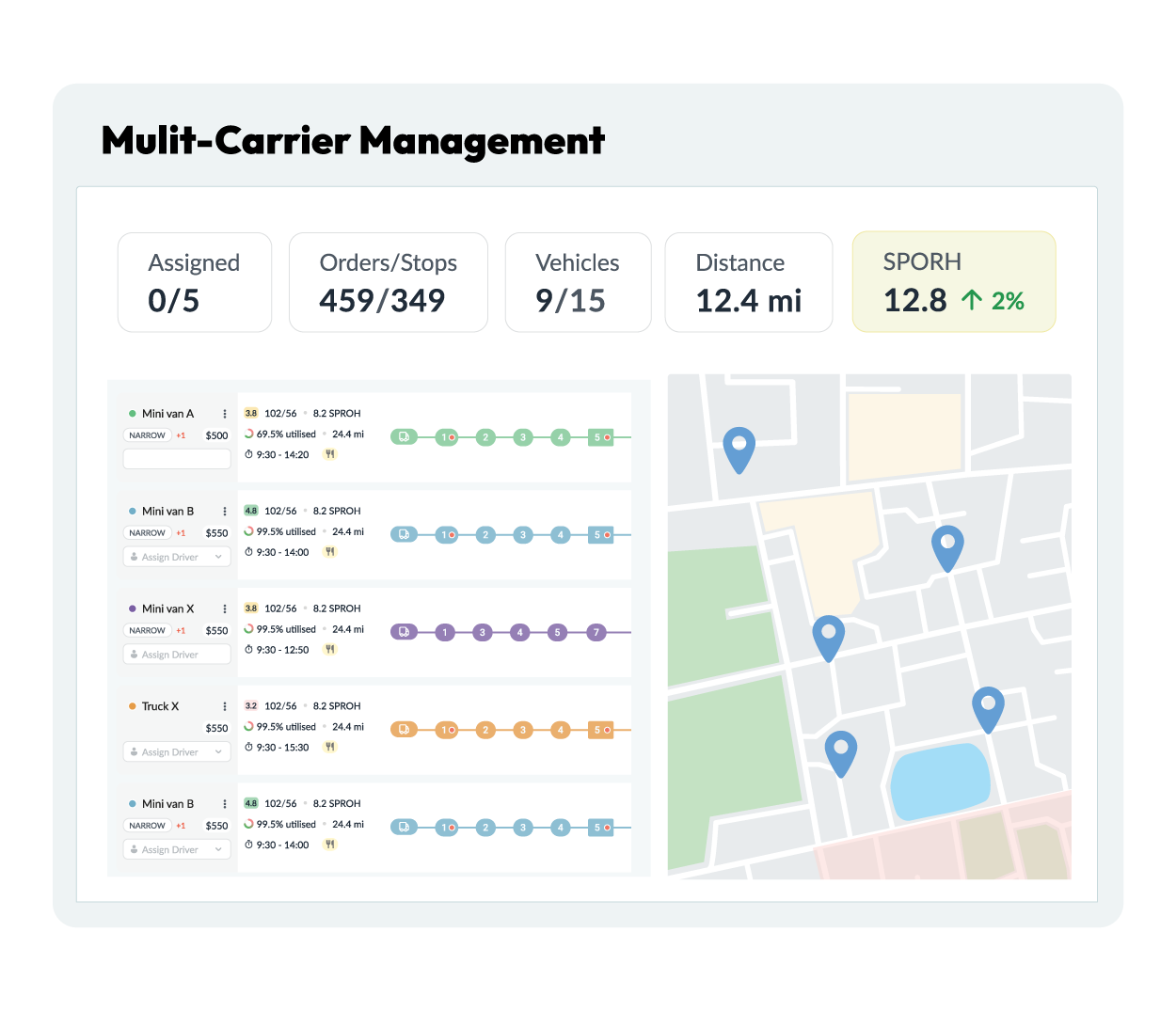
At scale, routing works best when traffic, SLAs, capacity and driver rules are solved together. FarEye generates optimized routes quickly, driving a 22% YoY decrease in dispatch time and a 12% YoY increase in capacity utilization.
The route optimization software supports real time adjustments when conditions change during execution. This keeps your route optimization system consistent across territories, achieving a 16% YoY increase in Stops per Route (SPR), so dispatch focuses on true exceptions. - Seamless Execution Powered By AI
Warehouse preparation improves when routes align with loading, staging and delivery priorities by zone. FarEye supports pre-sort and pre-load by SLA, vehicle and zone, which can reduce load-out time and loading errors. Live visibility into delays, detours and long halts helps the route optimization system trigger early interventions. Thereby contributing to a 6% increase in OTIF-compliant deliveries. - Improve Business Over Time With Analytics and Workflow Control
Performance analytics help teams spot patterns behind late stops, excess miles and repeated failures by lane. FarEye supports retrospective analysis across 61+ metrics, helping businesses save 75M+ kilometers via route optimization and achieve an 18% reduction in avg. cost per delivery.
Low-code workflow controls and self-learning algorithms help standardize decisions as operations grow, resulting in 550K+ Metric Tonnes of GHG Emissions Reduced. - Smart Service Times
Enhance the delivery experience with dynamic service times that account for real-world factors such as parking distance, elevator wait times and carry-in durations. Go beyond traditional ETAs with intelligent, adaptive service predictions for a smarter and more accurate delivery experience. This level of transparency creates reliability, builds trust and supports an 18% YoY increase in first time delivery. - Smart Parking
Optimize daily workflows and streamline service times with Smart Parking recommendations. FarEye uses advanced machine learning to analyze historical data and predict available spots near delivery destinations.
This allows drivers to park closer to the drop-off point, minimizing long walks with heavy shipments. By reducing physical strain and saving time, you improve driver productivity, effectiveness and overall customer satisfaction.
Best Practices for Implementing an AI Driven Route Optimization System
You get better outcomes when you apply AI with discipline, because routing improvements come from cleaner inputs and clearer objectives, not hype. Your route optimization system will only outperform legacy methods when you treat constraints as hard rules and enforce them consistently across routes.
- Start With Clear Metrics and a Baseline
Pick two or three metrics, measure them by zone and day and define what success looks like for the next eight weeks. This baseline helps your optimization system show real lift by separating model impact from seasonal demand changes. - Fix Inputs Before You Tune Models
Standardize addresses, stop types and exception reasons, then improve timestamp capture so your learning loop reflects what drivers actually experience. A route optimization system improves faster when each stop has clean service time data and consistent PoD events across teams. - Simulate Constraints to Stress-test Limits
Use your route optimization software to run "what-if" simulations that test how adding electric vehicles or changing service windows impacts fleet capacity. Validating these constraints in a virtual environment ensures your operational plan is advanced enough to handle peak volumes without breaking service commitments. - Automate Feedback Loops for Continuous Learning
Configure your route optimization software to ingest real time driver feedback on parking availability and accurate entry points. AI models thrive on fresh ground truth, so ensuring your system updates route attributes based on daily execution keeps your ETAs precise as you grow. - Pilot, Learn, Then Expand With Strict Rules
Run one pilot territory with real variability, document playbooks for mid-shift changes and lock strict safety rules that prevent risky reassignment decisions. Then expand depot by depot, because a route optimization system scales through repeatable operations, not one-off custom tuning.
Achieve Better Routing Outcomes With FarEye
A route optimization system delivers real value when it keeps routes feasible, protects service commitments and reduces manual dispatch effort across every shift. You can successfully apply AI by improving input quality, tightening constraint logic and creating a closed loop between planning decisions and execution reality.
As your operation grows, the route optimization software should learn stop times, predict risk and recommend actions that keep drivers productive and customers informed. FarEye supports that model through unified planning, execution visibility, analytics and configurable workflows that match how your teams actually run daily operations.
If you want fewer rescue moves and more predictable delivery performance, contact FarEye for a focused demo and validate results. Experience firsthand how the right technology turns volatility into a competitive advantage.
Sources:
https://www.coherentmarketinsights.com/market-insight/logistics-market-4388
https://www.marketsandmarkets.com/Market-Reports/logistics-transportation-market-74250424.html