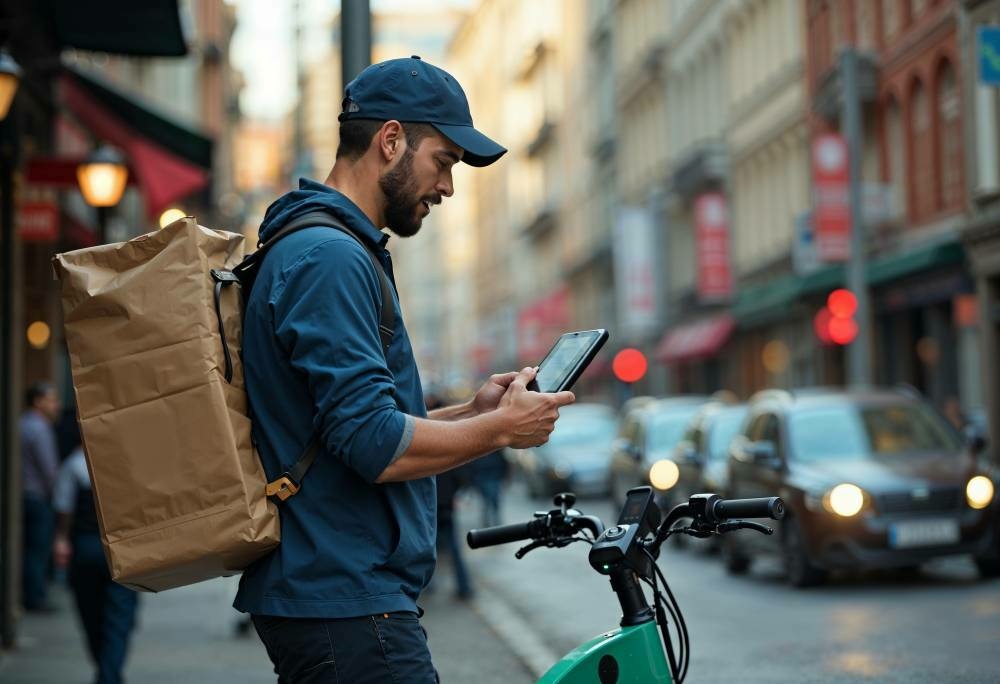
- Delivery drivers lose time when fixed routes ignore traffic, stop priority, vehicle limits, and last-minute address changes.
- The best route planner app for delivery drivers connects live traffic, multi-stop sequencing, delivery rules, and driver workflows.
- It helps reduce windshield time, missed delivery attempts, fuel waste, dispatcher calls, and route-level uncertainty.
- FarEye adds AI-based routing, real-time driver tracking, Smart Parking, Smart Audit, PoD capture, and exception management.
- Fleet teams can improve on-time performance, driver productivity, route visibility, and cost per stop across daily operations.
- The platform supports growing delivery fleets that need scalable, data-led route execution with fewer manual route interventions.
Globally, the logistics industry is projected to reach USD 19,305.7 billion by 2035, but growth will increase delivery pressure. Drivers already lose hours to manual route planning, traffic detours, wrong stop sequences, and last-minute address changes. Dispatchers feel the same pressure when fixed route plans ignore live road conditions and driver constraints.
The best route planner app for delivery drivers solves this gap by connecting traffic data, stop sequencing, delivery rules, and field visibility. It helps reduce windshield time, missed attempts, fuel waste, and unnecessary calls between drivers and dispatch teams.
For fleet managers, the right route planner app for delivery drivers can improve on-time performance while making long shifts manageable. Let's examine what separates the best route planner app for delivery drivers from basic navigation tools, and how FarEye helps teams execute deliveries smarter.
Why Delivery Drivers Face Long Hours and Inefficient Routes Daily
Most delivery delays trace back to planning tools that were never built for commercial routing at scale.
1. Manual Planning Consumes Time Drivers Should Spend on the Road
Dispatchers building routes by hand or in spreadsheets cannot account for every real-time variable. Traffic patterns, delivery windows, and vehicle capacity shift constantly throughout a shift. Manual planning locks drivers into a fixed sequence that breaks down the moment conditions change.
2. Basic Navigation Apps Ignore Constraints That Affect Delivery Performance
Consumer GPS apps calculate the fastest path between two points without considering delivery-specific needs. They skip stop sequencing, time windows, vehicle capacity, and driver skill requirements entirely. The best route planner app for delivery drivers must account for all of these factors simultaneously to produce a workable plan.
A leading logistics company in Thailand replaced manual planning with FarEye Route and cut its fleet from 300 vehicles to 130 for the same workload. Dispatch-process time dropped by 66% and planner headcount fell by 70%. Read the Full Route Planning Case Study.
What to Look for in the Best Route Planner App for Delivery Drivers?
Fleet managers should evaluate route planning software against operational requirements, not marketing claims alone.
- Real-time traffic integration that reroutes drivers automatically when road conditions change mid shift.
- Multi-stop optimization that sequences deliveries by time window, location, and vehicle load capacity.
- Dynamic order injection that adds last-minute stops without forcing a full route rebuild.
- Driver skill and zone matching that assigns stops based on certification, familiarity, or access requirements.
- Proof of delivery capture is built directly into the driver app for compliance and dispute resolution.
- Offline functionality that keeps routes accessible when drivers lose signal in remote delivery zones.
- Analytics and reporting that show route adherence, stop duration, and driver productivity over time.
- Scalability that supports growth from a handful of vehicles to enterprise-sized fleets without added cost.
How the Best Route Planner App for Delivery Drivers Differs From Basic GPS Tools
The distinction is not about map accuracy. It is about what the route optimization software is actually built to solve.
| Capability | Consumer GPS App | Route Planner App for Delivery Drivers |
|---|---|---|
| Multi-stop Sequencing | Manual reordering required | Automatic optimization across all stops |
| Time Window Compliance | Not supported | Built into the route calculation |
| Vehicle Capacity Limits | Not considered | Factored into load assignment |
| Real Time Re-routing | Traffic only | Traffic, exceptions, and new orders |
| Proof of Delivery | Not included | Native capture with photo and signature |
| Fleet Level Visibility | None | Full dispatcher and control tower access |
When a Growing Fleet Should Move Beyond Basic Navigation
Fleets running more than a handful of vehicles with multiple daily stops per driver hit a ceiling with consumer apps. At that point, missed windows and driver overtime start eating into delivery margins directly.
Key Features That Separate Enterprise Route Planner Apps From Consumer Tools
Enterprise-grade route planner apps solve problems that consumer tools were never designed to handle.
- AI-based route sequencing that recalculates optimal stop order as conditions change throughout the shift.
- Rate-based routing that compares in-house fleet cost against gig or third-party carrier rates instantly.
- Predictive risk visibility that flags at-risk deliveries before a service level agreement is breached.
- Driver communication tools that push real-time updates, customer notes, and delivery instructions directly to drivers.
- Control tower dashboards that give dispatchers a live view of every driver, stop, and exception.
Domino's used app-based driver workflows and performance visibility to cut average delivery time from 30 minutes to 22, a 27% reduction, while completing 1.4 million+ contactless deliveries. Check out how They did it.
Why FarEye is Built to Deliver the Best Route Planner App for Delivery Drivers
FarEye builds route planning technology that closes the operational gaps consumer navigation tools consistently leave open.
1. AI-based Routing That Adapts to Real-world Conditions
FarEye's routing engine factors in traffic, time windows, vehicle capacity, and driver skill sets simultaneously. Routes recalculate automatically when new orders arrive or when conditions change during active delivery execution. This reduces manual dispatcher intervention while keeping drivers on schedule throughout their shift.
2. Real-time Driver Tracking and Exception Management
Dispatchers get live visibility into every driver location, stop status, and delivery exception as it happens. Automated alerts flag delays before they escalate into missed delivery windows or customer complaints. This visibility supports faster recovery when routes deviate from the original plan.
3. Analytics That Turn Route Data Into Continuous Fleet Improvement
FarEye's reporting layer tracks stop duration, route adherence, and driver productivity across every delivery. Fleet managers use this data to refine future route plans and identify recurring operational bottlenecks. Over time, this creates a feedback loop that steadily improves delivery performance and cost per stop.
4. Proof of Delivery and Compliance Built Into the Driver Experience
Drivers capture signatures, photos, or OTP verification directly within the app at each delivery stop. This data feeds directly into dispute resolution and customer service workflows without manual reconciliation. Fleet managers gain an audit trail that reduces billing disputes and delivery-related customer complaints.
5. Smart Parking Recommendations That Reduce Walking Time and Service Delays
Smart Parking applies machine learning models to historical delivery data, predicting available parking spots close to each destination automatically. This lets drivers consistently park closer to delivery points, reducing the walking distance required to carry shipments all the way to the door.
Shorter walking distances directly reduce service time per stop and lower driver fatigue across long, high-volume delivery shifts over time. Fewer wasted minutes per stop compound into measurable productivity gains, driver satisfaction improvements, and stronger customer experience across every full route.
6. Smart Audit for Real-time Proof of Delivery Verification
FarEye's Smart Audit reviews completed delivery activity during driver debriefs using timestamped confirmations, geolocation tracking, and photo or signature verification data.
This lets dispatchers confirm completed tasks accurately and quickly identify discrepancies before they escalate into unresolved customer disputes across the fleet. This strengthens driver accountability, improves operational transparency across the fleet, and keeps every delivery aligned with documented quality standards over time.
Implementation Best Practices for Rolling Out a Route Planner App for Delivery Drivers
Moving from manual planning or consumer GPS tools to enterprise routing software requires a structured rollout sequence.
- Validate address and stop data before going live to prevent geocoding errors from disrupting early routes.
- Configure time windows and vehicle constraints during onboarding so routing logic reflects actual operational limits.
- Run parallel planning against existing routes for two to three weeks before full driver cutover.
- Train dispatchers on exception handling rather than manual route construction, since the software handles sequencing.
- Set performance baselines at 30, 60, and 90 days to measure adoption and operational improvement.
- Integrate the app with existing TMS or WMS systems to avoid duplicate data entry across platforms.
End Long Hours and Inefficient Routes With the Best Route Planner App for Delivery Drivers
Long hours and inefficient routes are direct symptoms of planning tools built around the wrong operational use case, not real delivery constraints. The best route planner app for delivery drivers closes these operational gaps directly at the fleet execution level across every single shift.
It gives dispatchers real-time visibility into every stop and gives drivers routes that reflect actual road conditions instead of outdated assumptions. FarEye delivers AI-based routing, live exception management, and delivery analytics built specifically for growing enterprise delivery fleets across every region.
Book a demo with FarEye today and see firsthand how AI-based routing transforms daily delivery operations at scale across your entire fleet.
Book a Demo With FarEye →Frequently Asked Questions
What is the best route planner app for delivery drivers?
The best route planner app for delivery drivers combines navigation with route optimization, dispatch visibility, driver workflows, and real-time execution support for enterprise fleets.
How is a delivery route planner app different from a consumer GPS app?
Consumer GPS apps provide directions from one point to another, while delivery route planner apps optimize multiple stops, vehicle capacity, delivery windows, and driver workflows.
What features should fleet managers look for in a route planner app?
Fleet managers should evaluate multi-stop optimization, dynamic rerouting, driver tracking, proof-of-delivery capture, ETA prediction, offline capability, and dispatch integration.
When should a fleet move beyond basic navigation tools?
Fleets should upgrade when manual route planning increases, delivery volumes grow, drivers face inefficient routes, or dispatch teams lack real-time control.
What enterprise-grade features do consumer tools lack?
Enterprise tools add fleet orchestration features like automated dispatch, capacity-based routing, driver compliance checks, exception management, analytics, and integration with logistics systems.
How does FarEye's Smart Parking feature help drivers?
FarEye's Smart Parking helps drivers identify suitable parking options near delivery locations, reducing search time, improving stop efficiency, and supporting smoother last-mile execution.
What is Smart Audit, and how does it support delivery compliance?
Smart Audit uses intelligent validation of delivery records to verify proof-of-delivery details, reduce errors, strengthen compliance, and improve operational accountability.
How should a fleet roll out a new route planner app?
Fleets should begin with operational mapping, integrate existing systems, test routes, train drivers, monitor KPIs, and expand after validating performance.
How large is the logistics industry expected to grow, and why does this matter for route planning?
The global logistics industry is expected to reach USD 19,305.7 billion by 2035, increasing pressure on fleets to manage higher delivery volumes, complex networks, and efficient route planning. As operations scale, route planner apps help businesses optimize stops, allocate resources, and maintain delivery reliability.
Reference: Singh, Snehal. "Logistics Market Research Report: Information by Transportation Type, Logistic Type, End User, and Region." Market Research Future. Last modified April 6, 2026. Figures are subject to change — verify current numbers before publishing updates.