Table of Contents
- The Shift: From Route Efficiency to System Efficiency
- Why Most Routing Investments Fail to Deliver Long-Term Value
- What Defines the Best Route Planning Software at Enterprise Scale
- The Strategic Lever Most Enterprises Miss: Predictive Accuracy
- Why FarEye Stands Out as the Best Route Planning Software
- From Optimization to Autonomy: The Next Phase of Logistics
- The Real Question is Not Efficiency. It is Decision Speed
Let Our Experts Optimize Your Deliveries Today
Let's talkKey Takeaways
- The best route planning software is no longer a routing tool. It is a decision intelligence layer that optimizes cost, capacity, and delivery performance in real time.
- Enterprises that rely on static routing face rising costs, underutilized fleets, and slower response to disruptions.
- FarEye enables continuous optimization across planning, dispatch, and execution, improving utilization, reducing costs, and increasing delivery reliability.
- The competitive advantage lies in decision speed, predictive accuracy, and system-wide orchestration, not just route efficiency.
Logistics efficiency used to be an internal KPI. Today, it is a boardroom concern. Margins are tightening. Customer expectations are compressing delivery windows. Fleet costs are rising. Yet most logistics systems still operate on delayed decisions and fragmented visibility.
This creates a structural problem:
- Plans are outdated before execution begins
- Capacity is underutilized despite rising demand
- Costs increase even when volumes remain stable
The issue is not routing. It is how decisions are made, at what speed, and with what level of intelligence.
This is where FarEye’s AI-based routing platforms redefine operational efficiency. As leaders in route planning and optimization, FarEye enables enterprises to move from reactive planning to continuous decision orchestration, where routing, dispatch, and execution operate as a single system.
The best route planning software today is not about optimizing routes. It is about optimizing the business behind those routes.
The Shift: From Route Efficiency to System Efficiency
Most organizations still evaluate routing performance at the route level. That lens is outdated. Operational efficiency today is determined by how well your system answers three strategic questions:
- Can Your Network Scale Without Adding Cost?
Route optimization enables higher delivery density and capacity without increasing fleet size, directly impacting profitability. - Can Your Operations Respond in Real Time?
Static planning creates delays. Dynamic systems reduce decision latency by continuously adjusting routes based on live conditions. - Can Your System Improve Without Human Intervention?
The next frontier of efficiency is not automation. It is self-optimization. Organizations that fail here will face:
- Rising cost per delivery
- Declining SLA adherence
- Limited scalability
Why Most Routing Investments Fail to Deliver Long-Term Value
Initial gains from routing software are common. Sustained efficiency is not.
Optimization Without Orchestration
Most tools optimize routes but ignore:
- Network design
- Capacity alignment
- Execution variability
This creates localized efficiency, not system-wide performance.
Planning Disconnected From Execution Reality
Plans are generated in isolation. Execution operates in uncertainty. This leads to:
- Route deviations
- Driver inefficiencies
- Cost leakage
Static Intelligence in a Dynamic Environment
Modern logistics is defined by variability:
- Demand spikes
- Traffic unpredictability
- Last-minute delivery changes
Static systems cannot adapt at the speed required.
What Defines the Best Route Planning Software at Enterprise Scale
At the enterprise level, routing is not a feature. It is an operating layer.
Network-first Optimization
Leading platforms optimize:
- Territory structures
- Demand distribution
- Fleet allocation
FarEye enables this through capacity planning and territory intelligence, ensuring efficiency begins before routes are generated.
Executive takeaway: Fixing routes without fixing the network only redistributes inefficiency.
Multi-constraint Decision Engines
Best route planning software must account for:
- Time windows
- Vehicle constraints
- Driver shifts
- Traffic conditions
Modern systems use algorithmic optimization to process these variables simultaneously, improving delivery performance and cost efficiency.
Continuous Optimization Loops
The best route planning software eliminates the gap between planning and execution. They operate as:
Plan ↔ Execute ↔ Re-optimize
This enables:
- Real-time rerouting
- Faster response to disruptions
- Higher delivery reliability
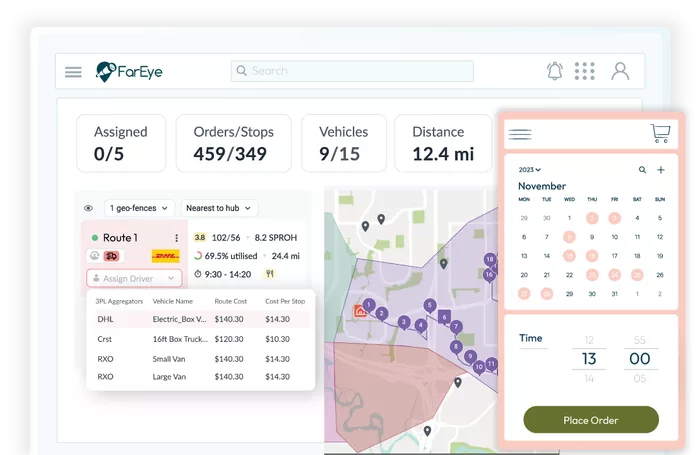
Cost-aware Decisioning, Not Distance-based Routing
Enterprise logistics decisions must consider:
- Cost per mile
- Fleet vs outsourced delivery
- Carrier performance
The best route planning software can reduce operational costs by up to 30% when aligned with financial variables.
Capacity Amplification Without Asset Expansion
Efficiency at scale is driven by utilization, not expansion. Optimized routing enables:
- More deliveries per route
- Reduced empty miles
- Better driver productivity
This increases delivery capacity without increasing fleet size.
The Strategic Lever Most Enterprises Miss: Predictive Accuracy
Routing accuracy is not determined by algorithms alone. It is determined by input precision.
Most systems fail because they cannot accurately predict:
- Service time
- Location complexity
- Execution variability
FarEye’s best route optimization software addresses this through:
- Smart service time modeling
- Zone-level intelligence
- Continuous learning loops
Result:
- 44% reduction in route deviation
- Significant time savings per driver
Executive insight: Efficiency gains plateau when prediction accuracy stagnates.
Why FarEye Stands Out as the Best Route Planning Software
FarEye is not a routing tool layered onto logistics operations. It is a core execution platform designed to optimize decisions across the entire delivery lifecycle.
Constraint-aware Routing Built for Execution Reality
FarEye models real-world complexity:
- Time windows
- Capacity constraints
- Traffic variability
- Driver schedules
This ensures routes are executable, not theoretical.
Unified Visibility Across Hybrid Fleet Ecosystems
Enterprise logistics is inherently fragmented:
- Owned fleets
- Third-party carriers
- Gig networks
FarEye consolidates these into a single control layer, enabling faster and more accurate dispatch decisions.
Workflow Automation that Eliminates Operational Friction
Manual intervention introduces delay and inconsistency. FarEye automates:
- Order allocation
- Route assignment
- Exception handling
This reduces SLA breaches and improves operational discipline.
Predictive Intelligence that Improves Over Time
FarEye continuously learns from:
- Historical delays
- Driver behavior
- Geographic patterns
This enables:
- Smarter routing decisions
- Continuous efficiency gains
- Reduced operational variability
Integration-first Architecture for Enterprise Environments
FarEye integrates seamlessly with:
- ERP
- WMS
- OMS
- TMS
- Telematics
This ensures rapid deployment without disrupting existing infrastructure.
Financial Intelligence Embedded Into Routing Decisions
FarEye enables:
- Cost visibility at the route level
- Carrier performance optimization
- Rate-based decision-making
This transforms routing into a financial control lever, not just an operational tool.
From Optimization to Autonomy: The Next Phase of Logistics
The evolution of routing is clear: from manual planning to automated routing to intelligent orchestration. The next phase is autonomous logistics systems.
These systems will:
- Predict demand before it occurs
- Adjust capacity dynamically
- Optimize continuously without intervention
The Real Question is Not Efficiency. It is Decision Speed
Every logistics leader is trying to improve efficiency. Few are addressing the root cause: decision latency within their systems. The best route planning software is not a routing engine. It is a decision engine.
FarEye enables enterprises to:
- Reduce cost structurally
- Increase capacity without expansion
- Execute with precision in real time
This is no longer about improving routes. It is about building a logistics system that can: decide faster, adapt continuously, and scale without friction. That is what defines operational efficiency at enterprise scale.
Transform your logistics operations with intelligent routing. Schedule a strategic demo with FarEye today.