Table of Contents
- The Operational Quagmire: Critical Challenges in Same-Day and On-demand Logistics
- How the Best Route Planners Resolve Same-day and On-demand Complexity
- How FarEye is a Better Route Planner with AI and Data Predictability
- Implementation: From Decision to Deployment
- From Operational Burden to Strategic Weapon
Let Our Experts Optimize Your Deliveries Today
Let's talkKey Takeaways
- The best route planner uses real-time data on traffic, weather, and order changes to continuously optimize delivery routes, minimizing delays and boosting efficiency.
- AI-driven platforms provide accurate ETAs, proactive alerts, and real-time fleet optimization to handle fluctuating demand and prevent bottlenecks in same-day logistics.
- FarEye's AI-powered software enhances driver efficiency and customer satisfaction through features like turn-by-turn navigation, digital proof of delivery, and dynamic resequencing, all of which help reduce errors and delays.
Consumer expectations have permanently shifted from convenience to immediacy. This makes delivery speed a baseline requirement rather than a competitive differentiator.
This compressed timeline has triggered an operational arms race. The on-demand logistics market is projected to explode to $138.2 billion by 2035. Yet even this staggering figure understates the immediacy shift: same-day delivery alone is projected to reach $36.2 billion by 2030. The gap between these numbers reveals the broader operational arms race; consumers aren't just demanding faster e-commerce, they're demanding instant fulfillment across every category.
Same-day and on-demand logistics are the fastest-growing segments in supply chain management, yet they also pose the most complex operational challenges. However, the difference between operational chaos and competitive advantage lies in deploying the best route planner, intelligent systems that orchestrate dynamic, profitable, and customer-centric delivery ecosystems.
Let's look at these operational challenges and how FarEye has transformed route planning from a back-office function into a strategic command center for logistics excellence.
The Operational Quagmire: Critical Challenges in Same-Day and On-demand Logistics
Meeting accelerated delivery expectations exposes operational vulnerabilities that traditional logistics infrastructure was never designed to address.
- The Velocity-accuracy Paradox
Both same-day and on-demand logistics demand split-second decision-making. However, manual dispatching or legacy systems introduce dangerous latency. Operations teams face a daily dilemma: rush orders out with inefficient routes that waste fuel and driver time, or spend too long planning and miss delivery deadlines entirely.
Either choice results in SLA breaches, eroded margins, and damaged customer relationships. In on-demand logistics, these challenges are even more pronounced, as customers expect perishable goods to arrive quickly and in pristine condition. - Demand Volatility & Capacity Crunch
On-demand logistics, especially in sectors like food delivery, operate without the luxury of overnight batch planning. Order volumes spike unpredictably, and weather events, promotional flash sales, or supply chain disruptions can overwhelm traditional routing models.
This volatility is a concern for e-commerce but extends to the unpredictable nature of grocery deliveries and restaurant orders. Businesses struggle to dynamically match fluctuating demand against available driver capacity without creating bottlenecks or idle resources, further complicating the delivery process. - Inventory Management Complexity
Same-day fulfillment, particularly for grocery and food delivery services, requires real-time visibility into inventory across multiple locations, such as warehouses, dark stores, and retail outlets.
Without intelligent integration, operations teams cannot determine optimal fulfillment sources, leading to stockouts, split shipments, and missed delivery windows. The inability to manage inventory on the fly forces costly emergency transfers and disappointed customers. - Omnichannel Fulfillment Pressure
Modern consumers expect seamless service whether ordering online, via mobile, or in-store. This creates costly complexity, especially in on-demand deliveries, where businesses must fulfill orders from multiple, often small, pickup points while maintaining consistent service levels.
Siloed systems prevent a unified view of orders, inventory, and capacity across channels, resulting in fragmented customer experiences and operational inefficiencies. - The Visibility-communication Void
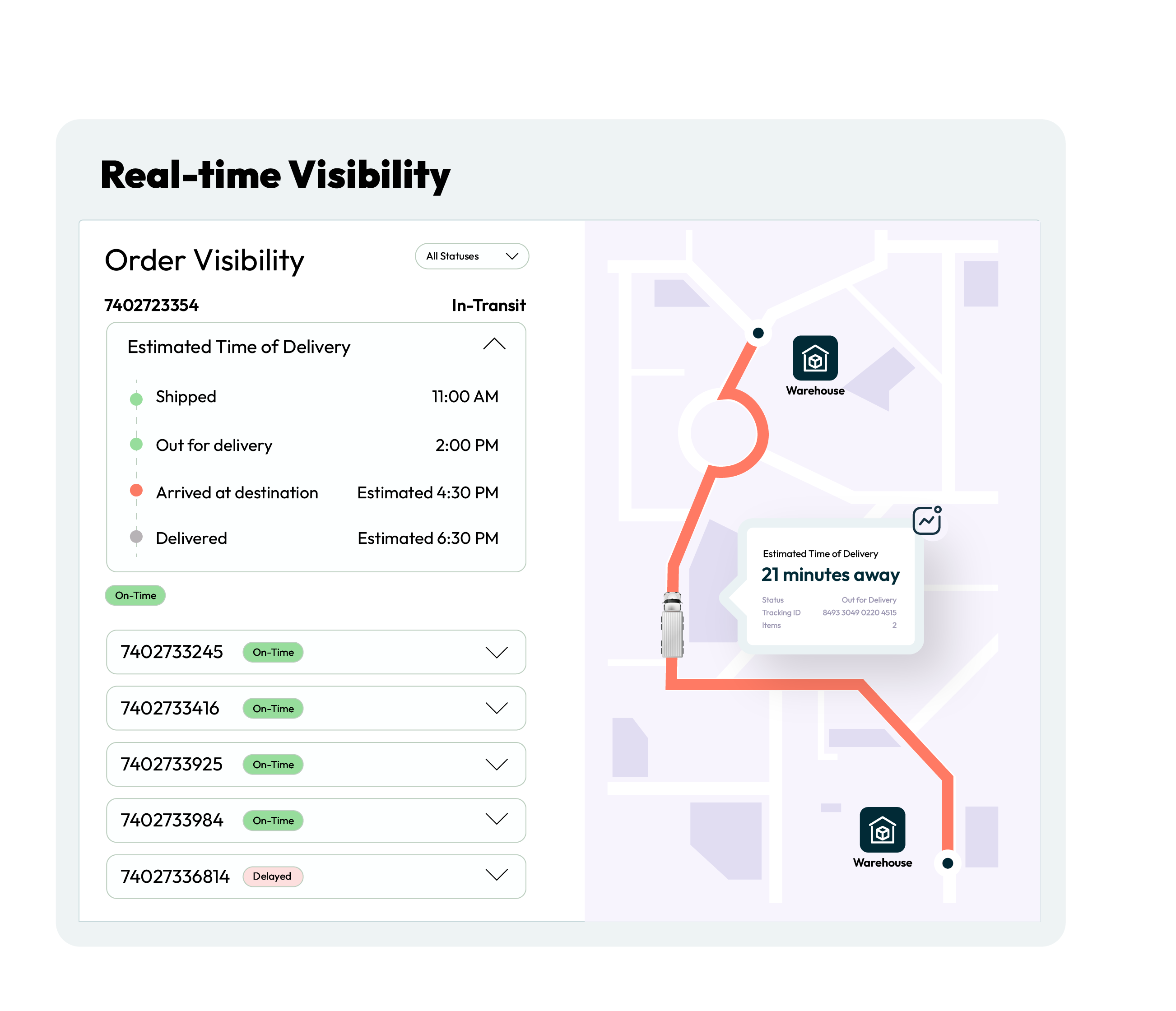
In both same-day and on-demand scenarios, customers expect minute-by-minute visibility, while dispatchers need command-center oversight. Traditional route planning creates information black holes.
Customers don't know when deliveries arrive, cannot modify addresses mid-route, and flood call centers with "Where is My Order" (WISMO) inquiries that erode margins. In on-demand food delivery, the lack of visibility can be even more frustrating, as customers expect real-time updates to manage their meal deliveries, with tight time windows. - Cost Escalation Under Pressure
Expedited logistics typically sacrifices efficiency for speed, especially in same-day and on-demand services. Without intelligent optimization, same-day services and on-demand food deliveries trigger cascading cost explosions.
This results in expedited shipping premiums, overtime driver wages, failed delivery reattempts, and fuel waste from inefficient sequencing.
These challenges aren't operational inevitabilities, but they're symptoms of inadequate tooling. A better route planner transforms these friction points into competitive differentiators.
How the Best Route Planners Resolve Same-day and On-demand Complexity
The best route planner transforms operational friction into competitive advantage through these five core capabilities.
- Dynamic Route Optimization
Real-time processing of traffic, weather, and order changes enables continuous route recalculation without human intervention. This dynamic optimization is essential for both same-day deliveries and on-demand services, where conditions change rapidly. The ability to instantly adjust routes ensures that businesses meet tight deadlines while maintaining operational efficiency. - Intelligent Capacity Management Across Channels
Algorithmic matching of fluctuating demand against available drivers, vehicles, and regulatory constraints prevents bottlenecks and idle resources. This capability ensures that resources are allocated efficiently, particularly in on-demand services where demand can fluctuate unexpectedly, enabling seamless execution of both same-day and on-demand deliveries. - Predictive Visibility for Proactive Decision Making
Machine learning-generated ETAs and proactive exception alerts shift operations from reactive firefighting to preemptive problem resolution. This predictive capability keeps businesses a step ahead in managing disruptions, enabling timely deliveries for both same-day and on-demand services. - Unified Command Infrastructure With System Integrations
Centralized dashboards provide dispatchers with real-time fleet status, route health metrics, and automated anomaly detection. Integration with systems such as WMS, TMS, OMS, and ERPs via APIs enables seamless data flow across inventory, routing, and dispatch systems. This ensures better coordination and operational efficiency across both same-day and on-demand deliveries. - Seamless Mobile Integration for Real-time Update
Driver-facing applications deliver turn-by-turn navigation, dynamic order management, and digital proof-of-capture capabilities. Mobile apps integrated with back-end systems allow drivers to receive real-time updates on routes and order changes. This ensures that both same-day and on-demand deliveries are completed on time, in good condition, and with accurate service.
How FarEye is a Better Route Planner with AI and Data Predictability
While these capabilities define category expectations, FarEye distinguishes itself through execution depth, unified intelligence, and proven outcomes across enterprise-scale deployments.
We have been recognized in the 2025 Gartner® Market Guide for Vehicle Routing and Scheduling Report. This validation confirms our leadership in transforming route planning from an operational necessity into a strategic differentiator.
- Constraint-aware Optimization Engine
FarEye's AI-powered route optimization software handles 100+ constraints simultaneously. The software distinguishes between hard constraints, which are the non-negotiables like HoS limits, vehicle capacity, and legal breaks. It also considers soft constraints, such as time windows and sequence preferences, which may be violated at a penalty.
This hierarchy ensures that FarEye respects inviolable boundaries while maintaining flexibility in preferred rules under controlled penalties. - Predictive Intelligence Layer
Analyzing various data points across traffic patterns, weather impacts, seasonal variations, and driver performance history, the platform generates dynamic ETAs that evolve as road conditions change. More critically, FarEye’s exception-detection capability continuously monitors route progress against predictive baselines.
This shifts operations from reactive firefighting to proactive intervention, reducing firefighting by 60% as agents fix issues before SLAs break, protecting margins and customer relationships simultaneously. - Control-tower Visibility
FarEye’s unified operational consciousness consolidates live vehicle locations, route adherence percentages, driver performance analytics, and automated anomaly detection in customizable interfaces. It does this regardless of fleet type, whether owned, contracted, or gig-based.
Moreover, native integration with WMS, TMS, OMS, and ERP platforms ensures seamless data flow across the entire logistics ecosystem, eliminating information silos. - Intelligent Exception Management
Geofencing triggers alert dispatchers to deviations instantly, while "what-if" scenario modeling enables instant evaluation of disruption responses. The AI-powered platform’s Intelligent alerting hierarchies filter routine updates while surfacing critical exceptions immediately.
This is how dispatchers gain strategic oversight without drowning in operational noise, enabling confident decision-making under pressure. - Driver Experience Platform
Transforming smartphones into sophisticated logistics terminals, FarEye delivers turn-by-turn navigation incorporating real-time traffic, route updates, and customer-specific access instructions.
Dynamic resequencing allows drivers to optimize remaining stops based on local knowledge or emerging constraints without destabilizing overall route efficiency. Hence, its AI-powered capabilities have achieved 50% fewer navigation errors for drives.
Additionally, digital proof-of-delivery capture (POD), including photo verification, electronic signatures, and barcode scanning, creates indisputable delivery records that accelerate billing cycles and eliminate "did not receive" disputes.
Implementation: From Decision to Deployment
Recognizing the need for advanced route planning is straightforward. However, executing a successful implementation requires strategic alignment across people, processes, and technology.
- Assessment and Goal Alignment
Successful implementations begin with an honest evaluation of current-state capabilities. Document existing pain points, manual dispatching bottlenecks, SLA breach frequencies, and cost escalation triggers. Quantifying baseline metrics establishes clear ROI benchmarks. - Integration Architecture
The best route planner features an API-first design enabling phased integration with existing WMS, TMS, OMS, and ERP systems. Pre-built connectors accelerate deployment, reducing integration timelines from months to weeks. - Change Management and User Adoption
Technology deployment fails without user buy-in. Comprehensive training programs tailored to dispatchers, drivers, and customer service teams ensure proficiency. Pilot programs with select routes validate configuration accuracy while building internal advocacy. - Continuous Optimization
Implementation marks the beginning of evolution, not the endpoint. Machine learning models improve through operational exposure, refining predictions as they absorb organizational-specific patterns.
Organizations that treat implementation as iterative sustain competitive advantage, ensuring that technology investments compound returns over time.
From Operational Burden to Strategic Weapon
Same-day and on-demand logistics represent both the greatest opportunity and most formidable challenge in modern supply chain management.
The best route planner is not a cost center but a profit multiplier. It transforms delivery operations from reactive cost sinks into proactive competitive weapons, enabling faster fulfillment, superior customer experiences, and sustainable margins even in compressed delivery windows.
FarEye emerges as one of the best route planners through its AI-driven unified intelligence, connecting constraint-aware optimization, predictive ETAs, control-tower visibility, and scalable architecture into a cohesive system.
Your competitors are already optimizing. Every day without intelligent route planning is a margin lost, and market share surrendered. Book a demo with FarEye today, or risk being left behind in the increasingly competitive logistics industry.
References:
Shah, Ronak. On-demand Logistics Market (2025–2035): Global Market Analysis Report. Future Market Insights, Inc., September 5, 2025.
Research and Markets. Same Day Delivery ‑ Global Strategic Business Report. Research and Markets, February 2026.
Lease Nathan, Oscar Sanchez Duran, and Carly West. Market Guide for Vehicle Routing and Scheduling. Stamford, Gartner, January 29, 2025.