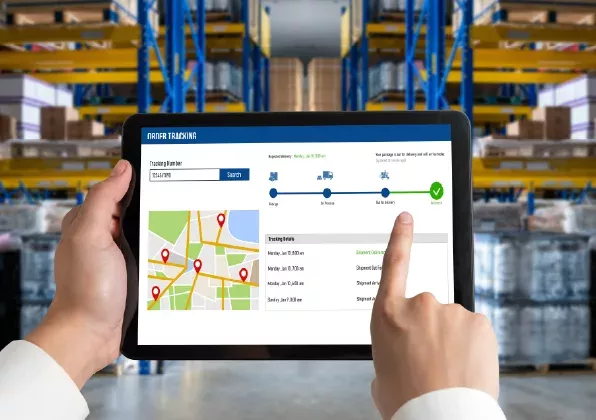
- AI route planning helps fleets move beyond fixed morning routes that fail during live execution.
- It connects traffic data, driver location, order changes, constraint logic, predictive ETAs, and exception alerts.
- The blog explains why route plans break when dispatch, telematics, and customer communication systems stay disconnected.
- FarEye closes this gap through AI-based routing, real-time control tower visibility, planned versus actual analytics, and continuous recalculation.
- These capabilities help reduce dispatch time, improve first-time delivery, increase route capacity, lower WISMO inquiries, and cut delivery costs.
- Strong AI route planning turns every completed route into better planning intelligence for future fleet decisions.
AI route planning promises to eliminate guesswork, yet many fleets still watch planned routes fall apart during execution. Globally, the logistics market is expected to grow by USD 386.52 billion at a 5.3% CAGR through 2030, raising the stakes for execution accuracy.
Dispatchers build optimized sequences each morning, only to see traffic and last-minute orders pull performance off the original plan. This gap between what AI route planning generates and what happens on the road drains fuel budgets and service levels.
AI routing alone cannot close that gap unless the platform stays connected to live execution data. Enterprises that treat planning and execution as separate systems underperform those that unify both layers.
Let's explore why this gap exists and how closing it improves fleet performance.
The Core Gap Between AI Route Planning and What Happens on the Road
Most AI route planning failures start with a disconnect between the planning engine and what actually happens after dispatch. A route optimized on paper still depends on drivers, traffic, and customers behaving exactly as predicted.
Once a route leaves the planning stage, dozens of variables begin working against it in real time. Weather delays, blocked loading docks, and last-minute order changes are rarely factored back into the original plan.
1. Traffic and Live Conditions Plans Cannot Predict in Advance
Legacy planning models rely on historical traffic averages instead of real-time congestion data at the moment of departure. This disconnect pulls AI route planning away from live execution reality within the first hour of any shift.
2. Driver Behavior That Deviates From Optimized Sequences
Drivers frequently reorder stops based on personal familiarity with a zone, even when the planned sequence is more efficient. Without live tracking, dispatchers have no way to correct these deviations before they affect downstream deliveries.
3. Manual Overrides That Break AI-Generated Logic
Dispatchers under time pressure often override optimized routes manually to accommodate urgent requests or perceived shortcuts. These overrides frequently ignore the constraint logic that the AI model used to build the original sequence.
4. Weather and Access Disruptions the Original Plan Never Accounted for
Sudden weather shifts, road closures, and blocked delivery access points rarely appear in the data used to build the morning plan. Routes built without a live disruption feed stay optimized on paper long after conditions on the ground have changed.
5. Disconnected Systems That Prevent Real-time Plan Updates
Planning engines that operate separately from dispatch, telematics, and customer communication tools cannot update routes as new information arrives. This fragmentation forces dispatchers to manually reconcile data across systems instead of trusting one unified execution view.
A leading logistics company in Thailand cut dispatch-process time and reduced its fleet from 300 vehicles to 130 using FarEye Route. See how They did it.
Key Capabilities That Close the AI Route Planning Execution Gap
A true AI route optimization software platform recalculates affected stops in seconds rather than requiring a full manual replan. This responsiveness is what separates modern AI route optimization software from legacy, one-time planning tools.
These capabilities separate real AI route planning from theoretical optimization that never survives contact with the road.
- Real-time re-sequencing that adjusts routes dynamically as traffic, delays, or new orders emerge mid-shift.
- Live driver location tracking that feeds actual position data back into the planning engine continuously.
- Predictive ETA modeling that updates delivery windows based on current conditions rather than fixed assumptions.
- Automated exception alerts that flag deviations before they cascade into missed delivery windows downstream.
- Constraint-aware planning that accounts for vehicle capacity, driver skill, and time windows simultaneously.
- Planned versus actual reporting that closes the feedback loop between what was planned and what occurred.
Wondering what accurate ETAs look like in live operations? A leading furniture retailer connected customer-selected delivery slots with routing and recorded a 97% increase in ETA accuracy, more on-time deliveries, and higher supported order volumes. Check out the Full Story.
How FarEye Delivers AI Route Planning That Matches Real-world Execution
FarEye closes the AI route planning gap with continuous execution data instead of a one-time morning route build. The platform keeps planning and execution connected throughout the entire delivery lifecycle.
1. AI-based Routing With Continuous Recalculation
FarEye improves AI route planning accuracy through live traffic feeds, driver behavior data, and real-time order changes. Routes adjust automatically instead of requiring dispatchers to manually rebuild sequences mid-shift.
Enterprises using this approach see a 22% year-over-year decrease in dispatch time, an 18% increase in first-time delivery rates, and a 16% increase in stops per route.
2. Real-time Control Tower for Execution Visibility
Dispatchers see live driver location, delivery status, and route deviations without relying on manual phone check-ins throughout the day. Automated alerts surface exceptions early, giving teams time to intervene before SLA breaches occur. This visibility drives a 95% increase in OTIF delivery rates, an 80% reduction in manual status update effort, and a 6% increase in OTIF-compliant deliveries overall.
3. Predictive ETA and Service Time Intelligence
The platform continuously refines estimated arrival times based on live conditions rather than fixed historical averages alone. This keeps customer-facing communication accurate even as routes shift throughout active execution. Accurate ETAs contribute to a 50% reduction in WISMO inquiries per order, a 15-point increase in customer NPS, and a 12% increase in capacity utilization.
4. Planned vs. Actual Analytics for Continuous Improvement
FarEye captures the gap between planned and actual performance at every stop, turning execution data into future planning intelligence. This closes the loop that most AI route optimization tools leave open indefinitely. This continuous feedback has helped enterprises save 75M+ kilometers, reduce 550K+ metric tonnes of GHG emissions, and cut average cost per delivery by 18%.
Implementation Best Practices for AI Route Planning Software
Rolling out AI route planning software requires more than switching on an algorithm and expecting immediate results. A structured deployment protects the accuracy that the platform is designed to deliver.
- Validate historical route and stop data before go-live so the AI model learns from accurate patterns rather than flawed history.
- Connect live GPS and telematics feeds during onboarding to ensure the platform receives real-time execution data from day one.
- Configure constraint rules for vehicle capacity and driver skill so that generated routes reflect actual operational limitations.
- Run parallel planning before full fleet cutover to compare AI-generated routes against existing plans and catch gaps early.
- Train dispatchers on exception handling rather than manual route building since their role shifts toward oversight and recovery.
- Track planned versus actual performance from day one to measure how quickly the platform closes the execution gap.
Ready to Close the AI Route Planning Execution Gap?
Closing the AI route planning gap protects margins that enterprises cannot recover once inefficiencies compound across a fleet. Fixed plans built once each morning cannot account for the traffic, driver behavior, and exceptions that unfold throughout the day.
Platforms built on continuous execution data close this gap instead of leaving dispatchers to manage it manually. FarEye connects AI-based routing, real-time control tower visibility, and planned versus actual analytics into a single execution layer.
Enterprises using this approach see fewer missed delivery windows and lower per-delivery costs across their networks.
Ready to close the gap between smart route plans and real-world execution? Book a demo with FarEye today.
Book a Demo With FarEye →Frequently Asked Questions
Why do AI-optimized routes still fall apart during execution?
AI routes fail when models lack real-time execution data, such as driver availability, traffic changes, failed stops, capacity shifts, and customer-driven disruptions.
What are the main causes of the gap between AI route planning and real-world execution?
The gap occurs due to outdated inputs, poor data quality, missing constraints, manual interventions, disconnected systems, and limited feedback from completed routes.
How is true AI routing different from legacy one-time planning tools?
Legacy tools create fixed route sequences, while AI routing continuously learns from execution data, recalculates plans, predicts disruptions, and improves delivery decisions.
What capabilities actually close the AI route planning execution gap?
Closing the gap requires real-time optimization, dynamic rerouting, predictive ETAs, telematics integration, driver feedback, exception management, and planned-versus-actual analytics.
Why does planned-versus-actual reporting matter for AI route planning?
Planned-versus-actual reporting reveals route deviations, service-time errors, delays, and operational patterns, helping AI models improve future route optimization decisions.
What results has FarEye delivered with its AI route planning approach?
FarEye has helped enterprises reach 18% lower average delivery costs and save 75M+ kilometers through route optimization, helping enterprises improve fleet efficiency and delivery execution.
How should enterprises roll out AI route planning software?
Enterprises should begin with clean data, defined constraints, system integrations, pilot routes, dispatcher training, KPI tracking, and continuous optimization.
How is the logistics market's growth relevant to AI route planning?
The global logistics market may grow by USD 386.52 billion at a 5.3% CAGR through 2030, increasing delivery complexity and the need for AI route planning. As networks expand across regions, carriers, and service levels, AI helps enterprises optimize capacity, adapt routes in real time, and maintain delivery performance at scale.
Reference: Technavio. "Logistics Market Analysis, Size, and Forecast 2026–2030." Published April 2026. Accessed July 8, 2026. Figures are subject to change — verify current numbers before publishing updates.