
Table of Contents
- Why Scaling a Fleet Isn't Just About Buying More Trucks
- Beyond Navigation: The Core Capabilities that Drive Value
- FarEye's Intelligent Truck Route Planning Software for Growth-stage Fleets
- Implementation: Turning Truck Route Planning Software Into a Measurable Scale
- Make Smarter Scale Decisions With FarEye Before Peak Demand
Let Our Experts Optimize Your Deliveries Today
Let's talkKey Takeaways
- Scaling fleets with more trucks and staff creates a margin trap, because fixed costs rise faster than utilization and service consistency can keep up.
- Truck route planning software unlocks hidden capacity through LTL and FTL optimization, automated dispatch, and more that reduces empty miles and improves stops per hour.
- FarEye helps growth-stage fleets turn optimization into repeatable execution with AI- powered constraint-led planning backed by a practical implementation path.
What if the $700 billion US trucking industry has been approaching growth wrong all along? For decades, fleet operators have accepted a deceptively simple premise as immutable law: to move more freight, you need more capacity.
This mindset has driven proportional investment in more vehicles, more drivers, more yard space and more administrative overhead. The problem? This linear scaling model erodes margins precisely when volume opportunities peak, creating a growth paradox that has trapped countless operators in cycles of expansion and contraction.
FarEye is challenging this conventional wisdom with truck route planning software that enables a fundamentally different approach to scaling. Let's examine how truck route planning software transforms fleet economics, enabling operators to handle growing demand without linear cost increases.
Why Scaling a Fleet Isn't Just About Buying More Trucks
More volume should mean more revenue. Yet many fleets hit a margin squeeze because growth adds cost and complexity faster than it adds profit. The real scaling challenge is not simply the assets. It is the operating conditions that shift as your network expands.
- Rising Driver Wages and Compliance Costs
As volumes rise, fleets often compete harder for qualified drivers. Wage pressure increases, and so do the hidden costs tied to hiring, retention, training and scheduling. At the same time, compliance becomes more difficult to manage at scale, with stricter documentation requirements, safety processes, and Hours of Service (HoS) adherence.
Every additional truck multiplies the effort needed to stay compliant, audit-ready and consistent across shifts and regions. - Increasing Customer Expectations for Accurate ETAs
Scaling adds more stops, more variables and more exception scenarios, but customer tolerance for uncertainty keeps dropping. Shippers and end customers expect tighter delivery windows, proactive updates and accurate ETAs that hold up in real conditions.
Without strong planning and real-time adjustment, ETA accuracy slips, service teams get overloaded and "Where is My Delivery?" (WISMO) volume spikes, raising cost-to-serve while damaging trust. - Fuel Price Volatility and Cost Sensitivity
Fuel is one of the fastest ways a growing fleet can lose margin. Price swings hit every route, and longer miles from suboptimal planning quickly become expensive. As customers negotiate harder on rates and surcharges, fleets need tighter control over route efficiency, idling, dwell time and empty miles.
When fuel volatility meets fixed-rate pressure, small planning gaps turn into large profit leakage. - Complex Regional Regulations and Freight Types
Expansion often means crossing into new states, cities and zones with different rules on permits, access restrictions, vehicle classes and operating hours. Add diverse freight types, special handling requirements, temperature control, hazardous classifications or delivery protocols, and route planning becomes more than distance and time.
Each new region and freight profile introduces constraints that can break manual dispatch logic and create costly misroutes, delays and compliance exposure.
Beyond Navigation: The Core Capabilities that Drive Value
True truck route planning software goes far past "best path on a map." It operationalises constraints, automates decisions at scale and turns daily planning into a margin-protecting system.
Here is what it actually delivers when fleet growth starts tightening budgets.
- Constraint-aware Planning that Prevents Expensive Routing Mistakes
Good routing starts with truck realities, not generic GPS. The engine plans with vehicle weight, height, axle limits, bridge restrictions, road classes, delivery windows and site access rules baked into every route decision.
That reduces avoidable detours, failed delivery attempts and penalty exposure. It also improves planner productivity by reducing the number of routes that require manual fixes, keeping costs steady even as volumes increase. - Multi-stop Optimization that Increases Stops Per Hour
Multi-stop optimization is not simply about sequencing stops. It is intelligent clustering and ordering that reduces idle time, cuts dwell-related delays and improves time-on-road utilization.
By tightening stop density and sequencing, fleets increase stops per hour without adding trucks or dispatch headcount. The result is lower cost per stop, higher driver productivity and better margin control as volumes scale. - Real-time Adjustments that Keep Execution Aligned to the Plan
Route plans lose value the moment conditions change. Strong truck route planning software provides dashboards for exceptions and enables on-route re-optimisation based on traffic, weather, order changes, cancellations or customer unavailability.
When the system can reroute without chaos, fleets protect ETAs, reduce late deliveries, and prevent costly ripple effects such as missed time windows and reattempts. That directly lowers cost-to-serve and stabilizes service performance. - Compliance and Safety Logic Built into Daily Planning
Scaling quickly can create compliance risks that quietly erode profits through violations, incidents, and insurance pressure. Software that factors in driver hours, legal limits, and rest requirements into planning helps reduce HoS violations and unsafe schedules.
It also supports consistent dispatch decisions across regions and shifts, protecting margins by lowering regulatory exposure and reducing operational variability. - Load Balancing and Backhaul Intelligence that Cuts Empty Miles
Load balancing distributes work realistically across routes and drivers, preventing overloaded routes, underutilized runs and avoidable overtime. Backhaul intelligence identifies return opportunities, consolidates compatible pickups and reduces empty backhauls that inflate fuel and maintenance costs.
Together, these capabilities improve utilization, lower fuel cost per mile, and help fleets absorb demand spikes without buying more equipment.
FarEye's Intelligent Truck Route Planning Software for Growth-stage Fleets
FarEye operates as an AI-powered fleet orchestration layer that includes truck route planning software purpose-built for operators scaling without proportional cost increases.
- AI-based Routing and Constraint Optimization
The software models vehicle parameters alongside operational constraints, so route plans stay feasible in the real world. It considers vehicle type, body configuration, and physical dimensions, including length, height, and weight limits. Then it aligns these parameters with vehicle capacity, driver hours-of-service, customer time windows, traffic patterns and delivery requirements.
This ensures routing decisions account for restrictions such as low bridges, narrow access roads, gated docks, and site-specific entry rules, not just distance and time. The result is feasible multi-stop plans that maximize utilization without violating compliance or service commitments, reducing rework, detours and failed attempts.
This intelligent orchestration has already delivered measurable impact at scale. In fact, FarEye has helped save 75M+ kilometres via route optimisation, significantly reducing fuel consumption, operational costs and carbon emissions across global logistics networks. - Carbon-aware Routing for Measurable Sustainability
The route optimization software schedules deliveries during low-traffic, low-emission periods without compromising customer requirements. The system balances speed, fuel efficiency and carbon footprint, enabling sustainability targets while maintaining competitive transit times and meeting tightening environmental regulations.
This approach delivers measurable environmental impact at scale. FarEye has helped reduce 550K+ metric tonnes of GHG emissions, demonstrating how intelligent routing and green delivery windows can translate sustainability goals into real, quantifiable outcomes. - Skill Based Crew Allocation
Matches delivery complexity to crew capabilities, ensuring high-value or specialized shipments get experienced teams while routine drops use standard configurations. The software supports flexible crew structures, such as one driver and one helper, optimizing labor costs against service requirements for each stop type.
It also factors in stop-level realities that drive time and risk, such as installation needs, heavy or fragile handling, cash collection, gated access, returns pickup, and documentation requirements. By assigning the right crew profile to each stop, teams reduce dwell time, avoid reattempts, and improve First Attempt Delivery Rate (FADR). - Intelligent LTL Consolidation for Cost Efficiency
Consolidates less-than-truckload shipments into optimal multi-stop routes that maximize truck utilization without sacrificing service windows. It automatically groups compatible freight by destination cluster, delivery priority and handling requirements, transforming fragmented LTL operations into efficient full-truckload equivalents.
This approach delivers measurable unit-economics gains. In practice, teams have seen an 18% reduction with FarEye's software, in average cost per delivery when LTL consolidation is planned with tighter sequencing and higher utilization. - FTL Route Planning that Protects Compliance and Margins
For full-truckload operations, FarEye supports multi-day route planning that accounts for long-haul realities like mandated breaks, rest windows, shift handovers and night driving constraints.
The system factors DoT-aligned rules and operational guardrails into route feasibility, helping fleets avoid plan-versus-execution drift that triggers delays, violations, and costly rescheduling. The result is fewer compliance exceptions, smoother dispatch continuity and better asset productivity across multi-day cycles. - Smarter Load Optimization for Higher Fill Rates and Lower Miles
FarEye's load optimisation capabilities help fleets use capacity more efficiently by improving how freight is arranged, balanced and assigned to vehicles based on weight, volume and handling constraints.
This reduces under-filled trucks, prevents overloaded runs and limits unnecessary split shipments. Better utilization directly lowers cost per mile, reduces extra trips and supports predictable service even when order mix changes. - Real-time Visibility that Turns Exceptions into Controlled Decisions
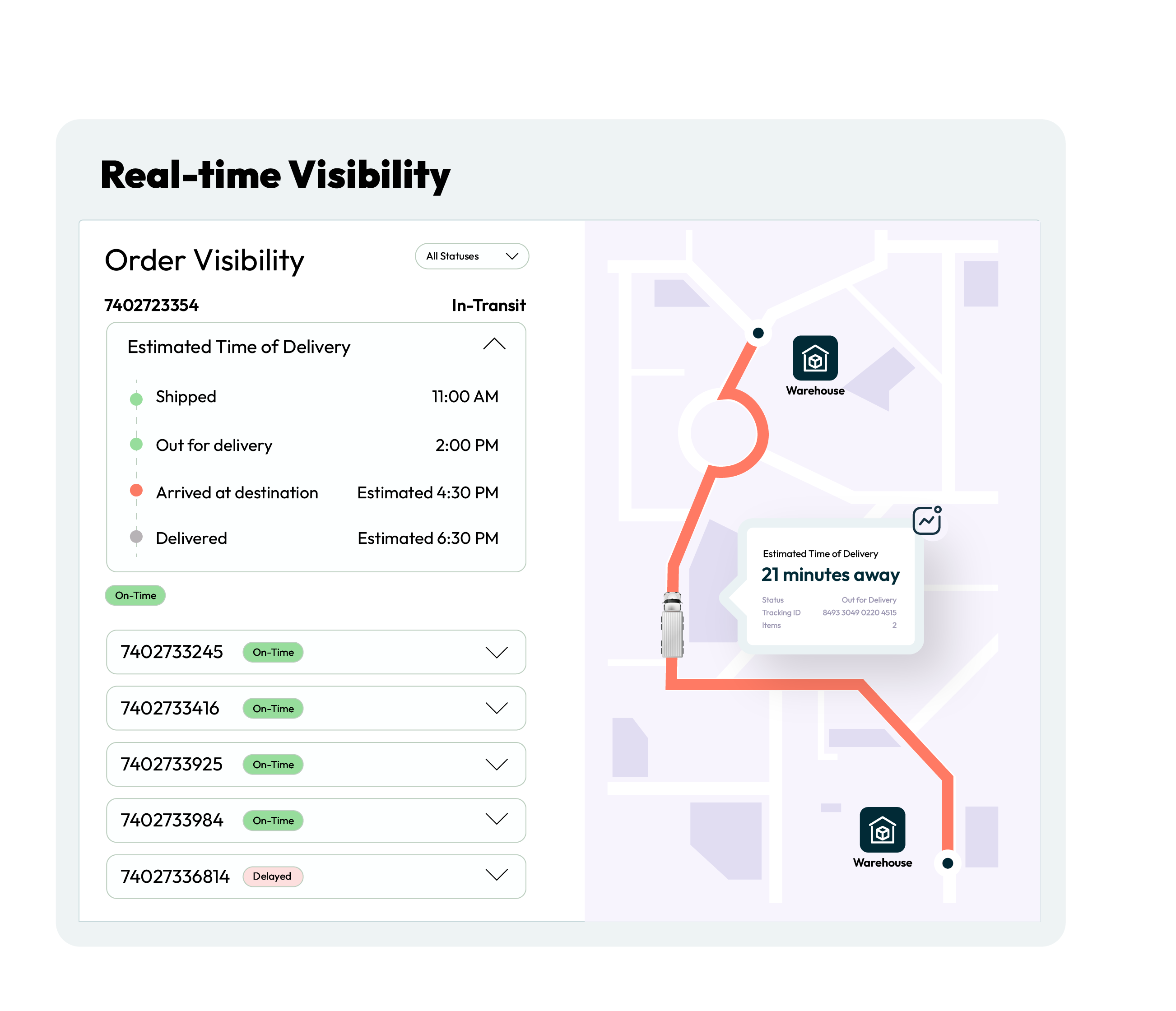
FarEye’s AI-powered software extends beyond planning into execution visibility, giving teams real-time awareness of route progress, dwell time, delays, and delivery completion status. With live dashboards and milestone tracking, planners and supervisors can spot risk early, prioritise interventions and reduce “surprise” late deliveries.
When visibility is connected to routing logic, teams can respond with action, not guesswork.
Implementation: Turning Truck Route Planning Software Into a Measurable Scale
Implementation is where route planning moves from a promising capability to a repeatable operating advantage, helping fleets add stops and utilization without adding trucks, headcount or overhead at the same rate.
- Start with a Scaling Goal
Define what "scale" means in your operation, then lock the service, cost and compliance limits that the system must never break. This keeps optimization aligned to margin and OTIF, not just shorter routes. - Codify Constraints Before You Optimise
Move tribal knowledge into structured rules for vehicles, customers, sites and driver capabilities so plans match real-world execution. The more complete your constraint library is, the fewer "dispatch overrides" you need later. - Stabilize Planning Data that Affects Daily Decisions
Validate geocodes, service times, load attributes and fleet master data. Treat data fixes as an operating cadence, because routing quality follows input quality. - Run a Bounded Pilot with Clear Success Metrics
Choose one region or lane where manual planning is already strained and where route density reveals fast gains. Keep the pilot under control, measure outcomes weekly and iterate on constraints until execution matches the plan. - Integrate Around Decisions, Not System Checklists
Prioritize the flows that change routing outcomes, such as orders, capacity, driver availability and real-time status signals. This ensures replans remain accurate and that the dispatch team trusts the platform's recommendations. - Set an Exception Workflow that Scales with Volume
Choose what changes the system can automate and which ones require approval from the dispatcher. A consistent exception model prevents last-minute chaos as stop counts rise and maintains SLA compliance.
Make Smarter Scale Decisions With FarEye Before Peak Demand
Fleet growth does not have to mean higher fixed costs and thinner margins. With the right truck route planning software, capacity becomes a planning outcome, shaped by constraints, utilization and service commitments.
It also helps teams operationalize that shift through constraint-led planning and continuous route re-optimization that keeps plans feasible as conditions change. If you wait until service slips or detention spikes, you will end up rebuilding routes reactively, paying more to recover trust and stabilize performance under pressure.
Learn the playbook now, benchmark your network, and spot the hidden capacity you already own. The operators who act early lock in efficiency before peak demand hits again. Book a demo with FarEye and make the shift before competitors do.