Table of Contents
- The Challenge Dispatchers Face: Variability, Complexity and Gaps
- How Route Optimization Algorithms Add Accuracy to Multi-stop Planning
- Why All This Matters: Accuracy Translates Directly into Business Value
- Embedding FarEye: AI and Machine Learning for Route Accuracy
- Best Practices to Realize Multi-stop Delivery Accuracy Gains
- From Routing Theory to Delivery Precision
Let Our Experts Optimize Your Deliveries Today
Let's talkA single misstep in a multi-stop delivery route can ripple across an entire day’s dispatch. A 10-minute delay at stop 7 morphs into missed windows at stops 12 and 15, rework, reroutes and customer complaints. In 2025, U.S. carriers are dealing with rising volumes an estimated 24 billion packages are expected to be delivered domestically.
The pressure is high: last-mile operations already absorb over 50% of total delivery cost in logistics. For dispatchers and allocators managing fleets of delivery vehicles, the promise of route optimization algorithms is not just efficiency; it’s precision, predictability and reliability in every stop.
In this article, you’ll follow the journey of how advanced routing logic transforms multi-stop dispatch from best guess to razor-sharp performance. You will see how an optimal routing algorithm powered by AI and ML closes the gap between plan and execution.
The Challenge Dispatchers Face: Variability, Complexity and Gaps
Before diving into route optimization algorithms, it helps to relate directly to your daily reality as a dispatcher or allocator:
- You juggle lists of stops with time windows, vehicle capacities and driver shifts.
- You inherit unpredictable factors: traffic delays, last-minute orders, road closures and customer availability changes.
- You must balance utilization (fill trucks fully) with a buffer for uncertainties.
- You field exceptions, failed stops, missed windows, rerouting and absorb their cost and reputation impact.
- You monitor KPIs: late-delivery rate, first-attempt success, reassignments and driver overtime.
In essence, your job is about translation: converting high-level business goals (on-time SLAs, utilization, cost control) into daily, reliable routes that survive real-world noise. That translation is where route optimization algorithms come in.
How Route Optimization Algorithms Add Accuracy to Multi-stop Planning
Let’s walk through core concept areas where route optimization algorithms shift your delivery system from “hope it works” to “engineered for accuracy.”
Constraint Modeling and Feasibility Checking
At its foundation, a route optimization algorithm must understand what is allowed. It encodes:
- Time windows per stop (earliest/latest)
- Handling or service time (loading, unloading, dwell time)
- Vehicle capacities (weight, volume)
- Driver shift rules, breaks and legal constraints
- Road/route restrictions (height, weight, one-way)
- Precedence rules (e.g., pick-up before drop-off)
By internalizing these as hard constraints or penalty-weighted soft constraints, the route optimization algorithm ensures no solution outright violates critical business rules. That inherently boosts delivery accuracy: the planner won’t schedule a route that is impossible to execute without manual fixes.
Intelligent Sequencing and Route Construction
Once constraints are in place, the route optimization algorithm must decide in which order to visit stops and which vehicle serves which cluster. Here’s how:
- Constructive heuristics (e.g., insertion, nearest-neighbor) build an initial feasible route.
- Local search and improvement (2-opt, 3-opt, swap, relocation) refine the sequence to reduce travel time or distance.
- Large Neighborhood Search (LNS) or destroy-and-repair logic helps escape local minima by reassigning sub-routes.
- Hybrid or multi-stage algorithms embed an optimal routing algorithm core, for instance, swapping route legs only when it improves the weighted objective (cost + SLA adherence + buffer).
In practice, this sequencing considers not just “shortest distance” but multi-dimensional costs (time, reliability, slack). A good routing engine doesn’t just minimize miles, it maximizes the probability that time windows are still met under real-world variability.
Buffering, Slack and Robustness
A route optimized to the tightest possible margins may fail catastrophically under the slightest delay. Accuracy grows when route optimization algorithms intelligently build in slack:
- Inter-stop time buffers to absorb minor delays
- Margin over worst-case predicted travel (e.g., using the 90th percentile travel time, not the mean)
- Alternate route segments/contingency edges baked in for flexibility
- Preemptive slack distribution (placing buffer where risk is highest)
Effective buffer planning ensures that minor deviations do not cascade into major failures. It’s the insurance cushion that protects accuracy.
Predictive Modeling and Learning
To make routing more aligned with reality, optimal routing algorithm systems ingest data:
- Historical travel times by time of day, day of week and route segments
- Traffic pattern models, congestion forecasts and weather impact
- Driver-specific behavior (preferred shortcuts, typical deviation patterns)
- Service time variability models (some stops tend to take more time)
- Machine learning layers that adjust travel-time estimates or penalty weights over time
When the algorithm’s input model more closely matches what actually happens, the delivered route is more accurate, with fewer surprises, fewer gap corrections mid-route.
Real-Time Reoptimization and Dynamic Adjustments
Even the best route can’t fully anticipate everything. The ability to adapt mid-route is critical:
- Trigger-based reoptimization when delays exceed thresholds
- Incremental reoptimization, adjusting only downstream legs, leaving past stops intact
- Dynamic insertion of new stops or urgent orders into the existing route
- Swap or reschedule downstream segments to maintain on-time delivery
- Driver feedback loop: if the driver reports a delay/blockage, the system recalibrates the remaining path
Real-time dynamic adjustment means your planned route stays aligned with the unfolding reality, preserving accuracy rather than letting minor drift become a major deviation.
Exception and Recovery Logic
No algorithm is perfect and exceptions will occur. The difference is in handling:
- Fallback reroutes or bypasses when a stop fails
- Rescheduling to alternate vehicles, if capacity allows
- Minimal repair heuristics to reoptimize only the affected portion
- Manual override support for dispatchers, augmented by algorithmic suggestions
- Anomaly detection/alerts to flag routes whose deviation exceeds acceptable thresholds
A robust route planning software reduces the number of failed deliveries or downstream shift impacts by proactively recovering from errors.
Why All This Matters: Accuracy Translates Directly into Business Value
When a dispatcher shifts from manual routing or basic heuristics to a system powered by advanced route optimization algorithms, the outcomes aren’t abstract; they’re measurable:
- Lower late-delivery rate and higher SLA compliance
- Fewer failed or missed stops, minimizing rework and customer callbacks
- Reduced miles per stop, cutting fuel and wear costs
- Higher vehicle utilization (more stops served per route)
- Better driver productivity (less deadhead or idle time)
- Improved ETA reliability, enabling proactive notifications
- Scalable operations (the same dispatch team handles greater volume with consistency)
Embedding FarEye: AI and Machine Learning for Route Accuracy
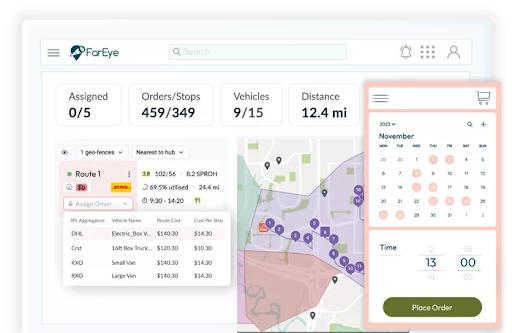
Let’s talk about how FarEye’s route optimization software fits into this architecture.
AI-powered Routing Engine
FarEye’s platform combines predictive analytics, optimization heuristics and dynamic re-planning to propose routes that are robust under real-world variation.
Constraint-aware, Enterprise-scale Planning
It supports large order volumes, handles multiple fleet types (captive, hybrid, outsourced) and integrates with WMS/TMS.
Real-time Dynamic Route Recalculation
When traffic or other events intervene, FarEye updates routes on the fly to salvage window integrity.
Learning from History
Its algorithms ingest past routing outcomes, driver deviations and actual travel-time deltas to refine model parameters over time.
Green Routing and EV Support
For fleets with electric vehicles, FarEye factors in charging stations and green windows to maintain both accuracy and sustainability.
Exception Handling and Smart Fallback
The platform includes reroute logic, recovery heuristics and dispatcher override tools for real-world robustness.
By positioning FarEye as your routing backbone, dispatchers gain a system that embeds many of the algorithmic guardrails above, freeing them from micromanaging every deviation.
Best Practices to Realize Multi-stop Delivery Accuracy Gains
To maximize the benefit of route optimization algorithms, dispatchers and allocators should adopt a methodical approach:
Data Hygiene and Geocoding Accuracy
Standardize addresses, validate geocodes and handle edge-case access roads
Snap stops at realistic road network pointsBaseline Measurement and Diagnostics
Measure current late rate, failure rate and driver deviations
Identify high-impact routes (dense, high-variance) for early pilotPilot Region or Fleet Rollout
Start in one city or zone
Capture deviations, compare the algorithm vs manual route performanceIterative Calibration and Feedback Loop
Feed execution data back to adjust travel-time models, slack margins
Monitor routes that drift and adjust algorithmic penaltiesDriver Buy-in and Guidance
Educate drivers about optimized route value
Provide in-cab navigation tools, visual maps and mobile apps
Capture deviation telemetry to understand “why” they deviateException Policy Design
Define thresholds for reroute triggers (minutes, load, arrival time)
Build fallback logic for stops that cannot be served
Empower dispatchers with override tools plus algorithmic suggestionsScale Carefully via Clustering and Zoning
For large territories, break into zones
Route within zones and occasionally recombine for cross-zone optimizationContinuous KPI Tracking and Governance
Monitor late rate, first-attempt success, route distance per stop
Set target thresholds and escalate when accuracy degrades
From Routing Theory to Delivery Precision
For dispatchers and allocators, the question isn’t whether route optimization algorithms are “nice to have,” it’s whether your operations can survive without them. In a world where customer expectations are rising, margins are tight and scale is non-negotiable, route optimization algorithms are the tools that turn theory into dependable execution.
By embedding constraints, sequencing intelligently, buffering for uncertainty, learning from history, dynamically reoptimizing mid-route and preparing for exceptions, high-end routing systems reduce the gap between plan and execution by orders of magnitude. FarEye’s AI-based route planning and optimization platform encapsulates these advanced capabilities, offering dispatchers the scaffolding to deliver multi-stop accuracy at scale.
Sources:
https://www.pitneybowes.com/us/shipping-index.html
https://www.statista.com/statistics/1434298/last-mile-share-of-total-shipping-costs/