
Table of Contents
- Why Your Real-world Challenges Demand Data-driven Routing
- From Raw Data to Intelligence: The Data Pipeline in the Route Management System
- How That Data Intelligence Translates into Smarter Deliveries
- Architecting for Scale, Real-Time and Enterprise Execution
- Addressing Common Concerns and Misconceptions
- FarEye: Contextual Fit for Enterprises
- Putting It to Work: How You Can Drive Value
- Ready to Transform Your Deliveries? Take the Next Step
Let Our Experts Optimize Your Deliveries Today
Let's talkWhen a regional fulfillment center in Chicago switched from hand-crafted routes to a data-driven route management system, its late-delivery rate dropped significantly in just six weeks. That’s not a fluke.
Logistics firms adopting route optimization now report fuel reductions approaching 20–25%. For dispatchers and allocators managing dozens or hundreds of vehicles, that kind of uplift is transformational.
Let’s understand how a modern route management system ingests and processes data and how that converts into smarter, more reliable, efficient deliveries.
Why Your Real-world Challenges Demand Data-driven Routing
Before diving into the architecture of the route management system, let’s center on what keeps dispatchers up at night:
- You assigned 30 deliveries today, but some vehicles still run 30 % under capacity while others are overloaded.
- Traffic snarls flip your planned ETAs upside down halfway through the shift.
- Drivers deviate to their “known shortcuts,” which disrupts upstream stops.
- New urgent orders land mid-route. You scramble to reassign.
- Your performance metrics (on-time, fuel, overtime) never quite match reality.
These are not edge cases; they’re everyday realities in U.S. operations. A robust route management system, powered by data, is your bridge from chaotic scheduling to reliable execution.
From Raw Data to Intelligence: The Data Pipeline in the Route Management System
A route management system (or routing management system) doesn’t magically make good decisions. It relies on a layered data pipeline. Here’s how a top system structures it:
Ingestion and Normalization
- Order/stop Data: Addresses, time windows, package dimensions
- Vehicle Metadata: Capacity, height/weight limits, availability
- Driver Constraints: Shift hours, rest rules, certifications
- Map and Network Data: Road graphs, turn restrictions, forbidden zones
- Historical Performance: Past travel times, delays, stop durations
- Real-time Feeds: Traffic, incidents, weather, telematics (GPS)
All these are cleaned, geocoded and normalized so the engine sees consistent data.
Derivation and Enrichment
- Precompute time/distance matrices for frequently traveled pairs
- Cluster stops spatially (zoning) to reduce combinatorial explosion
- Estimate service/dwell times when missing
- Flag constraints (e.g., “this stop needs special handling”)
Constraint Modeling
Your business rules become formal constraints:
- Time window bounds (earliest/latest arrival)
- Vehicle capacity (volume and weight)
- Route duration limits
- Road restrictions (low bridges, one-way)
- Regulatory constraints (driver rest, drive hours)
- Precedence (some deliveries must precede pickups)
Optimization Engine
This is the core solver. An advanced route management system (e.g., FarEye) combines algorithmic routing with AI heuristics to balance multiple objectives: distance, vehicle count, lateness and capacity usage.
- It begins with candidate route solutions
- It iterates via heuristics, metaheuristics or hybrid ML + search
- It can simulate “what-if” scenarios (roadblock, new stop, cancellation)
- It produces the “best feasible” set of routes and assignments
Dispatch and Execution Interface
- Routes are pushed to driver apps with details (stop sequence, ETA)
- Navigation and turn-by-turn guidance
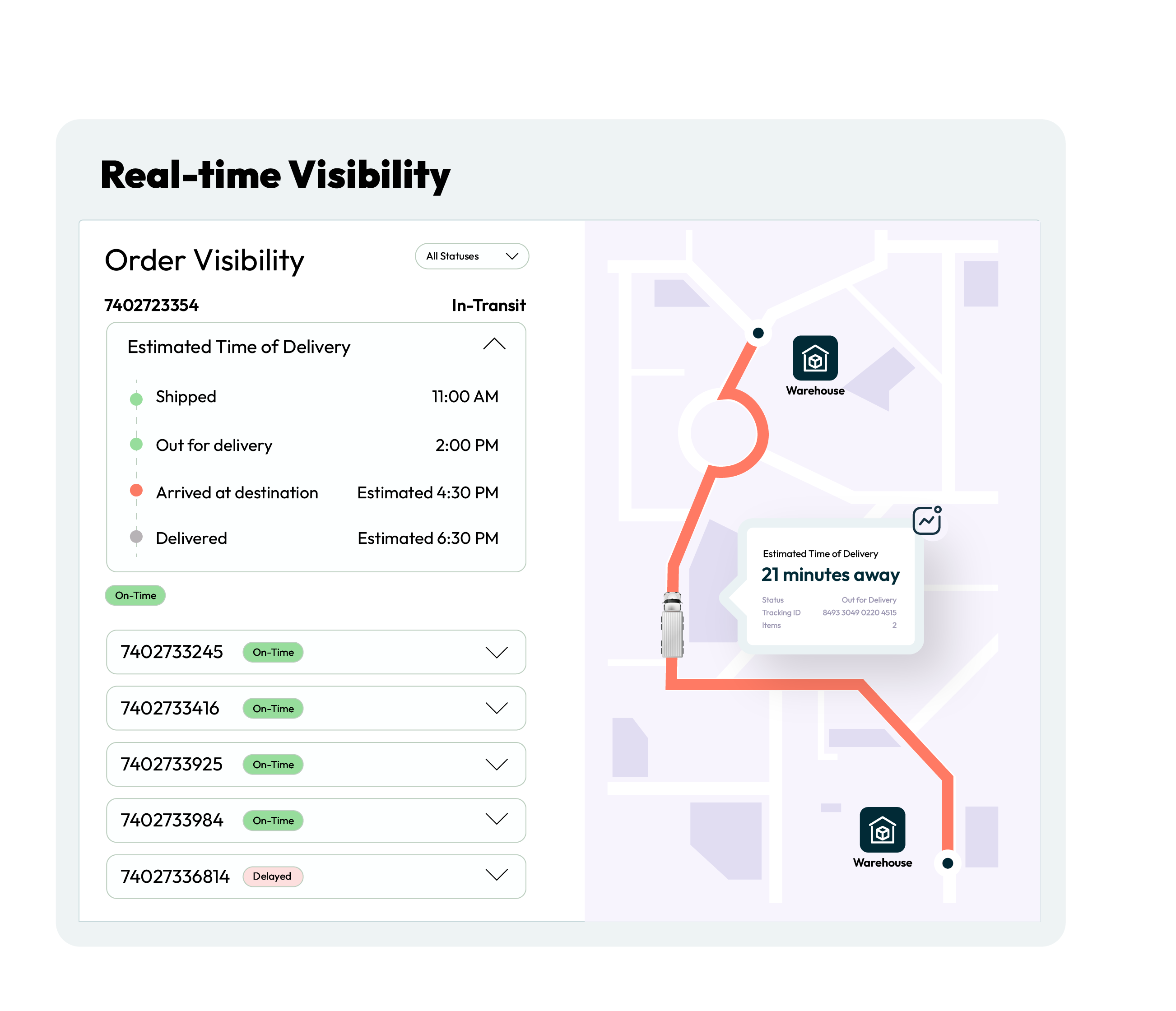
- Real-time status updates (arrived, departed, delays)
- Exception reporting (failed stop, closed entry, etc.)
Real-time Monitoring and Dynamic Adjustment
- The route management system tracks deviations or delay risks
- It triggers dynamic reroutes: reassign stops, shift sequences, adapt on-the-fly
- Updated ETAs propagate downstream
Feedback, Analytics and Learning
- Compare planned vs actual: delays, dwell-time variance, deviations
- Tab KPIs (on-time, fuel consumption, utilization)
- Use historical data to refine predictions (travel times, dwell time)
- Machine learning models adapt to driver behavior or shift patterns
Because this entire pipeline is data-driven, the route management system becomes increasingly accurate and reliable over time.
How That Data Intelligence Translates into Smarter Deliveries
Let’s go through key benefits you care about: capacity, reliability and responsiveness and how data-powered routing enables them.
Improved Capacity Utilization and Balanced Loads
Because the engine sees full order volumes and vehicle constraints, it can rebalance loads. You’ll see fewer half-empty trucks or desperate reassignments. The model ensures that every truck is packed closer to its effective capacity.
Better On-time Compliance and SLA Performance
By factoring traffic, route congestion patterns and service time variability, routes are not just “shortest distance”, they’re feasible within timing, with slack for variance. And when unexpected delays arise, the route management system reroutes to minimize late arrivals.
Reduced Fuel, Fewer Miles and Lower Cost
Every unnecessary mile or idling hour drains fuel. A smart routing engine minimizes those through tighter sequencing, fewer deadhead legs and avoidance of congested corridors. Studies show fuel reductions of 10–20 %.
Resilience to Change and New Orders
When a customer calls mid-route with an urgent order or a stop drops out, the system can adapt dynamically, reallocating tasks rather than waiting until day’s end. FarEye’s route management system APIs support this flexibility.
Continuous Improvement and Predictive Accuracy
Over time, the route management system learns your network. Which roads tend to slow down at 4 PM, which neighborhoods take more dwell time and which drivers deviate? That refined knowledge feeds back into better future route plans.
Architecting for Scale, Real-Time and Enterprise Execution
As a fleet dispatcher or allocator, you’ll ask: Will this system hold up when I scale to 200+ vehicles or 10,000 stops a day? The architecture matters.
- Modular data pipelines (batch + streaming): Allow both batch planning overnight and live updates midday.
- Scalable Optimization Engine: Decomposition, zone clustering and warm-start heuristics help handle large problem sizes.
- Low-latency Dynamic Triggers: Incremental reroute logic must respond quickly, without re-solving everything from scratch.
- Resilience and Fallback: If the traffic feed fails or the API is down, fallback to baseline routes.
- Integration Points: Connecting to TMS, OMS, warehouse systems and carrier networks.
- Driver-side Intelligence: Push lightweight recompute or local reroute decisions to the driver app when central connectivity lags.
- Explainability and Override support: Dispatchers need to understand why the system recommended a swap or reroute and override if needed.
Addressing Common Concerns and Misconceptions
- “Computers can’t model the tacit knowledge drivers have.”
True intelligence lies in learning from deviations and adjustments. A modern system treats driver deviations as learning signals rather than errors. - “Real-time rerouting will confuse drivers.”
A system must balance stability vs flexibility. Only reroute when gain exceeds disruption cost; update ETA granularly rather than wholesale reorder mid-route. - “Our data is messy, addresses wrong, times inaccurate.”
You must invest in address validation, geocoding cleanup and historical correction. The system only works well with quality inputs. - “Optimization will take too long for our scale.”
Use hierarchical clustering, zone-wise decomposition and warm-starting methods. You rarely need full re-optimization of 1,000 stops in one go. - “We need to manually override sometimes.”
Always include manual override or “swap stop” functions; dispatchers must retain control in exceptional cases.
FarEye: Contextual Fit for Enterprises
FarEye is an example of a route management system built for enterprise deployments and it exemplifies many of the principles here. FarEye’s route planning software uses AI and constraint-based routing across large order volumes, factoring SLAs, vehicle constraints, time windows and real-time changes.
Our routing APIs help integrate directly into existing order/TMS flows, enabling dynamic route generation whenever new orders or changes arrive. FarEye’s AI modules continuously learn from past route deviations to improve future route estimations and handle irregularities.
For U.S. fleets planning EV usage, FarEye’s platform supports optimized routing that considers charging stations along the route, helping maximize EV utilization without range anxiety.
In deploying such a system, U.S. enterprises benefit from a mature product that already embeds many of the advanced routing techniques (dynamic rerouting, constraint modeling, learn-from-deviation) that a dispatcher or allocator would demand.
Putting It to Work: How You Can Drive Value
- Baseline Your Current Metrics
Measure on-time delivery, average route utilization, overtime and missed deliveries. - Pilot in a High-volume Zone
Use the pilot to validate assumptions, test dynamic rerouting and measure uplift. - Set Up Your Data Foundation First
Clean location/address data, integrate telematics, standardize time windows. - Start With Overnight Planning, Then Enable Mid-route Flexibility
Don’t force full real-time from day one; allow the system to mature. - Involve Dispatchers and Drivers in the Loop
Give transparency into route logic and allow overrides. Gather feedback regularly. - Monitor, Refine, Iterate
Use feedback loops, track deviation patterns, refine dwell time estimates and retune slack levels. - Scale to Full Operations
Expand across zones once confidence is high. Leverage analytics and predictive modules.
Ready to Transform Your Deliveries? Take the Next Step
For professionals running logistics operations, a route management system is not just a software toy; it’s the backbone of operational efficiency, capacity leverage and SLA reliability. When the system ingests rich data, models realistic constraints, adapts in real time and learns from execution, dispatchers and allocators gain leverage and fewer surprises.
If you’re ready to turn routing complexity into operational advantage, explore how FarEye’s AI-powered route optimization software can transform your delivery efficiency. Book a live demo today and see smarter routing in action.
Source: