Table of Contents
- From Friction to Clarity: The Visibility Gap Dispatchers Face
- What Makes a Logistics Route Planner Truly “Data-First”?
- How a Data-first Routing Logistics Approach Enhances Visibility
- What Supply Chains Unlock When Visibility Improves
- Core Pillars of a Best-in-Class Logistics Route Planner
- Challenges and Real-World Tradeoffs (From the Dispatcher Lens)
- How to Begin Your Data-first Journey in Routing Logistics
- Turn Data into Visibility: Get Started Now
Let Our Experts Optimize Your Deliveries Today
Let's talkEvery morning, a U.S. dispatcher stares at a dispatch sheet cluttered with half-assigned orders, shifting windows, and driver gaps. That chaos is more than operational noise; it’s a symptom of blind spots in your supply chain’s nervous system.
Companies that invest in data-first logistics route planners routinely achieve over 40% on-time delivery rates, reduce empty miles, and regain visibility across fleet operations. In fact, the global route optimization and planning market is projected to reach USD 7.6 billion in 2025, with enterprise adoption driving much of that growth.
Let’s walk through how placing data at the core of routing logistics doesn’t just refine routing; it redefines supply chain visibility itself.
From Friction to Clarity: The Visibility Gap Dispatchers Face
The Fog of a Disconnected System
You may juggle a TMS, GPS modules, manual spreadsheets, and phone calls, but none operate on a unified, real-time data fabric. That disconnection means by the time a delay trickles through, it’s already too late.
The Downside of Fixed Plans in a Dynamic Day
Your routes may be optimized on paper, but traffic snarls, canceled orders, or last-minute add-ons break them apart. When a driver is forced to take a 20-minute detour and you lack visibility, downstream deliveries suffer.
Invisible Capacity, Hidden Inefficiency
Without per-vehicle, per-stop load visibility, you risk underutilizing trucks or leaving last-minute gaps. That means more trips, more cost, more risk.
These blind spots are more than nuisances in the U.S.; failed first delivery attempts cost carriers approximately $17.2 per order in added handling, fuel, and service costs. Data-first routing flips that paradigm. Instead of patching visibility, it embeds it.
What Makes a Logistics Route Planner Truly “Data-First”?
Data as Foundation, Not an Add-on
A data-first logic treats historical records, IoT/telematics feeds, external signals (weather, traffic APIs), and exception logs as fuel, not friction.
Three Critical Data Strata:
- Historical Data: Past delivery times, dwell durations, and route performance
- Real-time Streams: GPS feeds, live traffic, sensor data (e.g., vehicle load, temperature)
- External Context: Weather forecasts, road closures, event calendars
A powerful data layer fuses those inputs, contextualizes them, and feeds smart routing decisions.
Closed-loop Intelligence: Learning from Outcomes
Each route execution becomes a feedback point. Did a driver get delayed unexpectedly? That anomaly is fed back into machine learning models, which adjust future predictions. Over time, the system “gets smarter,” reducing surprises.
Multi-objective Optimization, Not Single-metric Trickery
A data-first logistics route planner balances distance, time, load, cost, driver breaks, regulatory compliance, and priority orders simultaneously, not by toggling weights manually, but by learning from past tradeoffs.
How a Data-first Routing Logistics Approach Enhances Visibility
With a data-first routing logistics approach, you gain a continuously updating view of every route leg, enabling you to detect disruptions early and recalibrate on the fly.
Real-time Map of Execution
Instead of waiting for status calls, you see actual vehicle progress, deviations, delays, and can probe the cause (traffic, breakdown, misroute).
Proactive Alerts and Exception Handling
Because you see data early (e.g., a route segment is backing up), you get triggered alerts to reroute, reassign, or preemptively inform downstream stops.
Confidence-scored ETAs
Rather than fixed ETAs, each route leg comes with a confidence score or range. For example, “Package B: ETA 2:15 pm ±10 min (87 % confidence).” That transparency helps customer service teams set expectations.
Load and Capacity Insight Per Vehicle
You know not just where a driver is, but how full they are, which stops remain unassigned, or whether additional small orders can be merged in right up to dispatch.
Supply Network Lens
Data-first route optimization software aggregates across hubs, depots, and fleets. You view systemic bottlenecks, e.g., “Hub A has 20% spare capacity but trucks returning half-empty.” That visibility enables strategic shifts (rebalancing, zone adjustments).
What Supply Chains Unlock When Visibility Improves
Once supply chains achieve deeper visibility, they unlock the ability to pivot proactively, coordinate across functions, and convert insight into competitive advantage.
Decision Shift: Detect → Decide → Act
Instead of firefighting every delay, you forecast potential breaks and decide on reroutes proactively. Visibility becomes a decision lever, not just a reporting tool.
Harmonized Functions
Operations, customer service, sales, and executives see the same supply chain picture. Urgent reroute? CS can message customers early; leadership can assess macro trends.
Scale Without Chaos
As your order volume rises, visibility acts as your “central nervous system.” You can onboard more routes, vehicles, or regions without losing coherence.
Risk Resilience
When a highway closes or weather strikes, visibility lets you spin up alternative routes in minutes, reducing cascading failures.
Brand Integrity and SLA Enforcement
With transparent ETAs and reliable execution, you reduce failed deliveries and customer complaints. Visible transparency bolsters credibility in B2B and B2C alike.
Core Pillars of a Best-in-Class Logistics Route Planner
At the foundation of every high-performing dispatch system are core pillars that ensure your logistics route planner delivers not just paths but trustworthy, actionable visibility across your network.
Scalable, Low-latency Data Architecture
Your platform must ingest live streaming data, merge large historical stores, and respond quickly. Latency kills visibility.
Routing Engine and AI/ML Layer
Beyond classic heuristics, the route solver must incorporate AI to predict durations, learn driver patterns, and adapt constraints dynamically. (FarEye, for example, incorporates AI-first routing with over 100 constraints.
Reoptimization and Dynamic Rerouting
When deviations occur, the planner must recompute routes mid-operation, not wait for the next day or manual refresh.
Visibility Dashboard and Alerts Module
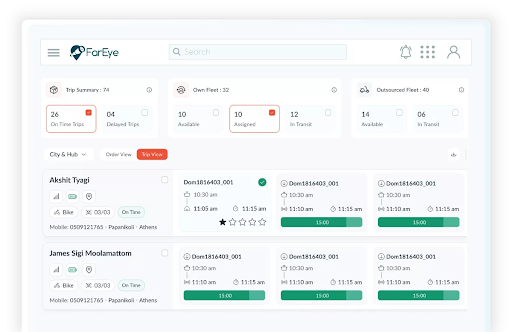
A dispatcher UI with map layers, stop status, heatmaps, and alert panels is essential to transform raw data into action.
Deep Integrations
You need seamless connectivity with TMS, WMS, OMS, telematics, and partner APIs. Data siloes defeat the data-first premise.
Governance, Data Quality and Trust
Data-first demands high quality: address validation, sensor calibration, anomaly detection, drift monitoring, or you get garbage in, poor routing out.
Challenges and Real-World Tradeoffs (From the Dispatcher Lens)
While data-first routing logistics unlocks visibility, dispatchers must still contend with real-world tradeoffs balancing computation speed, human judgment, and unpredictable field constraints under pressure.
Complexity Overload
Too many constraints or overly ambitious AI tweaks can slow route generation. You must balance precision with runtime.
Edge Cases and Manual Overrides
Some conditions, VIP orders, and last-minute emergencies require human override. A flexible system must allow safe intervention without breaking visibility.
Change Management
Dispatchers used to Excel or local maps may resist a data-first shift. Training, transparency, and trust-building are key.
Data Gaps and Quality Drifts
Missing sensor data, stale traffic feeds, or unvalidated addresses can erode trust rapidly. You must constantly monitor data health.
How to Begin Your Data-first Journey in Routing Logistics
Starting a data-first routing logistics journey means first assessing what you have, then layering in structure, tools, and adoption in a way that delivers visibility.
Audit Your Data Landscape
Catalog all sources: historical logs, GPS devices, traffic APIs, and order systems. Identify gaps or stale feeds.
Pilot a High-impact Region
Start with one geography or one depot. Use data-first routing there, test visibility, refine models, then expand.
Choose a Partner or Build Smartly
You can build in-house, but solutions like route planning software already embed AI/ML, dynamic rerouting, and integrations. The faster you realize visible benefits, the sooner trust spreads.
Map Key Metrics and Dashboards
Define OTIF, route deviation, empty-miles percentage, and reassign rate. Feed them into your dashboard as live KPIs.
Train Dispatchers and Enforce Trust
Onboard them by showing how visibility helps, not by mandate. Let them see logistics route planner suggestions, override safely, and learn how data improves daily.
Iterate and Refine
As you gather performance data, reweight models, refine constraint sets, and expand into more complex routing zones.
Turn Data into Visibility: Get Started Now
Visibility in supply chains isn’t a luxury; it’s the foundation that enables precision, agility, and growth. Traditional routing systems treat data as an afterthought; a data-first logistics route planner treats it as the battery behind the engine. The difference isn’t incremental; it’s transformational.
With FarEye’s AI-powered routing, real-time reoptimization, and per-vehicle load insights, you don’t just see your operations; you control them. Organizations like yours can move from reactive dispatch to proactive command. Let visibility drive choices.
Sources:
https://www.futuremarketinsights.com/reports/route-optimization-planning-software-market
https://www.statista.com/statistics/973182/last-mile-delivery-average-cost/