
Table of Contents
- Why Analytics Matter in Delivery Route Planning Software
- What Delivery Route Planning Software Analytics Should Measure
- 8 Ways Analytics Turn Delivery Route Planning Software Into a Continuous Improvement Engine
- How FarEye Helps Turn Routing Data Into Operational Improvement
- Implementation Best Practices for Delivery Route Planning Software Analytics
- Turn Delivery Data Into Better Performance With FarEye
Let Our Experts Optimize Your Deliveries Today
Let's talkKey Takeaways
- The Cost of Opaque Execution: Standard route planning is a reactive utility that ignores real-world execution data, leaving operations completely exposed to margin leakage, route drift, and service failures.
- The Continuous Improvement Mandate: To command profitability, enterprises must deploy advanced delivery route planning software to aggressively transform daily execution data into a strict, continuous improvement loop.
- Granular Visibility and Cost Control: A powerful analytics layer exposes hidden network bottlenecks by rigorously tracking planned versus actual performance, ETA variance, and carrier productivity.
- Measurable Profit Protection with FarEye: FarEye translates this routing data into absolute operational control. As a direct result, the platform secures an 18% reduction in average cost per delivery, a 22% decrease in dispatch time, and a 44% drop in route deviations.
A strong delivery route planning software platform should do more than generate efficient routes. It must help teams diagnose exactly what happened during execution, why service issues occurred, where costs escalated, and how to rigorously improve the next plan.
That is where analytics become operationally important. In high-volume, multi-stop delivery networks, route quality, ETA accuracy, proof capture, and resource utilization directly influence both service and cost outcomes.
The right analytics layer turns daily execution into a structured improvement loop, helping teams move from reactive dispatch decisions to better operational control. Modern tools also make it easier to connect planning with visibility, execution, and reporting across the last mile.
Let's learn how analytics strengthen delivery performance and how FarEye helps turn routing data into continuous improvement.
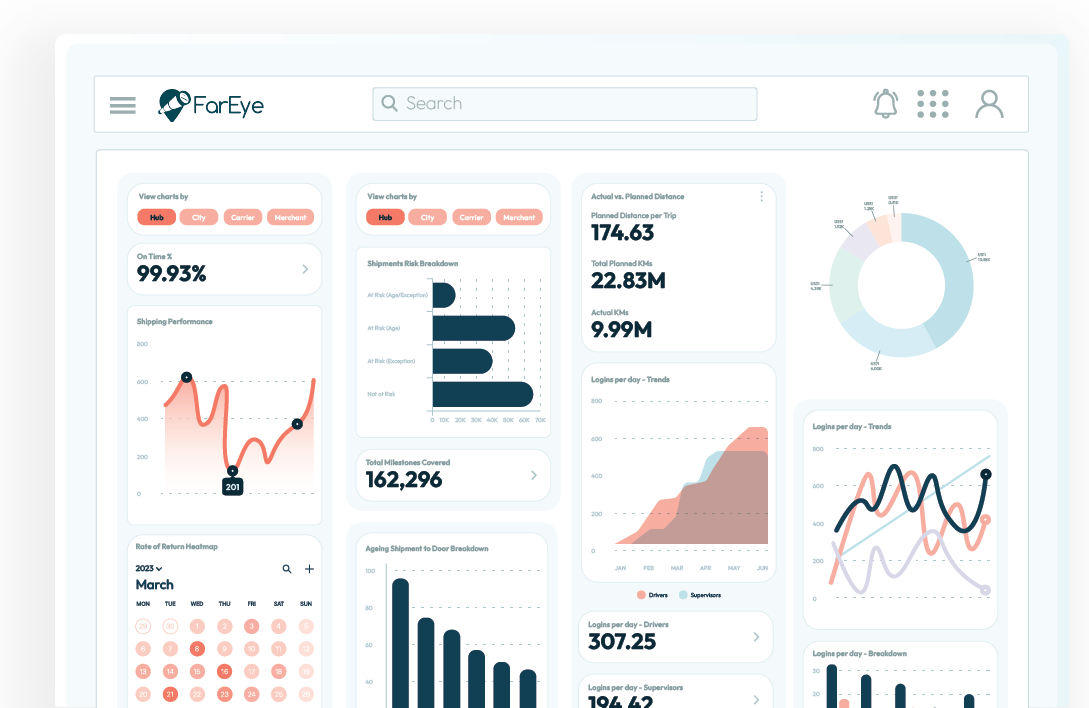
Why Analytics Matter in Delivery Route Planning Software
Analytics matter because they help teams move beyond route creation and into route improvement. A well-designed delivery route planning software environment can make that process much easier by turning daily delivery activity into usable insights.
- Better Visibility Reduces Blind Spots
Teams can see where routes drifted, where delays happened, and which assumptions failed. - Stronger Data Improves Decisions
Dispatchers and planners can refine route logic using actual field performance. - Clearer Measurement Supports Accountability
Route adherence, proof quality, and stop-level performance become easier to review. - A Continuous Loop Drives Improvement
Every delivery day becomes a source of insight for the next one.
Without analytics, route planning stays reactive. With analytics, teams can improve service, control, and consistency over time.
What Delivery Route Planning Software Analytics Should Measure
To support continuous improvement, analytics should cover more than distance and drive time. Strong route data should help teams measure:
- Planned versus actual route performance
- On-time delivery and delay patterns
- ETA variance across routes and time windows
- Cost per delivery and miles driven
- Capacity utilization and stops per route
- Route adherence and stop productivity
- Proof-of-Delivery (PoD) completeness
- Exception frequency and recovery time
This is where vehicle route planning software becomes more valuable than a simple route builder. It helps teams connect route design with live execution data, making it easier to understand how field conditions affect service quality and cost over time.
8 Ways Analytics Turn Delivery Route Planning Software Into a Continuous Improvement Engine
The real value of analytics lies in what teams do with the data after routes are completed. These insights help businesses move from daily route execution to a more structured approach to improvement across planning, dispatch, costs, and customer experience.
- Planned Versus Actual Visibility Improves Route Quality
Comparing planned routes with actual execution helps teams spot route drift, weak assumptions, and operational gaps. In strong delivery route planning software, this visibility improves route logic over time. - ETA Accuracy Becomes Easier to Improve With Delivery Route Planning Software
Tracking ETA variance across routes, zones, and delivery windows helps teams identify recurring delay patterns and improve forecast quality. Better ETA accuracy also makes delivery route planning software more valuable across operations and service teams. - Capacity Forecasting Supports Better Fleet Planning
Historical demand data helps operations teams forecast capacity needs before the day begins. That means better fleet sizing, stronger territory planning, and fewer last-minute adjustments. Instead of reacting to volume spikes after they happen, teams can plan for them with more confidence. - Delivery Slot Analytics Strengthen Scheduling
Slot performance shows whether appointment windows are realistic, overbooked, or underutilized. Measuring missed windows, slot adherence, and demand by zone or daypart helps businesses improve slot logic and reduce service strain. - Carrier and Cost Analytics Expose Hidden Leakage
A strong analytics layer reveals route cost, cost per delivery, carrier productivity, and partner performance. The right route optimization software makes cost and service trade-offs easier to evaluate. - Dispatch and Execution Analytics Reduce Firefighting
Route deviations, unplanned halts, and repeated exception types highlight avoidable friction. This is where delivery route planning software starts improving execution, not just planning. - Consumer Experience Metrics Show the Real Delivery Impact
Route performance is not only an internal efficiency issue. It affects WISMO, missed deliveries, and customer trust. Reviewing route execution alongside customer-facing outcomes helps teams improve transparency and reduce support pressure. - Business-level Analytics Help Leaders Improve Over Time
At the leadership level, analytics help teams review route, driver, and network performance month-on-month and year-on-year. That makes delivery route optimization software more than an operational tool. It becomes a decision system for service strategy, staffing, territory design, and growth planning.
How FarEye Helps Turn Routing Data Into Operational Improvement
FarEye helps extend route planning into a broader analytics-led operating model. Instead of treating routing as a daily planning task, the platform integrates forecasting, dispatch, route optimization, customer communication, and business reporting into a single workflow.
- Upstream Planning Improves
FarEye supports capacity forecasting, cost-per-delivery prediction, and what-if simulations to help teams improve route readiness before dispatch. - Daily Execution Becomes Easier to Manage
Teams can connect routing, scheduling, carrier selection, and visibility into a single layer, making it easier to detect delays and SLA risk earlier. - Smart Service Times Improve Route Accuracy
FarEye also helps teams improve service-time assumptions using smarter planning inputs. With FarEye, teams report a 12.5% increase in stops per hour and a 44% reduction in route deviation. - Performance Outcomes Become Measurable
With FarEye, teams report strong performance improvements across daily delivery operations. For example, they report a 22% YoY decrease in dispatch time and a 16% YoY increase in stops per route. In addition, teams report an 18% YoY increase in first-time delivery and a 12% YoY increase in capacity utilization. - Efficiency and Sustainability Improve Together
With FarEye, teams also report a 6% increase in OTIF-compliant deliveries and 75M+ kilometres saved through route optimization. Alongside this, teams reported an 18% reduction in average cost per delivery and a reduction of 550K+ metric tonnes of GHG emissions.
These outcomes reinforce a simple point: route analytics matter because they help improve both daily execution and long-term performance.
Implementation Best Practices for Delivery Route Planning Software Analytics
To make analytics useful, teams need clear operating discipline. A few practical steps can make adoption much stronger:
- Start With a Focused KPI Set
In delivery route planning software, track route adherence, ETA variance, cost per delivery, on-time delivery, and proof of completeness first. - Compare Planned Versus Actual Weekly
A regular review cycle helps identify route drift, weak assumptions, and recurring exceptions. - Use Shared Dashboards Across Teams
Routing, dispatch, and customer teams should work from the same data view. - Connect Core Systems Early
Stronger delivery route planning software performs best when OMS, WMS, TMS, telematics, and proof workflows are connected early on. - Review Customer and Route Metrics Together
WISMO, failed attempts, and notification performance should sit alongside operational KPIs. - Turn Exceptions Into Workflow Changes
Recurring issues should shape slot logic, dispatch rules, and route constraints within delivery route planning software environments.
Turn Delivery Data Into Better Performance With FarEye
The real value of delivery route planning software appears after dispatch, when teams use analytics to improve what happens next. Better route performance comes from measuring actual execution, comparing it with expectations, and refining planning, scheduling, dispatch, customer communication, and cost control over time.
That is what turns vehicle route planning and delivery route optimization software into long-term performance levers rather than daily planning utilities. FarEye supports that shift by connecting route analytics with forecasting, dispatch visibility, execution control, and customer outcomes in one operating model.
For businesses looking to improve service consistency and route performance at scale, now is the right time to move toward a more connected approach. That is where FarEye can help. Contact FarEye to explore an analytics-led model that supports better visibility, stronger control, and continuous operational improvement.