
Table of Contents
- Understanding Route Planning Software
- Why Traditional Routing Systems Fall Short
- How Modern Routing Intelligence Improves ETA Accuracy
- FarEye: Turning Predictability into Performance
- Comparing FarEye's AI-based Routing Software with Traditional Routing Tools
- The Road Ahead: Delivering Precision at Scale
Let Our Experts Optimize Your Deliveries Today
Let's talkSpeed has become nonnegotiable. About 48% of shippers and 53% of 3PLs now report that customers expect deliveries in less than two days. Another 27% of shippers and 26% of 3PLs say that two- to three-day delivery windows still prevail. This intensifying demand forces logistics operations to squeeze slack time, limit buffer overhead and sharpen ETA accuracy.
To thrive under these expectations, many firms are turning to route planning software solutions that intelligently model constraints, ingest live data and generate dynamically optimized schedules. The result: delivery windows that once seemed ambitious become predictable commitments, not guesses.
Understanding Route Planning Software
Modern route planning software helps logistics teams design the most efficient delivery routes. It accounts for real-world variables such as traffic flow, delivery urgency, driver shift windows and SLAs, so each run performs as planned. Unlike fixed maps, the system ingests live telematics and traffic updates and adapts routes on the fly, giving planners the data they need to make faster, better operational decisions.
Predictive ETAs combine machine learning with vehicle telemetry to forecast arrival times with greater confidence. By analyzing congestion patterns, weather and historical service times, these models replace broad estimates with schedules you can rely on. That reliability lets planners tighten delivery windows, cut reattempts and keep costs under control.
Why Traditional Routing Systems Fall Short
Legacy tools such as spreadsheets, fixed maps and GPS apps were never designed for enterprise-scale logistics. Their limitations include:
- Lack of Dynamic Reoptimization: Inability to adjust routes when orders or traffic conditions change.
- Poor Constraint Management: No recognition of capacity limits, driver schedules or regulatory compliance.
- Limited Visibility: Planners cannot monitor real-time delays or SLA breaches.
- Low Scalability: Systems struggle to handle growing multi-fleet or multi-hub networks.
These gaps lead to late deliveries, wasted miles and increased operational costs.
How Modern Routing Intelligence Improves ETA Accuracy
Modern logistics depends on precision and the latest generation of routing intelligence uses automation, analytics and real-time data to enhance ETA accuracy across every delivery.
Real-time Dynamic Routing
Modern route planning software for deliveries uses AI models that constantly check road, weather and vehicle conditions. When something unexpected pops up, the system reshuffles routes or moves jobs to nearby drivers so downtime stays low and SLAs stay on track.
Predictive Analytics and Learning
Advanced platforms learn from historical data, forecasting delays before they happen. For example, by identifying recurring bottlenecks in certain zones or time windows, the system refines future plans for improved consistency.
Constraint-aware Optimization
Today’s routing intelligence incorporates driver skill mapping, vehicle restrictions and customer preferences into every plan. This ensures compliance while minimizing idle time and improving asset utilization.
Centralized Visibility
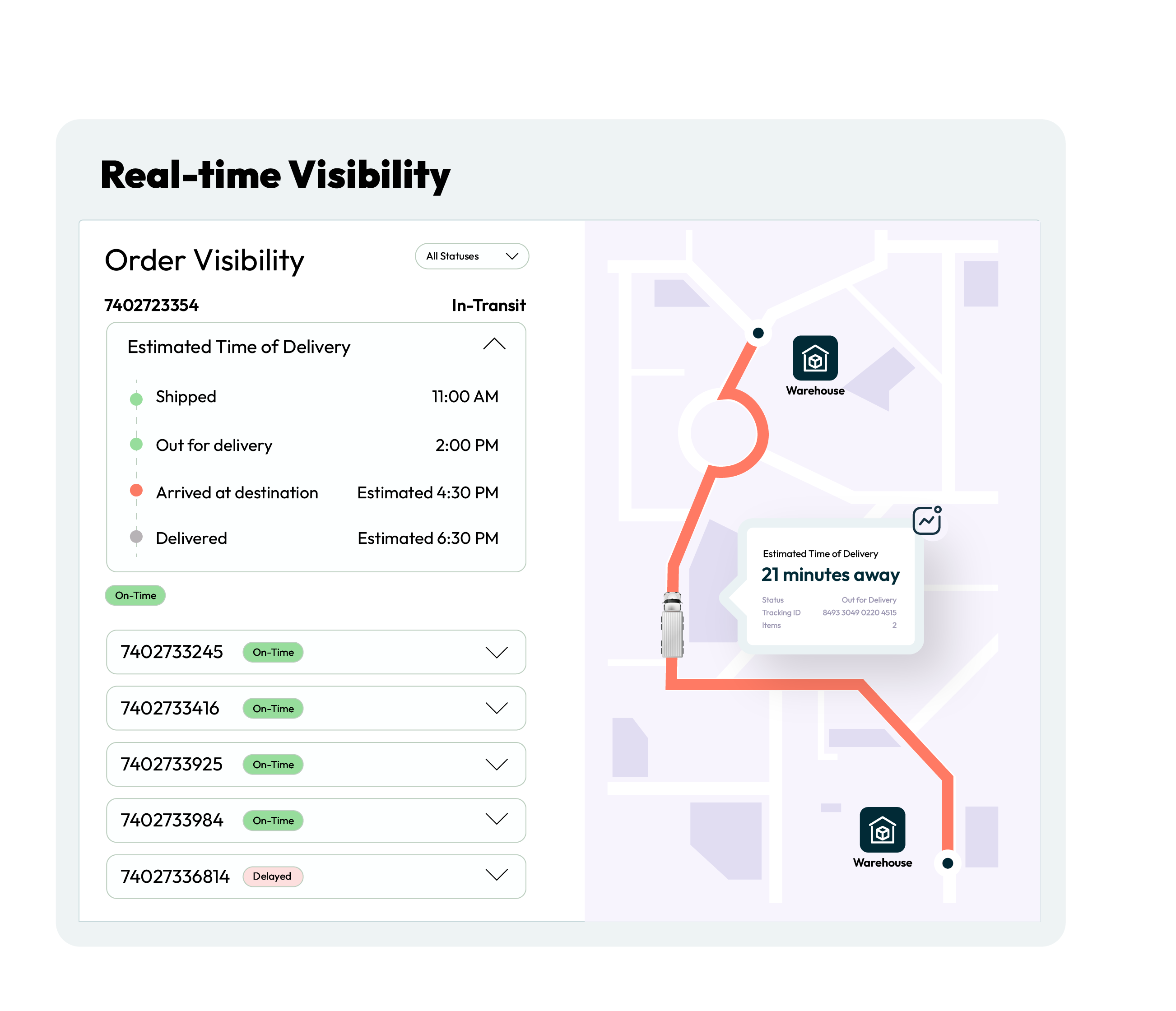
The best route planning software links effortlessly with enterprise systems like TMS and WMS. It gives logistics teams one clear view of their entire network. From that unified dashboard, managers can follow each delivery in motion, track ETA shifts in real time and act quickly when exceptions occur.
FarEye: Turning Predictability into Performance
At FarEye, we build routing intelligence for complex, high-volume delivery networks. Our focus is on consistency, helping enterprises stay efficient and dependable across diverse fleets and regions.
AI-powered Optimization Engine
Modern routing platforms address the Vehicle Routing Problem and last-mile complexity together. They process large delivery volumes in seconds, streamline planning workloads, and help keep service expectations on track.
Dynamic Slot Selection
Customers can choose delivery slots that align with both convenience and operational efficiency. This improves first-attempt success rates and minimizes rescheduling costs.
SLA-driven Planning
Every route is optimized around SLAs, regulatory limits and driver rest hours. The result is higher OTIF (On-Time, In-Full) performance and reduced penalty exposure.
Real-time Reoptimization
When traffic patterns shift or orders are added mid-route, the system automatically recalibrates sequences, ensuring on-time arrivals without manual intervention.
Actionable Analytics
FarEye’s analytics suite provides granular insights into ETA variance, route performance and delivery costs. This feedback loop helps logistics managers refine future planning and continually improve performance.
Comparing FarEye's AI-based Routing Software with Traditional Routing Tools
Traditional tools were built for fixed routes and predictable conditions. FarEye’s intelligent orchestration is designed for the real world, where plans must adapt by the second.
| Feature | Traditional Tools | FarEye Route Planning Software |
| Route Optimization | Manual or semi-automated | AI-based dynamic optimization |
| ETA Accuracy | Basic GPS-based | Predictive, real-time recalculation |
| Integration | Limited | End-to-end with TMS, WMS, CRM |
| SLA Compliance | Reactive | Proactive and monitored |
| Scalability | Restricted | Enterprise-level multi-fleet |
| Customer Visibility | Minimal | Real-time updates and alerts |
| Sustainability | Not supported | Green delivery windows and EV routing |
The Road Ahead: Delivering Precision at Scale
The logistics industry is changing rapidly and staying efficient is no longer enough. Success now depends on accuracy, agility and complete visibility across operations. Using route planning software helps logistics teams cut down wasted miles, anticipate delivery challenges and meet strict SLAs with confidence.
At FarEye, we focus on helping businesses achieve this through intelligent routing, real-time analytics and automation that bring predictability to large-scale delivery networks. For companies searching for the best route planning software for deliveries, the journey toward dependable ETAs and stronger customer trust begins with data-driven precision and smarter planning.
Source: