Table of Contents
Let Our Experts Optimize Your Deliveries Today
Let's talkThe handling of mixed and partial loads is not just about the transportation of freight but rather about moving it smartly. The less-than-truckload (LTL) market in the U.S. is projected to grow at a CAGR of 5.8% from 2024 to 2030. This is mainly due to the rapid growth of e-commerce and the increasing customer demands for quicker and smaller shipments.
As the network of regional carriers and 3PLs grows denser, dispatchers are under pressure to coordinate more loads, more often, with fewer resources. This is where LTL routing software comes to the rescue. With the help of smart algorithms, automation, and real-time visibility, it simplifies planning, assigning, and monitoring of less-than-truckload operations for carriers.
For logistics providers handling hundreds of small shipments daily, intelligent LTL routing tools have become a competitive necessity.
What is LTL Routing?
Lower than truckload (LTL) is when one shipment is not enough to fill the vehicle and so it involves multiple shippers sharing the same vehicle. Each shipment can have different weights, destinations and delivery windows.
In this type of routing, dispatchers much constantly balance these three important variables:
- Co-mingling of Loads: Ensuring Trucks are filled efficiently without exceeding any weight limits.
- Route Priority: Aligning deliveries to minimize time and costs
- Customer Commitments: Maintaining and meeting the promised delivery windows
How LTL Routing Software Simplifies Dispatch Operations
Manual LTL Routing can lead to missed pickups, wasted miles or even underutilized trailers. Small inefficiencies can quickly multiply when scaled across an entire fleet. On the other hand, LTL routing software can help simplify these complications.
Real-time Load Consolidation
LTL routing technology uses live shipment and vehicle data to group compatible loads dynamically. The system also continuously optimizes the overall operations, at all times, depending on the number of new pickups, cancellations, or priority changes. This real-time consolidation helps dispatchers fill trucks faster and cut down on empty space.
Smart Route Optimization
The solution applies advanced algorithms that weigh in distance, traffic situation, driver hours, and delivery priorities. The outcome is a route that is the most economical one, computed in seconds. It ensures trucks will take the route with the least cost while fulfilling all customers' requirements.
Multiple Stop Routing
LTL routing software is able to effortlessly deal with situations that have several pick-ups and drop-offs among various shippers and consignees. It automatically sequences stops for maximum time and fuel efficiency while ensuring driver compliance with service hours and delivery windows. This helps dispatchers plan multi-leg routes that maximize asset use and minimize turnaround times.
Load and Capacity Optimization
The capability of LTL routing software to pair shipments with existing capacity instantly is one of its most significant benefits. The program considers truck sizes, weight restrictions, and space usage to guarantee that all trucks operate at nearly their maximum efficiency. By efficiently loading the trucks, the companies can avoid underuse of their vehicles, keep the load distribution safer and thus, get more revenue per mile.
Visibility and Customer Communication
Transparency builds trust. With real-time GPS tracking, (Estimated Time of Arrival) ETAs, and proactive notifications, customers always know when to expect their shipment. Live updates also help dispatchers handle exceptions immediately instead of reacting after the fact.
Together, these capabilities transform how dispatchers plan and execute operations, turning complex, manual routing into a streamlined, data-driven process that improves speed, accuracy, and profitability.
How FarEye Helps Optimize LTL Routing and Dispatch
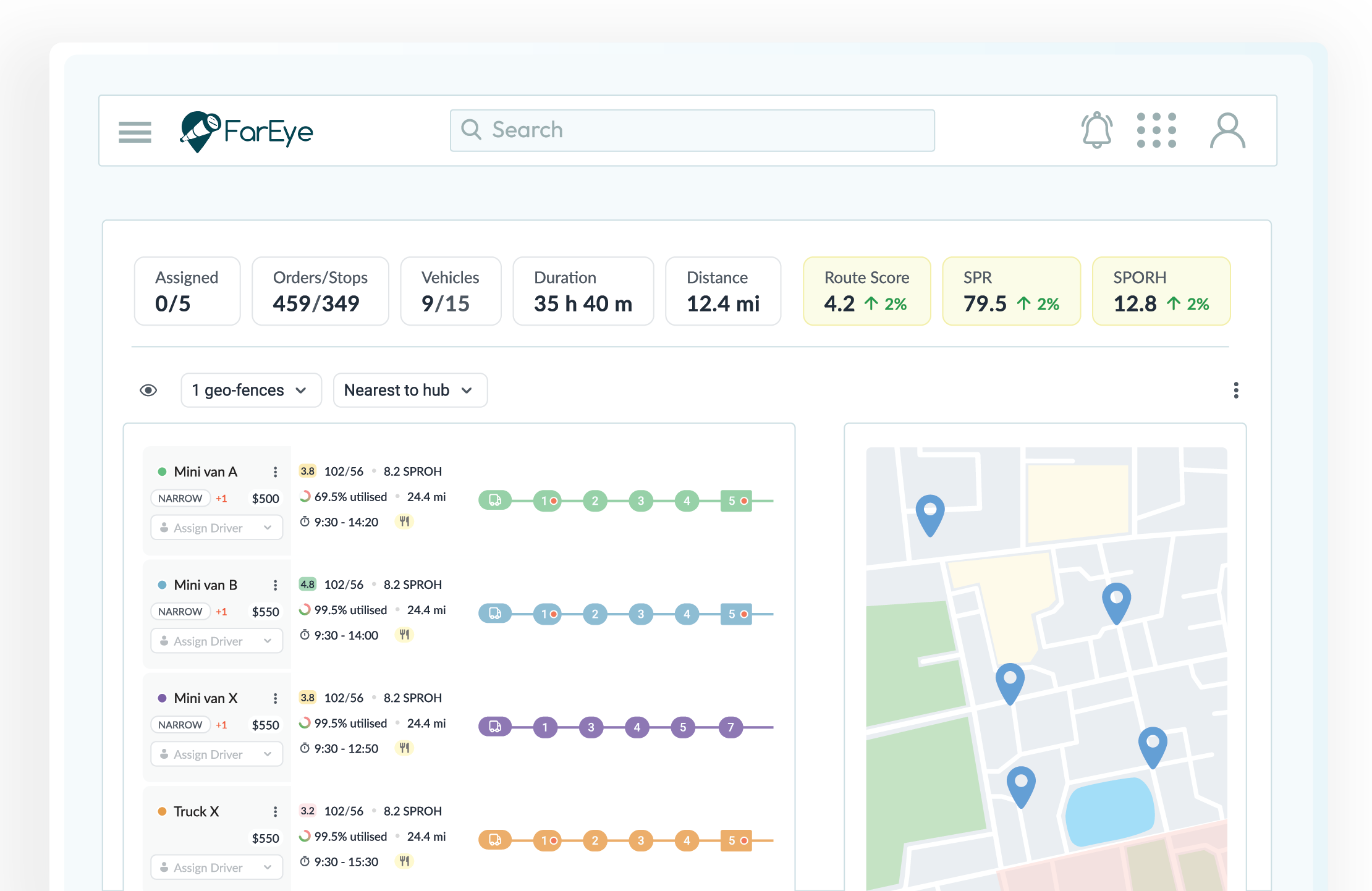
FarEye, a global delivery management and routing intelligence platform, takes LTL optimization a step further. Our technology unifies planning, execution, visibility, and analytics, giving logistics teams full control over their mixed-load operations.
What makes FarEye stand out is its ability to merge LTL routing software with a strong Transportation Management System (TMS) framework. We create a single, intelligent solution that connects every part of the transportation lifecycle, from load planning to carrier management.
End-to-end Visibility and Control
The capability of LTL routing software to pair shipments with existing capacity instantly is one of its most significant benefits. The program considers truck sizes, weight restrictions, and space usage to guarantee that all trucks operate at nearly their maximum efficiency. By efficiently loading the trucks, the companies can avoid underuse of their vehicles, keep the load distribution safer and thus, get more revenue per mile.
Dynamic Load and Route Optimization
FarEye uses AI-powered intelligence to constantly redo the calculation of the best route whenever there is a change in conditions. The platform takes into account various constraints like shipment information, truck size, road congestion, and even the presence of drivers. This ensures mixed and partial loads are always planned in the most cost-efficient sequence, cutting fuel use and transit times.
Smart Allocation and Capacity Utilization
LTL routing abilities automatically pair up shipments with the vehicles that can accommodate them, taking into consideration the proximity of the routes and the compatibility of the cargos. The system continuously scans for partial load opportunities to minimize unused space. This helps fleets achieve near-full capacity without compromising timelines, a crucial advantage for LTL carriers dealing with fluctuating volumes.
Transportation Management System Integration
FarEye’s built-in TMS capabilities extend routing intelligence across the entire logistics chain. The platform supports:
- Multi-Modal Carrier Management: Onboarding, contract, and performance management across Full Truck Load (FTL), LTL, parcel, and intermodal networks.
- Rate Selection: Automated carrier and rate card management to ensure cost-optimized transport choices.
- Inbound & Outbound Operations: Unified yard, cross-dock, and load-planning visibility, covering both LTL and FTL shipments.
- Transportation Orchestration: Route planning, in-app driver navigation, sequencing, break-time compliance, and safety management.
- Control Tower Visibility: End-to-end GPS tracking and deviation alerts to proactively manage exceptions.
- Analytics: Actionable insights into carrier performance, delays, ETAs and overall transportation KPIs.
Data Intelligence and Historical Data for Constant Improvement
Each delivered package returns performance information to FarEye’s analytics engine, which constantly learns and refines its models. Dispatchers have the chance to keep an eye on important metrics like route adherence, cost per mile, and load fill ratio in real-time. The main advantage is how FarEye combines this live data with historical performance insights.
FarEye, through the storage and analysis of historical delivery records, points out the repeating inefficiencies, the seasonal demand patterns, and the route deviations that are affecting profitability. Historical data greatly helps logistics teams understand driver behavior trends, lane performance, and customer delivery preferences over the long run.
Turning Complex Routing into Simple and Scalable Growth
With LTL routing software, companies can move from guesswork to precision. FarEye's complete optimization strategy, supported by its integrated Transportation Management System (TMS), empowers businesses to shift from reactive routing to proactive operations.
Smarter routing doesn't just simplify dispatch, but it transforms how businesses operate. Where every mile counts, the future of efficiency lies in data-driven routing that brings together people, process, and technology, seamlessly and strategically.
Source:
https://www.grandviewresearch.com/industry-analysis/less-than-truckload-market-report