
Table of Contents
- What Delivery Routing Software Actually Does For Dispatch
- The Dispatch Pain Points Delivery Routing Software Removes
- The Metrics Seamless Dispatch Improves First
- Architecture and Integrations That Make Dispatch Fast, Not Messy
- How to Evaluate Delivery Routing Software?
- Why FarEye Leads With AI-powered Delivery Routing Software Built for Enterprise Dispatch
- Best Practices for Implementing Delivery Routing Software
- Upgrade Dispatch Confidence With FarEye Today
Let Our Experts Optimize Your Deliveries Today
Let's talkKey Takeaways
- Market Growth and Risks: With the US freight market projected to reach USD 1,724.6 billion, small dispatch misses quickly scale into overtime, claims and WISMO.
- Feasible Planning: Delivery routing software stabilizes operations using constraint-led routing, live ETAs and controlled reassignment when volumes spike.
- Speed and Compliance: Explore how FarEye helps dispatch teams move faster without losing compliance or risking service failures.
Dispatch boards can flip by noon when volume spikes, time windows tighten, partner fleets check in and one restriction turns a plan risky fast. The United States freight and logistics market is already expected to rise from USD 1,381.09 billion in 2025 to USD 1,433.58 billion in 2026.
It is forecast to reach USD 1,724.6 billion by 2031, so missed dock rules, low bridges and delays quickly cascade into overtime and claims. Delivery routing software keeps plans feasible by validating addresses, applying real constraints, refreshing ETAs and guiding controlled reassignment for every shift as conditions change.
Let's learn what enterprise dispatch needs to stay consistent, from planning to Proof-of-Delivery (PoD) and how FarEye supports faster decisions without sacrificing compliance at scale.
What Delivery Routing Software Actually Does For Dispatch
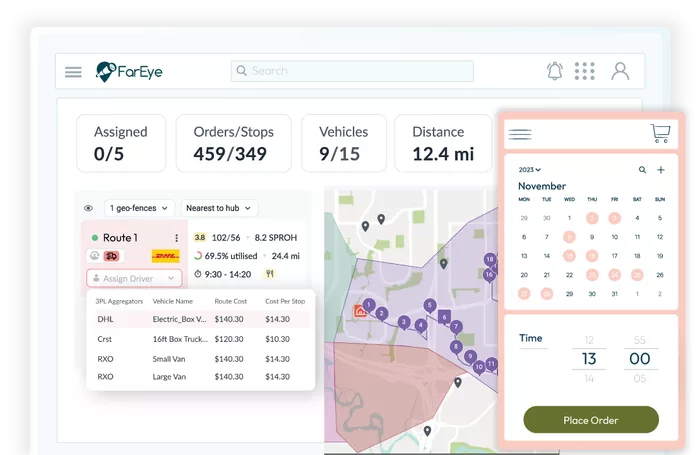
Dispatch performance improves when the workflow runs job-to-route-to-proof without rework, because planners and operators share one consistent operating picture. At its best, delivery routing software connects order intake, route creation, driver execution and PoD so dispatch can guide outcomes, not chase updates.
- From Orders to Routes Without Manual Rework
Delivery route planning software ingests orders, validates addresses, applies service-time assumptions and batches stops by zone so planners start with clean inputs. Before routes are published, feasibility checks confirm time windows, capacity and access rules so dispatch does not send drivers into preventable failures.
When volumes surge, delivery routing software keeps the same workflow, which reduces version conflicts and keeps planners focused on decisions, not spreadsheets.
- Constraint-led Planning That Holds up in the Real World
Constraint-led planning accounts for time windows, vehicle class, driver shifts and breaks so the plan survives real conditions across dense urban delivery areas. Commercial constraints matter too, including restricted roads, low bridges, loading rules and site access windows that can invalidate routes if ignored.
With delivery route planning software, dispatch can model these rules once, reuse them daily and reduce manual exceptions that damage On-time In-full (OTIF) targets.
- Day-of Control That Keeps the Plan Credible
Day-of control relies on real-time signals, ETA refresh, stop status and geofences so dispatch sees drift early and intervenes with confidence. Partial route rebuilds and controlled reassignment protect delivery windows because updates publish quickly without rebuilding the day from scratch.
When delivery routing software does this well, dispatch shifts from reactive calls to proactive decisions that keep first-attempt delivery rates stable.
The Dispatch Pain Points Delivery Routing Software Removes
Dispatch teams face recurring friction that wastes hours, increases reattempts and weakens customer trust, especially when conditions diverge from morning assumptions. The right platform replaces fragile workarounds and restores control, so commercial vehicle routes stay feasible while commercial routes stay on schedule.
- Spreadsheet Dispatch and Fragile Plans
Spreadsheets break under scale, because updates lag reality, versions conflict and approvals slow publishing while drivers already start moving. Delivery routing software replaces fragile plans with constraint-led routes and a single board, which reduces churn during peaks and late add-ons. - Exception Overload and Late Escalations
Exceptions multiply from missed scans, access failures, customers not available, driver delays and mis-sorts that hide inside chat threads. With delivery routing software, alerts follow playbooks with owners and deadlines, which shortens resolution time and reduces repeat visits. - Fragmented Visibility Across Owned and Partner Fleets
Multiple portals create inconsistent events, incomplete ETAs and uneven accountability, especially when dedicated carriers and gig fleets surge during promotions. Delivery route planning software consolidates execution signals, which helps dispatch compare performance fairly and manage capacity without guessing. - Customer Communication Gaps and WISMO Growth
Inaccurate time windows and delayed alerts raise "Where is My Order?" (WISMO) volume, increase support calls and reduce presence at delivery, which directly increases First-attempt Delivery Rates (FADR). Delivery routing software keeps customers aligned with real progress, which protects Net Promoter Scores (NPS) and reduces avoidable reattempts.
The Metrics Seamless Dispatch Improves First
Seamless dispatch should show up in measurable outcomes, because leaders track service quality through operational efficiency, customer experience and cost stability. When delivery routing software is implemented well, the earliest gains usually appear in a small set of metrics that reflect daily execution discipline.
- On-time Delivery and Time Window Accuracy
Tighter ETA variance protects promised windows because dispatch can intervene earlier when risk signals appear and conditions start drifting. Reliable time window accuracy improves OTIF performance, and it reduces WISMO escalations that occur when customers lose confidence in expected arrival timing. - Cost Per Stop and Miles Per Route
Savings come from fewer reattempts, better clustering and reduced empty miles that accumulate when routes are planned without real constraints. With delivery route planning software, the cost per stop improves through feasible batching and fewer mid-shift resets that waste capacity and fuel. - Route Adherence and Driver Productivity
Cleaner sequencing reduces mid-shift surprises, which raises route adherence and improves driver productivity without encouraging unsafe driving habits. It also supports Hours-of-Service (HoS) compliance and Department of Transportation (DOT) requirements, since plans respect legal duty limits and reduce last-minute reshuffles that disrupt rest timing.
PoD events and scan discipline also improve, because drivers follow consistent flows and dispatch can coach using verifiable timestamps. - Exception Resolution Time
Fast resolution depends on playbooks, ownership and Service Level Agreement (SLA) timers that convert alerts into routed tasks instead of open-ended message threads. When exception resolution time drops, FADR rises and customer support teams spend less time explaining preventable delays.
Architecture and Integrations That Make Dispatch Fast, Not Messy
Strong outcomes depend on fresh data and systems that stay synchronized, because dispatch decisions are only as good as the signals behind them. A modern platform keeps inputs clean, pushes updates quickly and preserves an auditable execution trail across commercial vehicle routes and commercial routes.
- Data Feeds That Stay Fresh
Telematics and GPS pings, driver app events, barcode scans and Internet of Things (IoT) signals feed a normalized timeline that clarifies movement and stop progress. Delivery routing software filters by route, zone, carrier or SLA risk so attention stays on issues that can change outcomes, not background noise. - Integrations That Remove Re-entry
Delivery route planning software benefits most when integrations flow both ways, because planning assumptions improve as execution events confirm real service-time patterns. An Order Management System (OMS) should remain connected end to end, as clean order data drives clean routing decisions.
It should also integrate with Enterprise Resource Planning (ERP), Transportation Management System (TMS) and Warehouse Management System (WMS) so planning, inventory and transport execution stay aligned. This keeps orders and statuses synchronized, so dispatch avoids retyping data during peak pressure. Telematics and carrier APIs add real-time signals, keeping one shared view accurate and actionable. - APIs and Webhooks for Real-time Actions
APIs and webhooks push ETA changes, missed scans and geofence breaches to the right owners quickly, which accelerates tickets, escalations and messaging. This automation keeps responses consistent across teams, and it reduces delays caused by manual forwarding and late discovery. - Governance, Security and Reliability
Role-based access, audit trails, data ownership and uptime expectations protect operational trust, especially when multiple partners share the same control view. A reliable platform reduces false positives, which helps operators act quickly because alerts feel credible and decision cycles stay short.
How to Evaluate Delivery Routing Software?
Selection should focus on three questions that cut through marketing noise and reflect real dispatch pressure across geographies, fleets and service commitments. A good evaluation validates constraint coverage, speed of change and alert trust under realistic load, not polished scenarios with perfect data.
- Does it Handle Your Constraints at Your Volume?
Test seasonal surges, dense urban routes, multi-depot planning and mixed fleets, so feasibility remains stable when the operation resembles a real week. Ask teams to model the constraints that routinely break plans, because delivery routing software must succeed where dispatch spends the most time. - Can Dispatch Adjust Fast Without Rebuilding the Day
Validate partial reroutes, controlled reassignment and instant publishing so updates reach drivers quickly while plans remain coherent and auditable. The best platforms preserve continuity because dispatch cannot afford full resets when a few exceptions threaten the entire route set. - Will Teams Trust the Signals Enough to Act
Measure alert precision, false positive rates and playbook clarity so operators act fast without second-guessing the system during peak pressure. - Does it Integrate Cleanly With Your Core Systems?
Confirm that the platform connects with ERP, OMS, WMS and TMS. Also, validate CRM, telematics and carrier APIs, so data stays consistent without manual re-entry. - Does it Prove Value With Measurable Metrics?
Define a baseline before the pilot, then track OTIF, cost per stop, miles per route and FADR. Include SLA adherence, exception resolution time and WISMO volume, so gains are visible across teams. - Can it Scale Without Breaking During Peaks?
Stress test high stop counts, multi-zone dispatch and mixed fleet execution under real operating hours, not trimmed demo scenarios. Verify uptime, role permissions and audit trails, because dispatch confidence drops quickly when systems lag or events go missing.
FarEye's platform approach helps teams validate constraint coverage, speed of change and alert trust in one operating view. That makes it easier to move from pilot learning to scalable dispatch performance across complex delivery networks.
Why FarEye Leads With AI-powered Delivery Routing Software Built for Enterprise Dispatch
Enterprise dispatch needs one platform where planning strength and day-of agility reinforce each other, because outcomes depend on both feasibility and fast intervention. FarEye unifies route optimization software, execution visibility and PoD so teams can plan, dispatch and close work without switching tools.
- AI-based Routing and Constraint Optimization
FarEye uses machine learning and AI to model time windows, capacity, service times, traffic and driver shifts, producing feasible multi-stop plans at scale. This precision drives a 16% YoY increase in Stops per Route (SPR) and a 12% YoY increase in capacity utilization.
The delivery routing software improves ETA reliability and route compliance by learning from zone patterns and execution outcomes, then refining plans. - Unified Visibility Across Owned, Outsourced and EV Fleets
FarEye aggregates telematics, GPS and partner events into one control view so dispatch can compare progress consistently across fleet types. This unified visibility helps teams assign the right vehicle to the right job faster, while maintaining consistent standards across commercial routes and commercial vehicle routes. - Workflow Automation and Exception Handling
Orders flow into dispatch, routes auto-assign and exceptions trigger predefined actions so operators spend less time patching gaps during volatility. This automation delivers a 22% YoY decrease in dispatch time.
FarEye's delivery routing software reduces SLA misses by standardizing playbooks, improving ownership clarity and closing loops with verifiable PoD events. - Predictive Intelligence With Machine Learning
FarEye learns from historical data, zone patterns and execution signals, so routing accuracy improves and alerts become more relevant over time. This creates stronger in-day decisions because dispatch sees risk earlier and can protect delivery windows without increasing manual check-ins. These insights contribute to an 18% YoY increase in first-time delivery. - Complete Integration Stack
It supports API-first connectivity across ERP, OMS, WMS, CRM, telematics, TMS and IoT sensors, so adoption fits existing enterprise stacks. Delivery route planning software performs best when integrations stay tight and FarEye's platform design supports that without forcing teams to rebuild core systems. - Financial and Carrier Optimization
FarEye tracks carrier performance and cost signals to reduce leakage, strengthen accountability and improve provider selection across fluctuating capacity conditions. This approach improves commercial routes' performance while keeping commercial vehicle routes compliant, visible and defensible when disputes require PoD detail.
Best Practices for Implementing Delivery Routing Software
Success depends on more than just software installation. It requires aligning your data, teams and workflows to support a proactive dispatch model. Follow these steps to ensure a smooth software rollout that delivers measurable ROI.
- Validate Master Data
Cleanse customer addresses, vehicle constraints and service time baselines before launch. Accurate inputs prevent routing failures and ensure the system reflects reality from day one. - Integrate Core Systems Early
Connect your ERP, OMS, WMS and TMS immediately to establish a single source of truth. This connectivity ensures dispatchers act on real-time inventory and order data without manual re-entry. - Standardise Exception Playbooks
Define clear rules for handling common disruptions like delays or missed scans. Consistent playbooks help dispatchers resolve issues quickly without escalating every alert. - Define Baseline Metrics
Establish clear targets for OTIF, cost per stop and FADR before the pilot begins. Tracking these KPIs from the start proves value and highlights areas for further optimisation. - Pilot with a Control Group
Test the software on a specific zone or fleet type to refine business logic. Use this phase to adjust constraints and gain user buy-in before rolling out to the entire network.
Upgrade Dispatch Confidence With FarEye Today
Dispatch teams succeed when routes stay feasible, ETAs stay accurate and exceptions trigger fast actions that prevent missed commitments. Delivery routing software strengthens every phase of the delivery chain by aligning planning, execution and customer communication under one unified system.
Daily performance improves when plans reflect realistic constraints and mid-route adjustments happen quickly without disrupting drivers. FarEye elevates this advantage by combining AI-driven routing, predictive intelligence, workflow automation and fleet-wide visibility to raise FADR and protect OTIF performance.
Request a focused demo of FarEye and explore how a pilot can validate improved reliability, reduced delivery costs and seamless dispatch execution across your network.
Sources:
https://www.mordorintelligence.com/industry-reports/united-states-freight-logistics-market