Table of Contents
Let Our Experts Optimize Your Deliveries Today
Let's talkElectric vehicles are redefining the future of transportation. Yet, operational efficiency remains a major roadblock. Fleet managers, delivery operators and logistics companies face daily challenges such as charging delays and limited station visibility.
Although the number of public EV charging ports in the U.S. has grown more than sixfold over the last decade. It has increased from about 30,000 in 2016 to nearly 196,000 in January 2025. But availability doesn't always mean accessibility. A number of the charging stations are either not in service, busy serving other cars, or located too far from the major routes.
In a situation where on-time deliveries mean profits for the business, even a small disturbance can result in dissatisfied customers and loss of income. An EV route planner is essential for a company. The charging data is transformed into intelligent, real-time routing decisions, ensuring the company's fleet is always efficient, sustainable and on schedule.
The Real-world Challenges of EV Fleet Operations
Shifting from gas-powered to electric car fleets involves more difficult challenges than before. EV routing, unlike traditional routing that merely enhances distance or time, must consider several interconnected parameters such as battery life, weight, roads, weather and charging points.
Some challenges are:
- Range Anxiety: Drivers and dispatchers have concerns about depletion of battery power while on the circuit, especially in areas where charging stations are scarce.
- Unpredictable Grid Conditions: Power changes or schedule shut-downs can affect the availability of charging and rerouting the vehicles may be necessary.
- Variable Charging Speeds: Each station does not provide the same rate of charging. The use of a DC fast charger might reduce waiting time, but a single slow AC point can throw the whole schedule off.
- Data Silos: Real-time charger APIs integration is still lacking in numerous fleet systems, which means that planners are unable to see the actual conditions of the network.
An EV route planner bridges these operational gaps, merging telematics, traffic data and grid intelligence into a unified platform that dynamically adjusts routes.
How an EV Route Planner Transforms Delivery Efficiency
An EV route planner is far more than a navigation tool. It acts as a digital co-pilot, constantly analyzing live data to ensure vehicles reach their destinations efficiently and sustainably. Here's how it makes a difference:
Optimizing Charging Stops for Maximum Uptime
The best EV charging route planner doesn’t just locate the closest charging station, but it also determines the ideal stop. It takes into consideration the battery condition, the type of charger and waiting times. Consequently, this leads to minimum downtime and maximum use of the vehicles in the case of big delivery fleets.
Balancing Energy Costs and Time
Electricity prices are subject to variations depending on the area or the time of day. Advanced EV routing systems factor in real-time energy tariffs to recommend low-cost charging windows. This reduces the cost of operations while keeping deliveries on schedule.
Electricity prices can fluctuate by region or even hour. Advanced EV routing systems factor in real-time energy tariffs to recommend low-cost charging windows. This cuts operational expenses while maintaining punctuality.
Predictive Battery Management
With the help of AI, algorithms assess the impact of different factors such as terrain, temperature and load on the battery discharge. Users are not just informed about the low battery situation, but they also get rerouting suggestions in advance. This prolongs the battery life and simultaneously increases the route’s reliability.
Integrating Traffic and Weather Data
The EV route planner continuously incorporates live traffic and weather feeds. For instance, strong headwinds or heavy congestion can alter consumption rates. The system automatically recalculates Estimated Time of Arrival (ETA) and charging requirements in real-time to avoid any disruptions in the route.
Enabling Multi-stop and Multi-vehicle Coordination
For businesses managing multiple EVs, routing tools optimize dispatch schedules, cluster deliveries and balance loads across the fleet. This saves energy and ensures equitable work distribution among drivers.
Support Sustainability Through Smarter EV Routing
Every optimized mile reduces emissions, but sustainability is more than cutting tailpipe gases but it's about total lifecycle efficiency.
Intelligent EV routing contributes to:
- Lower Grid Strain: The route planners anticipate the low demand for electricity and schedule the charging at that time, thus avoiding the grid overloads during peak consumption hours.
- Reduced Idling and Wait Times: By directing vehicles to available chargers, fleets avoid unnecessary energy and time waste.
- Extended Battery Life: Maintaining the battery within the optimal charge and discharge cycle range varies but prolongs battery life, thus lowering replacement costs.
- Data-driven Carbon Reporting: Businesses can measure and report precise CO₂ savings using analytics integrated into the EV route planner dashboard.
How FarEye Powers Efficient EV Routing
FarEye, a logistics platform, has built advanced capabilities especially designed for electric mobility. The EV route optimization tool merges live visibility, charging station data assessment, and AI-based optimization to guarantee that fleets are green and efficient.
Here's how FarEye tackles modern EV routing challenges:
EV Windows
By analyzing various factors such as traffic data in real-time, order density, fleet availability and grid status, FarEye finds the most efficient delivery and charging windows. This capability allows dispatchers to choose “green windows” with low-cost and low-emission options where vehicles can charge or deliver with little or no delay dynamically.
The system continuously recalibrates as orders are added or removed, ensuring optimized capacity utilization and reduced idle time across the fleet.
Charging Station Integration
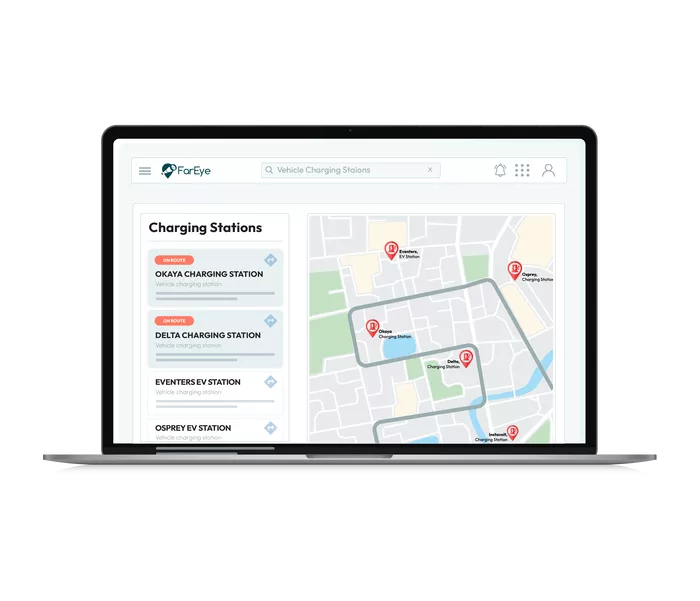
FarEye's route analysis includes charging stations that it crosschecks by type, availability, waiting time, peak-hour load and vehicle compatibility. This is done so that drivers know the charging stops beforehand and do not waste time looking for them. This also reduces any idle time in case the drivers fail to find a charging station in time.
Green-fleet Routing
The system prioritizes environmentally friendly route planning by considering factors such as energy consumption, ground accessibility, restricted environmental regions and delivery schedules simultaneously. This helps companies comply with environmental regulations, reduce battery use and increase the cost-effectiveness of operations.
Energy Consumption Monitoring
FarEye incorporates vehicle telematics in order to monitor the current state of the battery, the remaining range, the regenerative braking and power consumption patterns. Precise prediction helps better shift management and eliminates emergency roadside charging.
AI-driven Smart Suggestions
The intelligent routing engine continuously analyzes live events, such as traffic surges, order spikes, and weather changes, and automatically recommends route corrections, charger detours, or fleet reassignments to safeguard SLAs.
Real-time Task Allocation
This allows orders to be dynamically distributed to the best-fit EV based on payload, route distance, current charge and driver availability. This maintains high productivity and prevents the draining of any vehicle or the inefficient use of its capacity.
Such insights allow businesses to track their steps towards decarbonization, find places with a potential for improvement and showcase verified sustainability metrics to regulators and customers alike.
Powering the Future of Electric Fleet Efficiency
As EV adoption grows across the U.S., an intelligent EV route planner is a good choice for businesses as well as the environment. With smarter EV routing, fleets can reduce costs, boost driver productivity and stay resilient amid grid fluctuations. True efficiency lies in using the expanding charging network intelligently.
FarEye enables predictive planning, dynamic scheduling and carbon-aware operations that ensure on-time deliveries with the least carbon footprint. Electric mobility is reshaping the logistics industry and the secret to staying on top is smart routing.
To be the leaders in the upcoming era of fleet performance, enterprises need to engage in smarter planning, quicker movement and cleaner delivery.
Source:
https://www.climatecentral.org/climate-matters/electric-vehicle-charge-up