Table of Contents
- What is Vehicle Scheduling Software?
- Scheduling vs. Routing: What’s the Difference?
- The Delivery Moment That Exposes the Shortage
- Compliance and Constraints: Rules That Make or Break Reliability
- Multiply Capacity Without Adding Headcount
- Real-time Control When Plans Break in the Field
- Driver Experience Becomes Your Retention Strategy
- KPIs to Track and Typical Ranges
- What to Modernize First (Pilot Plan)
- Evaluation Checklist
- Use Cases and Industries
- Risk/Objection Handling
- Do More With the Drivers You Already Have
Let Our Experts Optimize Your Deliveries Today
Let's talkA missed morning grocery drop or delayed pharmacy delivery feels personal to your customers. For you, the dispatcher or allocator, it signals stretched resources, unplanned overtime or shifted priorities.
According to the U.S. Bureau of Labor Statistics, there were roughly 364,000 open jobs in the Transportation, Warehousing and Utilities sector in July 2025. The gap between promised service and delivered service grows when you lack enough drivers.
That gap erodes reputation, increases costs and burns out the crews you do have. Vehicle scheduling software offers a way to close that gap, turning resource scarcity into process optimization, better planning and predictable performance.
What is Vehicle Scheduling Software?
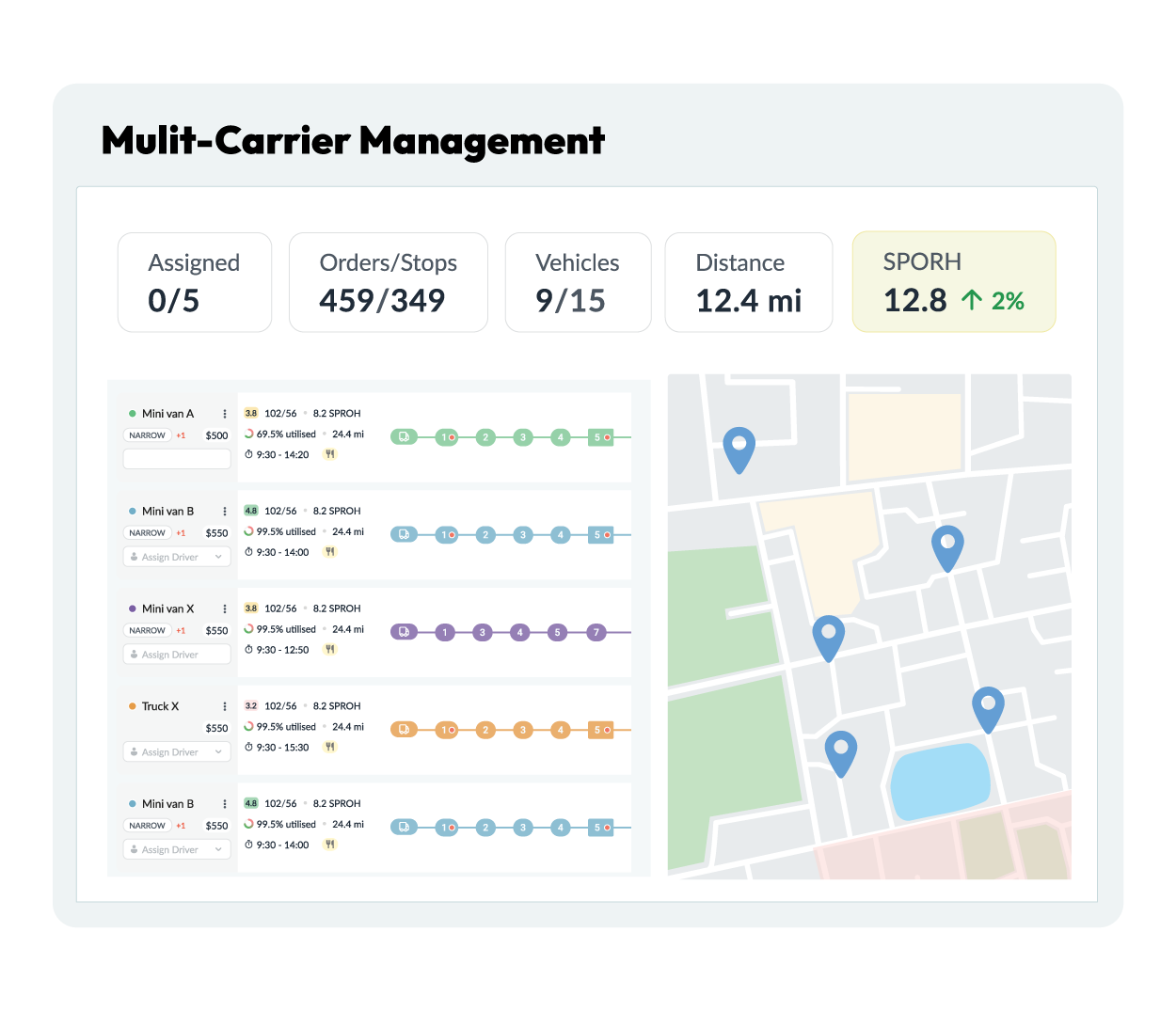
A planning engine that assigns work (stops, crews, vehicles, time windows) under real-world constraints and continuously re-optimizes as conditions change. It handles which driver does what stop, when, with what vehicle and skills, all while respecting constraints like time windows, hours-of-service and vehicle capacity.
Scheduling vs. Routing: What’s the Difference?
While these terms often get used interchangeably, they address different layers of operational planning:
- Scheduling decides who, when, which vehicle, which crew, skills required, shifts and breaks and hours-of-service (HOS) compliance.
- Routing defines the turn-by-turn path each vehicle takes, the order of stops, road networks, traffic patterns and shortest or fastest paths between points.
Top solutions in the market combine both into vehicle routing and scheduling software, so that the schedule respects human, legal and fleet constraints and the routes are efficient, realistic and adaptive.
The Delivery Moment That Exposes the Shortage
You’ve seen it: a surge in same-day orders hits between 5-7 PM; a driver has too many bulky stops; another route misses a time window; customers complain. These are not just operational pains; they are signals that manual planning and fixed routes cannot absorb today's variability without burning out drivers or lowering service.
Vehicle scheduling software helps make those surges manageable by embedding constraints (building access, stop windows, crew skills), automatically balancing load across available drivers and reducing costly failures like missed deliveries or late arrivals.
The Delivery Moment That Exposes the Shortage
You’ve seen it: a surge in same-day orders hits between 5-7 PM; a driver has too many bulky stops; another route misses a time window; customers complain. These are not just operational pains; they are signals that manual planning and fixed routes cannot absorb today's variability without burning out drivers or lowering service.
Vehicle scheduling software helps make those surges manageable by embedding constraints (building access, stop windows, crew skills), automatically balancing load across available drivers and reducing costly failures like missed deliveries or late arrivals.
Compliance and Constraints: Rules That Make or Break Reliability
Every schedule must obey the real rules. Here’s how top platforms enforce compliance:
- Hours-of-Service (HOS): Ensuring drivers are not scheduled beyond legal drive time, including rest periods.
- Meal/Break laws, union rules or local ordinances for driver rest.
- Fleet constraints: Hazmat, refrigerated (reefer) loads or weight limits; only certain vehicles can carry hazardous materials or temperature-sensitive goods.
- Multi-day Tours: For long distance or overnight routes, continuity matters how many hours a driver can work over days, lodging, etc.
- Driver Skills and Certifications: E.g., white-glove delivery crews, big and bulky handling, special equipment.
FarEye’s vehicle scheduling and routing software explicitly includes capacity for these, especially in big and bulky routing, where skills and vehicle constraints feature prominently.
Multiply Capacity Without Adding Headcount
You can’t just hire your way out of a driver shortage. With vehicle scheduling software, you can:
- Consolidate loads: same-area stops, similar delivery windows, so vehicles are fuller.
- Reduce “deadhead” and backtracking.
- Align slot offerings with what you can realistically deliver (e.g., timeslots customers can see are those where capacity exists).
FarEye’s Route Planning Software uses AI and machine learning to predict demand surges and optimize assignments ahead of time. You get more completed stops, fewer overtime costs and improved first-attempt success.
Real-time Control When Plans Break in the Field
In delivery operations, no plan survives the road unchanged. Scheduling software earns ROI when it:
- Detects delays in transit (traffic, weather, customer unavailability) and re-optimizes remaining stops.
- Offers driver app visibility and communication: updates, proof of delivery and exception handling.
- Alerts dispatchers and triggers corrective action automatically (rescue drivers, reallocation of stops).
FarEye builds these live-feedback loops into its platform so dispatchers aren’t blind when disruptions happen.
Driver Experience Becomes Your Retention Strategy
Schedules that make sense reduce churn. Consider:
- Predictable end-times and fair distribution of workload.
- Minimal overtime and realistic stop counts per route.
- Reduced stress when crews know ahead of time about access constraints, building policies or expected dwell times.
When drivers feel respected and schedules reflect real ground conditions, they stay longer. FarEye’s tools respect driver skills, shifts and rest laws, decreasing burnout and increasing satisfaction.
KPIs to Track and Typical Ranges
Tracking the right metrics not only shows progress; it informs what needs adjusting. Improvements depend on baseline, network density and delivery types but these are metrics dispatchers should measure, with rough ranges based on industry experience:
| KPI | What to Track | Typical Range/Goal* |
| First-attempt Delivery Rate | % of deliveries completed successfully on the first try | 85-95%, depending on address accuracy and density |
| Stops per Hour or per Route | How many customer stops a driver completes | Varies by route type: urban ~6-10 stops/hr; rural fewer |
| Overtime Hours per Route | Extra hours in driver pay over scheduled route | Aim <10-15% of total driver hours |
| Miles per Stop | Travel distance divided by number of stops | Urban: 3-6 miles/stop; rural/hilly higher |
| On-Time % (Window Adherence) | % of stops delivered within promised time window | 90-98%, depending on how tight windows are |
* Goals depend on your current performance, service type (e-grocery, white-glove, same-day), geographic spread and fleet size.
Also track secondary metrics: dwell time per stop, customer complaints and delivery time variance all help refine schedule quality.
What to Modernize First (Pilot Plan)
Before full rollout, start with a focused pilot to de-risk and prove value:
- Data Preparation: Ensure clean addresses, verified service time windows, skills matrix (crew skills), vehicle capacities, depot rules and SLAs.
- Pilot Region and Duration: Choose one region (ideally medium complexity route, some bulky, some small stops), run pilot for 2-4 weeks.
- Baseline Metrics: Capture current metrics like first-attempt success, overtime hours, stops per hour.
- Involve Dispatchers and Drivers Early: Get their input on constraints, behavior, key pain points.
- Measure Impact Frequently: Compare pilot KPI improvements, identify surprises, adjust before scaling.
Evaluation Checklist
Here’s a compact comparison table to help you evaluate vendor platforms effectively:
| Feature/Capability | Why it Matters |
| Multi-constraint Optimizer | Handles skills, windows, vehicle types, breaks, etc. |
| Mid-route Reoptimization | Reacts to disruptions like traffic, delays, cancellations |
| AI ETA Prediction | More accurate arrival promises, less buffer waste |
| HOS/Meal and Break Enforcement | Ensures legal and safe schedules, driver satisfaction |
| Multi-day Tour Support | For long-haul or multi-day routes, reduces driver fatigue |
| Skills/Certification Matching | White-glove, big and bulky, hazmat, etc. |
| Territory Shaping and Smart Slotting | Cuts backtracking, clusters deliveries efficiently |
| Support for PUDO/Lockers | Adds flexible delivery options, avoids failed attempts |
| Driver App UX + Communication | On-route feedback, visibility, easier exception handling |
| Sandbox/Simulation Mode | Test scenarios, what-if planning without disrupting live ops |
| Cost and Carbon Analytics | Understand true cost per stop, sustainability reporting |
| APIs (TMS/WMS/ERP) | Seamless data flow, fewer manual touch pointsSeamless data flow, fewer manual touch points |
| Security/SSO/Compliance | Enterprise-grade access and data protection |
Use Cases and Industries
Here are real delivery and logistics types that benefit heavily from pairing scheduling and routing software:
- E-grocery: Tight time windows, perishables, frequent small order clusters
- Furniture/White-Glove: Bulky pieces, two-person crews, assembly, narrow access windows
- Pharma/Temperature-Controlled: Require strict temperature/humidity compliance, possibly hazmat rules, fast response
- Same-Day and Courier Services: Urgency, dynamic requests, frequent exceptions, customer expectations on tracking
Risk/Objection Handling
When considering implementing vehicle scheduling software, these are common concerns and how to mitigate them:
| Concern | Mitigation/Best Practice |
| Change Management Resistance | Include dispatchers and drivers early; allow feedback loops in pilot; show wins fast |
| Driver Adoption Problems | Ensure driver app usability; incorporate local constraints so schedules feel realistic |
| Workflow Disruption | Map current workflow; integrate with existing TMS/WMS; avoid double systems during pilot |
| Integration Effort | Choose platforms with strong APIs; ensure data quality; lay groundwork (depots, skills, time windows) first |
| Pilot Risk | Limit scope; monitor well; compare with baseline; allow iteration before scale |
Do More With the Drivers You Already Have
Every hour your current drivers spend unproductively or juggling last-minute changes is an opportunity lost. With vehicle routing and scheduling software, you gain the tools to enforce legal constraints, respond dynamically and plan routes that respect both customers and your workforce.
FarEye offers AI-powered planning and execution solutions. Our route optimization software adds adaptive scheduling, skill and constraint matching, live visibility and dynamic rerouting.
These turn driver shortage from a liability into a manageable optimization lever. Approach the next peak with confidence: better software, clearer constraints, smarter execution.