Table of Contents
- Understanding Multi-stop Route Planning in Delivery Operations
- Why Same-day and On-demand Delivery Creates Unique Routing Challenges
- The Role of Multi-stop Route Planning in Fleet Efficiency
- FarEye: Transforming Routing with AI and Machine Learning
- How to Implement Multi-stop Route Planning in Practice
- A Smarter Way Forward with FarEye
Let Our Experts Optimize Your Deliveries Today
Let's talkSame-day delivery is no longer a novelty; it’s a customer expectation. According to a 2025 report, nearly one in three U.S. shoppers now expects same-day delivery. Yet for many logistics operations, making it reliable, cost-effective and scalable remains elusive.
A regional courier once shared that their last-mile chaos often begins at midday, when last-minute orders flood in and manual route adjustments fail. That pressure point handling dynamic demand without blowing cost or service levels is where multi-stop route planning becomes critical.
In this blog, you’ll see how deploying a robust multi-stop route planner isn’t just a back-office upgrade. It’s the backbone that allows you to deliver on same-day promises, reliably and profitably.
Understanding Multi-stop Route Planning in Delivery Operations
Before diving into benefits, let’s define what multi-stop route planning means in the context of delivery operations. Simply put, it’s the process of creating optimal vehicle paths that visit multiple delivery or pickup stops in a single tour, subject to constraints like time windows, vehicle capacity, driver shifts and service durations. It’s not a dumb go to the nearest next stop rule; rather, it’s a sophisticated optimization engine that considers combinations, tradeoffs and dynamic conditions.
A multi-stop route planner must also support dynamic insertion and reoptimization, i.e., when new orders appear mid-shift. The system should be able to slot them into existing routes or reassign intelligently. That ability becomes a must for on-demand or same-day delivery workflows, not a luxury.
Why Same-day and On-demand Delivery Creates Unique Routing Challenges
To appreciate why multi-stop route planning is indispensable, you must first understand the pressures dispatchers face:
Tight Time Windows
Often, customers expect delivery within narrow windows, say, within a 2–4 hour block. Missed windows erode brand trust and may incur SLA penalties when every minute counts; routing must be precise.
Dynamic/Late-breaking Orders
Unlike planning for next-day operations, same-day delivery means new orders arrive after route dispatch. The system must support real-time insertion or local reoptimization without disrupting a driver’s workflow.
Cost Pressure and Thin Margins
Same-day services command premium expectations, but margins are tight. Fuel, labor and wear-and-tear, each extra mile or idle minute chips away at profitability.
Scalability Under Demand Surges
Peak periods include lunch rush, evening orders spike volumes. A manual or spreadsheet approach breaks at scale. A powerful multi-stop route planning engine lets you handle dozens or hundreds of stops without collapse.
Real-world Variability and Disruptions
Traffic congestion, last-minute cancellations, wrong addresses and delays are inevitable. Your routing system must be resilient and adaptive, not rigid.
The Role of Multi-stop Route Planning in Fleet Efficiency
Let’s walk through the concrete ways a strong multi-stop route planner improves same-day delivery operations.
Maximizing Route Density and Throughput
A multi-stop planner sequences stops to maximize how many deliveries a single vehicle can make in one trip, while respecting constraints. Even shaving a few minutes per route adds up significantly across dozens of vehicles.
Reducing Idle and Deadhead Miles
Instead of drivers crisscrossing the map, the planner clusters stops smartly to minimize empty travel. That reduces fuel, wear and tear and wasted time.
Balancing Competing Objectives
A solution that only minimizes distance may violate time windows or overburden drivers. A best-in-class multi-stop route planner lets you balance objectives, e.g., minimizing lateness, distributing workload evenly, honoring driver breaks and cost efficiency via adjustable weights in its objective function.
Real-time Reoptimization and Insertion
When new orders come in or delays occur, the system can re-optimize locally or globally, inserting stops or reassigning routes. Doing this intelligently, rather than brute force, helps maintain service without chaos.
Predictive Intelligence and Machine Learning
Over time, routing systems ingest historic data (travel times, delays, stop durations) to predict future performance. This prediction allows preemptive sequencing (e.g., anticipating traffic delays) and smarter buffer planning.
Instilling Robustness through Slack
No route is perfect. A good planner builds in buffer segments to absorb small delays, preventing a domino effect of missed windows. It may also identify fallback options when constraints tighten.
Real-time Monitoring and Exception Management
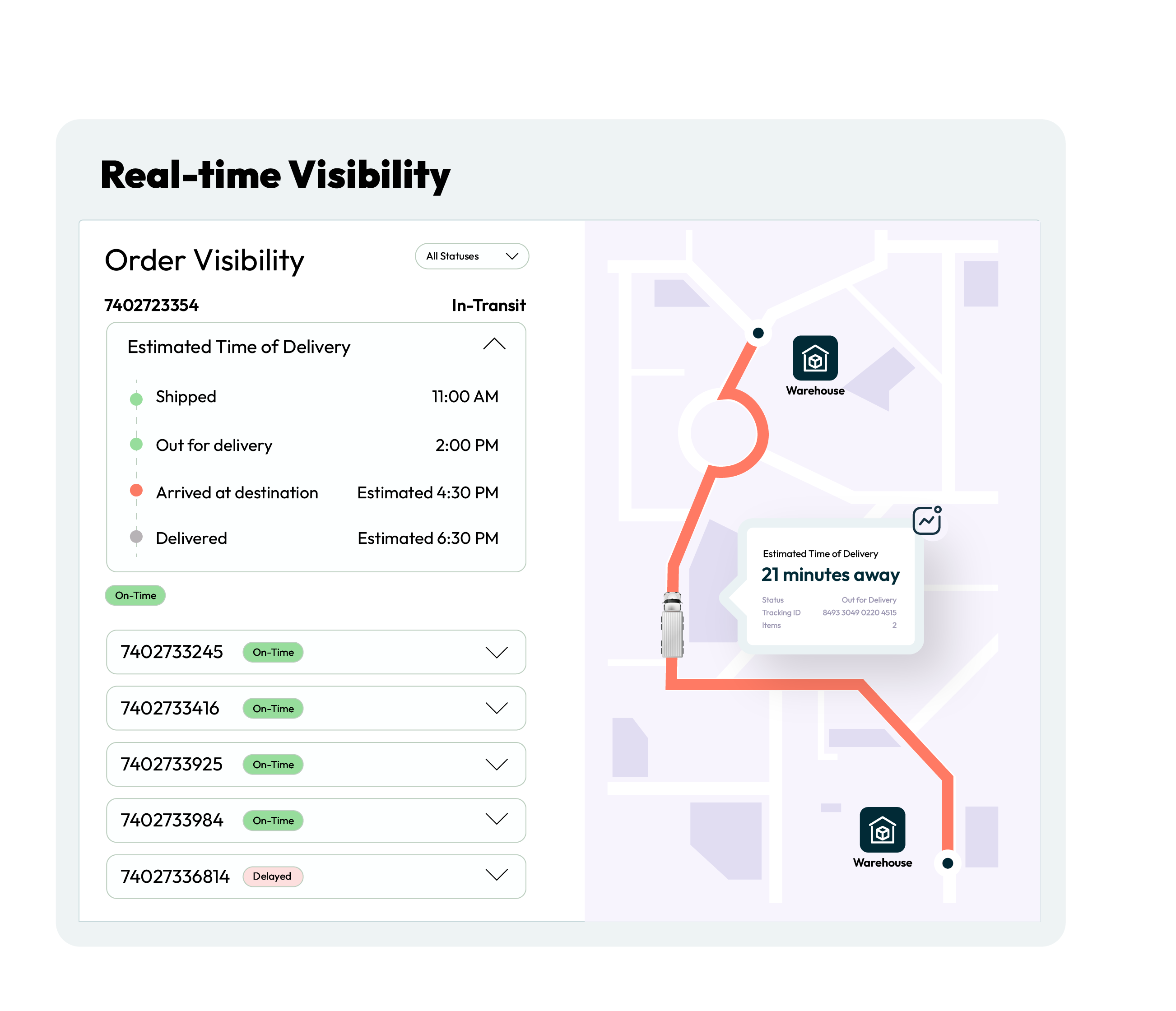
Dispatchers need visibility into route progress, deviations and exceptions. The planner must feed a dashboard, trigger alerts and allow manual override where needed.
Cost Savings and Sustainability Gains
Less distance, fewer vehicles needed, lower fuel consumption and lower maintenance all contribute to bottom-line gains. Also, eco-conscious operations become a differentiator.
It’s no coincidence that route optimization software is forecast to become a multi-billion-dollar market; the ROI justifies the investment. Also, last-mile delivery now makes up as much as 53% of total shipping costs in many operations making routing optimization an urgent lever.
FarEye: Transforming Routing with AI and Machine Learning
When choosing a multiple route planner solution, FarEye stands out as a purpose-built, AI-forward routing engine that addresses the full spectrum of routing challenges.
AI-powered Route Optimization
FarEye’s platform uses machine learning models that analyze traffic patterns, historical driver performance, time-of-day behavior and regional characteristics to generate smarter route sequences. This moves planning from heuristic rules toward predictive intelligence.
Dynamic Reoptimization and Real-time Visibility
When orders shift, deliveries get delayed or new requests pop up, FarEye’s real-time engine can reinsert stops, reassign routes and push updates to driver apps transparently. Its ability to shrink delivery windows from multi-day estimates to “near real-time predictions” improves accuracy and reduces failed deliveries.
Integration and Orchestration Across Systems
FarEye links seamlessly with order management (OMS), warehouse management (WMS) and other systems. That ensures routing isn’t an isolated module; it’s embedded into your supply chain workflow.
Recognized Leader in Routing Space
In 2025, FarEye was named a Representative Vendor in Gartner’s Market Guide for Vehicle Routing and Scheduling, underscoring its breadth and credibility. Our routing capabilities cover geofencing, territory planning, load balancing and advanced scheduling.
Tangible Performance Gains
Enterprises using FarEye report reduced operational costs, more on-time deliveries, higher route density and lower idle time. Because the solution learns and refines itself, the benefits compound over months.
In short: FarEye isn’t a routing add-on; it’s a routing backbone built to power same-day and on-demand delivery at scale.
How to Implement Multi-stop Route Planning in Practice
As a dispatcher or allocator, you’ll need a systematic rollout. Below is a practical path.
Step 1: Audit your current routing baseline
Capture metrics: average miles per route, stops per trip, on-time percentage, driver idle time and exception rates. Understand your pain points and bottlenecks.
Step 2: Clean up your data
Ensure accurate geocoding, standardized address data, realistic travel-time history and service-duration estimates. Inaccurate inputs produce bad optimization.
Step 3: Define rules and constraints
Time windows, driver shifts, breaks, vehicle capacities and service priorities all must be encoded cleanly. Distinguish hard vs soft constraints (i.e., which can be bent if needed).
Step 4: Select a multi-stop route planner (e.g, FarEye) and pilot
Start in one geography or zone. Run parallel comparisons between your legacy routing and the optimized plan. Track metrics closely.
Step 5: Calibrate and iterate
Adjust buffer sizes, weighting between objectives (cost, lateness, fairness) and insertion logic. Use real-route feedback to refine.
Step 6: Scale in phases
Expand across zones, increase volume and onboard more drivers gradually. Monitor for exception rates, driver feedback and performance decay.
Step 7: Enable reoptimization triggers
Define when route recomputation should run (e.g., ≥ 15-min delay, new high-priority order). Limit how many upcoming stops can shift to reduce driver confusion.
Step 8: Build feedback loops
After each shift, compare actual vs planned metrics. Use that data to retrain predictive models, adjust estimations and tighten optimization.
Step 9: Communication and training
Train dispatchers and drivers on how to interpret re-sequences or dynamic changes. The smoother the human interface, the more likely the plan will be respected in the field.
Step 10: Expose visibility externally
If you can push ETAs, map tracking or updates to customers, you deflect “where’s my order?” support calls and enhance customer trust.
A Smarter Way Forward with FarEye
As you wrestle daily with dispatch complexity, chaotic order inflows and margin pressure, multi-stop route planning is your instrument of control not a toy. With FarEye, you gain a routing engine driven by AI and machine learning, capable of handling dynamic mid-flight changes, predictive sequencing and real-time visibility.
Implementing this technology shifts your role from firefighting to orchestrating. You no longer chase chaos; you structure responsiveness. Dispatchers and allocators become navigators of intelligent systems, not frantic re-routers.
If you’re ready to turn same-day delivery into a sustainable advantage rather than a headache, set up a live pilot or demo with FarEye. Let the routing engine shoulder the complexity, while your team focuses on execution, scaling and continuous improvement.
Sources:
https://www.statista.com/statistics/1434298/last-mile-share-of-total-shipping-costs/