
Table of Contents
- The Concept: What Does a “Dynamic, Data-driven Map” Mean?
- Why Map With Multiple Stops Matters: Business and Operational Drivers
- Core Architecture and Data Layers of Multiple Stops Route Planner (Technical View)
- How to Make Your Map with Multiple Stops Truly Dynamic
- FarEye as the Intelligent Multiple Address Route Planner Backbone
- Activate Your Dynamic, Data-driven Map with Multiple Stops Now
Let Our Experts Optimize Your Deliveries Today
Let's talkYou open your dispatch dashboard and lay out 50 or 100 delivery addresses on the map. Your system draws lines, sequences stops and hands off routes to drivers. But by midmorning, several drivers are behind schedule, new orders come in, traffic snarls appear and your original map with multiple stops begins to unravel in real time.
That’s more than frustration; it’s costly. In fact, last-mile delivery is estimated to comprise up to 53% of total supply chain costs. That gap between the fixed route plan and the chaotic reality on the road is where most inefficiencies, missed windows and driver frustration come from.
In this blog, you will discover how to transform that traditional multi-stop map into a dynamic, data-driven asset. One that reroutes itself, flags exceptions, learns over time and drives continuous improvement.
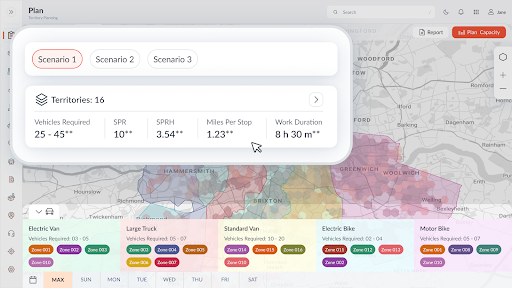
The Concept: What Does a “Dynamic, Data-driven Map” Mean?
Traditional Map with Multiple Stops, the Starting Point
In most operations, a map with multiple stops is a fixed routing artifact. You input addresses, call a route solver and dispatch drivers. But once vehicles depart, the map sits inert; it can’t adapt to changes, deviations or new requests.
Transitioning to a responsive, adaptive system
To make your map truly dynamic and data-driven, you must embed real-time responsiveness, intelligence and feedback capability:
- Real-time Updates And Rerouting
When a driver runs late or a road closes, the system adjusts the remaining sequence, not necessarily redoing the whole plan. - Rich Meta Data on Stops and Route Segments
Each stop carries attributes (priority, service duration, risk factor, insertion cost) and each road link carries expected speeds, congestion risk or toll cost. - Analytics and Feedback Loops
After each route run, differences between the plan and the actual get recorded. Patterns of delay or deviation feed future improvements. - Integration with Business Logic and Constraints
Your map engine must respect shift hours, vehicle loads, forbidden zones, service windows and ad hoc insertion logic.
In this context, a route planner with multiple stops is no longer just a solver; it’s the real-time steering mechanism behind your dispatching operations.
Before vs After (contrast)
- Traditional System: one-shot route generation, manual adjustments, limited insight
- Dynamic System: continuous route adaptation, exception alerts, predictive modeling, learning over time
Why Map With Multiple Stops Matters: Business and Operational Drivers
Turning your map into a dynamic asset delivers value on multiple fronts:
Operational Efficiency Gain
- Reduced travel distance, driver hours and fuel consumption: Because you eliminate backtracking or redundant paths
- Mid-route insertions handled smartly: Your system can gracefully insert new or urgent stops without full rework
- Resilient disruption handling: Traffic, delays or cancellations don’t break your operations; routes evolve
Service Quality and Predictability
- More reliable ETAs, fewer missed window predictions and adjust dynamically
- Proactive alert customers when delays loom, reducing complaints
Resource Optimization and Scalability
- Balanced load across your fleet no one driver gets overwhelmed while others underperform
- Scalability to hundreds or thousands of stops, manual routing fails at scale
Strategic Insights and Continuous Improvement
- Spotting bottlenecks and zone-level issues: You can see which areas or times consistently cause delays
- Learning from execution deviations and exceptions: shape a better future route
ROI Levers (select highlights)
- Lower operating costs (fuel, overtime)
- Higher throughput per route
- Improved customer satisfaction and retention
As last-mile delivery costs now drive up to 50-60% of total supply chain expense in many U.S. operations, this is a lever you cannot ignore.
Core Architecture and Data Layers of Multiple Stops Route Planner (Technical View)
Below is a modular view of how a dynamic routing map is built, how data flows and where challenges lie.
Data Flow (high-level)
Order/constraint input → route optimization → dispatch → real-time monitoring → event-triggered reoptimization → dispatch updates → execution logged → analytics → model calibration → next cycle
Base Map and GIS/Road Network Layer
Handles underlying road topology, turn restrictions, speed limits and network updates. Must support versioning, custom overlays and updates when new infrastructure arises.
Geocoding and Map Matching
Translates addresses reliably into geographic coordinates. Maps incoming GPS traces to the road network to match driver movements to links. Challenges: address ambiguity, GPS noise and misalignment.
Routing and Optimization Engine
Core solver for the vehicle routing problem with multiple stops and constraints (time windows, load, priority). It must support fast reoptimization and scale across many vehicles.
Real-time and Streaming Input
Feeds from traffic APIs, accident and closure services, weather and order change events. These updates change cost data on segments or trigger route reconsideration.
Business Logic and Constraint Layer
Encodes your organization's rules: shift hours, load capacities, restricted zones, priority stops and slack policies. They act as guardrails that the routing engine must respect.
Visualization/Dashboard/Map UI
User interface for dispatchers: live vehicle positions, route overlays, exception alerts, route-change suggestions. Enables human intervention or override.
Analytics, Forecasting and Insight Layer
Compares planned vs actual performance, detects anomalies, produces “what-if” simulations and aids model parameter tuning (travel time variance, buffer sizing).
Integration/API/Event Orchestration Layer
Connects with order management, warehouse systems, driver mobile apps and vehicle telematics. Accepts new orders or cancellations, pushes route updates and manages event triggers.
Monitoring, Logging and Exception Handling
Logs system events, errors, fallback routing paths and unmapped addresses. Maintains audit trails and supports debugging and resilience.
Each layer must manage algorithmic trade-offs (latency vs thoroughness, partial vs full reoptimizations) and ensure consistency under scale.
How to Make Your Map with Multiple Stops Truly Dynamic
Here’s a step-by-step operational playbook you can adopt for multiple address route planner:
Clean and Validate Your Data
Ensure high data quality: accurate addresses, deduplication and normalized formats. Use historical telematics to validate expected travel times. Pitfall: garbage in → poor routes.
Model Travel Time Distributions, Not Fixed Estimates
Leverage historical segment-level data plus time-of-day patterns to forecast probabilistic travel times. Incorporate variance and risk so your route planner understands uncertainty.
Design for Partial and Incremental Reoptimization
You cannot always re-solve the full route midstream. Use local repair, window-based reoptimization or heuristic adjustments to keep changes modest and intelligible for drivers.
Real-time Event Handling and Prioritization
Define clear event thresholds (e.g., delays over 5 minutes, order cancellations) that trigger route changes. Use hysteresis to avoid route thrashing.
Buffer and Slack Logic
Strategically insert slack in legs or at high-risk stops. Don’t over-optimize away all slack; the unavoidable small delays magnify otherwise.
User Experience and Driver Trust
Present route change suggestions clearly, minimize abrupt reordering and allow override paths. Drivers must feel confident in the adjustments.
Feedback Loop and Learning
Continuously capture actual vs planned data, analyze deviations and feed those patterns back into your travel time models and buffer logic.
Testing, Simulation and What-If Scenarios
Before deploying changes, simulate new stop insertions, vehicle load shifts or volume surges. Run stress tests under peak load to validate robustness.
FarEye as the Intelligent Multiple Address Route Planner Backbone
FarEye is not just another mapping tool; it is engineered to embody this dynamic, data-driven philosophy in enterprise logistics. Here’s how it connects the map with multiple stops:
- FarEye’s route planning software natively supports large volumes and multi-stop routing, producing optimized schedules and routes automatically.
- Its route optimization software uses advanced AI/ML to adapt to real-time changes (order cancellations, new requests) and reoptimize routes seamlessly.
- FarEye's multiple stops route planner supports over 100 constraints simultaneously (time windows, capacities, priority orders). This makes it a powerful route planner for multiple stops tool for complex enterprise fleets.
- Its smart geocoding ensures accurate mapping from customer addresses to coordinates, reducing address errors and misroutes.
- FarEye’s dashboard surfaces exceptions, deviations, alerts and suggested reroutes, enabling dispatchers to intervene or trust the system flexibly.
- It continuously collects execution data to refine its route models and improve the predictive engine over time.
- Review platforms cite high adoption of route optimization, auto dispatch and order management features by FarEye users; 90%+ satisfaction in some use reports.
In short, FarEye provides a production-grade map + routing engine platform that transforms your map with multiple stops into a live, evolving, tactical asset.
Activate Your Dynamic, Data-driven Map with Multiple Stops Now
Your dispatch map, once a fixed batch of pins and lines, can evolve into your most powerful operational asset. When your routing stack supports real-time responsiveness, feedback loops and business-aware constraint logic, that map with multiple stops becomes a living, learning engine.
With FarEye as your routing backbone, you can leverage AI, machine learning, constraint-based planning and real-time adaptation. This transforms planning into execution, uncertainty into predictability and traditional maps into strategic control.
If you’re ready to evolve your routing system into a dynamic, data-driven engine or want a custom implementation roadmap, let’s connect.
Source:
https://sloanreview.mit.edu/article/cutting-last-mile-delivery-costs/