Table of Contents
- The Dispatcher’s Dilemma: Fuel Waste vs. Delivery Reliability
- What “Best” Means: Core Capabilities of the Best Route Planner App for Delivery Drivers
- ROI Mechanisms: How Fuel Cuts and ETA Precision Translate into Dollars
- Edge Cases and Challenges: What Dispatchers Must Guard Against
- How FarEye Executes This Vision (And Why It Stands Out)
- Ready to Drive ROI? Try the Best Route Planner App for Delivery Drivers
Let Our Experts Optimize Your Deliveries Today
Let's talkDelivery margins are razor-thin and one wrong turn or traffic jam can shift a route from profitable to loss-making. In the United States logistics sector today, a 5–10% fuel overspend due to routing inefficiencies easily eats into margins. Meanwhile, customers expect tight delivery windows; a missed ETA can damage reputation and incur penalties.
That’s why enterprise fleets and growing delivery-heavy businesses now consider route optimization not just a tool, but a lever for strategic advantage. Let’s see how the best route planner app for delivery drivers can drive measurable ROI by cutting fuel waste, improving capacity and making ETAs more reliable.
The Dispatcher’s Dilemma: Fuel Waste vs. Delivery Reliability
As a dispatcher or allocator, you know that routing is under constant tension. On one side, your budget line bleeds from idling, backtracking and suboptimal sequencing. On the other hand, SLAs and customer expectations demand on-time-in-full (OTIF) reliability.
Consider a typical scenario: your fleet must deliver 500 stops in an urban metro area, under time windows, with varying package sizes, vehicle types, driver shift constraints and real-time traffic. Traditional methods (manual planning, fixed routes or simple map tools) struggle when dynamic disruptions occur a road closure, a last-minute order or a delayed driver.
In practice, logistics operators report that better routing can cut empty or out-of-route miles, lowering fuel and maintenance burden. Lower overtime, lower detention and fewer penalties follow naturally.
But these gains only emerge if the best route planner app for delivery drivers can handle complexity and reoptimize dynamically. Over time, it should also learn and adapt much like leading systems that use AI and machine learning.
What “Best” Means: Core Capabilities of the Best Route Planner App for Delivery Drivers
Before we go deeper into ROI, it helps to define what distinguishes a best route planner app for delivery drivers. For your fleet, the right solution must do more than sequence stops; it must handle constraints, respond to disruptions and continuously improve. Here are the essential capabilities:
Constraint-aware Optimization
The planner must account for vehicle capacity (volume, weight), driver shift hours and rest breaks, regulatory constraints (e.g., Hours of Service in the U.S.), time windows, priority deliveries and special handling instructions. FarEye’s route planning engine explicitly factors driver schedules, capacities and time windows.
Multi-objective Balancing
It should optimize not only for the shortest distance, but also for fuel efficiency, ETA reliability, driver convenience and even sustainability (e.g., EV routing, green paths). FarEye supports EV route planning (including factoring in charging stations) as well.
Real-time and Dynamic Reoptimization
When traffic, cancellations or last-minute orders arise, the system should adjust routes on the fly rather than lock the route traditionally. FarEye’s dynamic routing capabilities allow live adjustments.
Predictive ETA Modeling and Buffer Insertion
Good systems use historical and real-time data to predict likely travel times and insert buffer slack to avoid cascading misses. FarEye applies AI frameworks and continuous learning to refine ETA accuracy.
Driver-facing Mobile App
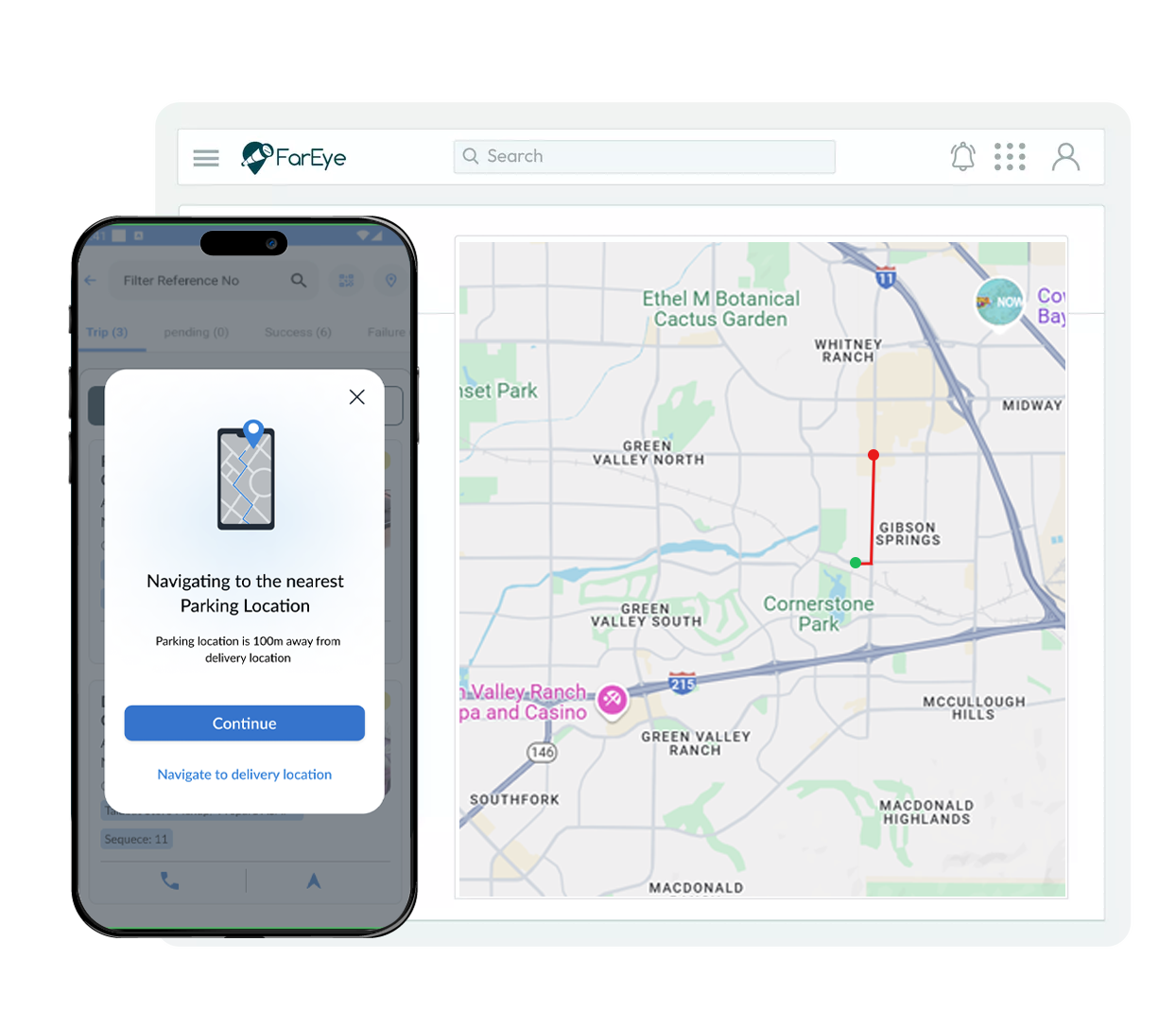
The route planner app for delivery drivers must provide turn-by-turn guidance, handle offline or poor connectivity conditions, allow driver deviation logging, capture proof-of-delivery and feed back performance data. FarEye’s route planner app for delivery drivers turns a smartphone into a route execution tool.
Analytics, Feedback Loops and Continuous Improvement
The system must monitor deviation, measure actual versus plan, detect anomalies and feed that data back into model tuning. AI and ML modules improve routing over time.
Integration and API-based Extensibility
The route planner app for delivery drivers must plug into your OMS, TMS, CRM, telematics and operational systems. FarEye offers routing APIs for seamless integration.
When all these come together, the best route planner app for delivery drivers behaves less like a traditional planner and more like a self-optimizing, responsive dispatch brain.
ROI Mechanisms: How Fuel Cuts and ETA Precision Translate into Dollars
Let’s break down how the best route planner app for delivery drivers transforms operational leaks into measurable gains.
Fuel, Distance and Maintenance Savings
By reducing unnecessary mileage backtracks, empty legs and detours, routing optimization directly cuts fuel usage and wear and tear. Even single-digit percentage reductions in mileage scale fast in large fleets.
For example, vehicle routing software claims to reduce idle time and fuel usage by handling optimal sequencing, traffic and stop orders. Also, smoother routing reduces harsh braking, idling and engine cycling, lowering maintenance, tire wear and part stress.Better Utilization, Fewer Trips, Fewer Vehicles
With a route planner app for delivery drivers, a dispatcher can pack more stops per route and balance load better across drivers, avoiding underused vehicles or spare capacity. That lets you postpone fleet expansion or reduce vehicle count.
Savings on Labor, Overtime and Detentions
Optimized schedules reduce the need for last-minute reassignments, overtime or manual fix-ups. Fewer scheduling surprises and detentions (waiting at docks, client sites) save driver pay and penalties.
Improved SLA Performance and Penalty Avoidance
By hitting ETAs more reliably, you minimize missed windows, cancellations and SLA breach costs. That protects revenue, preserves customer trust and reduces rework or compensation costs.
Incremental Revenue and Competitive Advantage
Freed-up fleet capacity and reliability can let you take on more orders (e.g., during peak periods) without adding new assets. The reputation of on-time service bolsters customer acquisition and retention.
Scalability and Reduced Planning Overhead
Route optimization software reduces the hours your planners spend manually sequencing, debugging or reacting to disruptions. That lowers overhead and boosts scalability.
So ROI = aggregate of cost savings + avoided penalties + revenue upside minus the software, integration, training and maintenance costs.
Edge Cases and Challenges: What Dispatchers Must Guard Against
While ROI sounds attractive, real-world friction often eats away gains unless addressed. As a dispatcher, watch for:
- Poor Data Quality/bad Addresses: Garbage in begets suboptimal routing. Geocoding errors doom ETA accuracy.
- Driver Non-compliance/Route Deviations: If drivers deviate frequently or skip the planned order, gains erode. The route planner app for delivery drivers must allow deviation logging (with reason) but discourage random detours.
- Overly Tight Time Windows or Rigid Constraints: If you constrain too much, you starve the optimizer of flexibility.
- Too Frequent Route Reoptimization (Route Thrashing): Rerouting too often confuses drivers; set thresholds.
- One-time Launch Neglect: The optimization model must evolve with feedback; one-off deployment underperforms.
- Integration Bottlenecks: If data flow (orders, telematics, GPS) is delayed or disjoint, routing logic lags or misaligns.
- Scalability and Computational Load: As stops grow to thousands or more, solver performance must scale.
- Change Management and Adoption Risk: Dispatchers and drivers may resist change; training and buy-in are essential.
If you address these, the route planner app for delivery drivers becomes a tool of leverage rather than a cost.
How FarEye Executes This Vision (And Why It Stands Out)
Let’s connect these concepts to a real enterprise-grade solution, FarEye and see how it addresses each major dispatch challenge.
AI and Machine Learning Backbone
FarEye’s platform uses AI-driven route planning and continuous learning to refine ETA predictions, reduce deviations and adapt to route behavior.
Constraint-rich Routing
It handles vehicle capacities, driver work-hour constraints, time windows, special handling, tolls, road constraints and EV charging needs.
Dynamic Routing and Real-time Reoptimization
When disruptions arise mid-route, FarEye’s route planning software recalculates the optimal path for remaining stops.
EV and Green-routing Support
For fleets with electric vehicles, FarEye routes with charging station constraints built in, helping you both reduce fuel and hit sustainability goals.
Driver App and Execution Feedback
The FarEye driver app turns any smartphone into a route execution terminal, capturing deviations, proof-of-delivery and performance data.
Plug-and-play API Integration
It supports API-based routing calls from your OMS or TMS, enabling seamless integration without huge overhauls.
Scalable Enterprise Architecture
Designed for large fleets and high-volume routing, with analytics, dashboards and exception management built in.
In short, FarEye is not a generic map-based tool; it’s built for dispatchers, with AI, feedback loops, constraint awareness and enterprise scale.
Ready to Drive ROI? Try the Best Route Planner App for Delivery Drivers
For dispatchers who balance cost control and delivery reliability daily, the best route planner app for delivery drivers is not just a tool; it’s a multiplier. By eliminating fuel waste, enabling tighter ETA discipline, boosting utilization and reducing friction, it converts operational inefficiencies into returns.
FarEye exemplifies this class: AI-driven routing, real-time adaptability, driver execution and feedback loops combine into a system that scales with your business. The ROI isn’t theoretical; it’s measurable, aggressively favorable and often realized in the first year.
If you're ready to go beyond simple maps and manual workload and want to see routing become a profit center rather than a cost center, you may want to test FarEye in your fleet.
Source: